
DISH RESEARCH · Side dish
Atkilt Wat
This Atkilt Wat guide follows Richa’s explicitly simplified Atakilt Wat/Atkilt wot interpretation: cabbage, potatoes and carrots cook covered with onion, garlic, ginger and spices infused quickly into oil. Olive oil or vegan butter is an explicit starting alternative; conditional water or broth and separate serving accompaniments remain scoped.
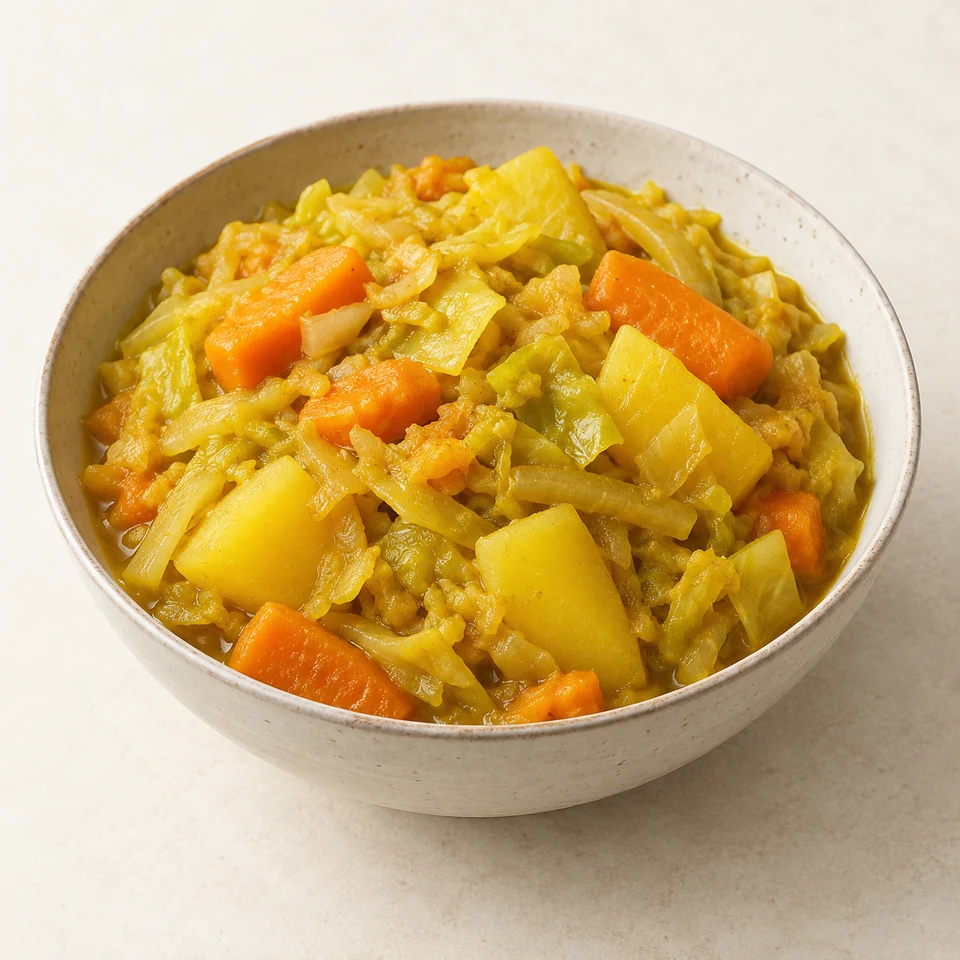
About Atkilt Wat
Research draft based on the references below. These notes describe particular recipes and presentations; ingredient connections are still being reviewed.
This Atkilt Wat guide follows Richa’s explicitly simplified Atakilt Wat/Atkilt wot interpretation: cabbage, potatoes and carrots cook covered with onion, garlic, ginger and spices infused quickly into oil. Olive oil or vegan butter is an explicit starting alternative; conditional water or broth and separate serving accompaniments remain scoped.
Flavour: Richa identifies her own spice-infusion interpretation and says it has its own flavour profile, but provides no precise final heat, sweetness, acidity or seasoning-balance description. Those qualities remain unresolved; optional green chili does not prove a fixed heat level.
Texture and appearance: The source explicitly cooks the covered vegetables until tender and uses tender potatoes as the card’s final endpoint. Golden onion is an earlier cooking stage. A crisp finish or a specific texture contrast is not described.
Ingredients in Atkilt Wat
Richa lists two teaspoons olive oil or vegan butter, two minced garlic cloves, one teaspoon ginger, optional green chili, half cup onion, quarter teaspoon each cumin, fenugreek, cardamom and cinnamon, half to three-quarter teaspoon turmeric, one-eighth teaspoon cloves, a generous dash black pepper, three-quarter cup carrots, two medium potatoes, half head cabbage and half teaspoon salt. Water or broth is added only if needed for sticking/deglazing. The separate injera, lentil wat and gomen wat serving recipes remain unresolved, as do vegan-butter and broth formulas. Her traditional niter-kibbeh discussion does not add dairy butter or ghee to this selected interpretation.
Source limits: Vegan-butter/broth formulas,accompaniment identities/formulas and conditional liquid amounts unprovided.
- Olive oil, 2 teaspoons divided, alternative to vegan butter[1]Optional
- Vegan butter, 2 teaspoons divided, alternative to olive oil[1]OptionalSource-specific formulation remains unresolved.
- Garlic, 2 minced cloves[1]Recipe ingredient
- Ginger, 1 teaspoon minced[1]Recipe ingredient
- Green chili, 1 chopped, optional[1]Optional
- Onion, half cup chopped[1]Recipe ingredient
- Cumin powder, quarter teaspoon[1]Recipe ingredient
- Turmeric powder, half to three-quarter teaspoon[1]Recipe ingredient
- Fenugreek seeds or powder, quarter teaspoon[1]Recipe ingredient
- Cardamom powder, quarter teaspoon[1]Recipe ingredient
- Cinnamon powder, quarter teaspoon[1]Recipe ingredient
- Clove powder, one-eighth teaspoon[1]Recipe ingredient
- Black pepper, a generous dash[1]Recipe ingredient
- Carrots, three-quarter cup sliced[1]Recipe ingredient
- Potatoes, 2 medium chopped, 1.5 loaded cups[1]Recipe ingredient
- Cabbage, half head finely chopped[1]Recipe ingredient
- Salt, half teaspoon with additional adjustment in method[1]Recipe ingredient
- Water, couple of splashes if sticking, alternative to broth[1]Optional
- Broth, couple of splashes if sticking, alternative to water[1]OptionalSource-specific formulation remains unresolved.
- Injera, serving accompaniment, full recipe unknown[1]Identity unresolved
- Lentil wat, serving accompaniment, full recipe unknown[1]Identity unresolved
- Gomen wat, serving accompaniment, full recipe unknown[1]Identity unresolved
These foods describe the cited recipe. Ask the kitchen about its version and any additional ingredients or handling.
Origins & food traditions
Explore the countries and cooking traditions associated with this dish. These connections do not establish a single birthplace or limit where the dish is eaten today.
Richa published this recipe on 7 July 2014 and updated it on 1 May 2024. She explicitly describes her interpretation of Ethiopian Atakilt Wat/Atkilt wot, a simplified version using spices infused quickly into oil instead of having long-infused niter kibbeh ready. She relates her experience eating Ethiopian vegetable platters in Seattle. The protected Wikibooks permanent revision separately identifies Atkilt Wat as Ethiopian cabbage and potato stew, but its paprika, coriander, cayenne and cilantro recipe is not merged with Richa’s spices. Individual historical origin and national-standard formulation remain unknown.
Source limits: Historical invention and national-standard formulation unverified; existing alias review statuses not promoted.
Countries
Cuisines & regions
Associations in the cited sources
These describe source-specific cultural or geographic connections. Catalogue links may still need review.
- Countries & places
- Ethiopia
- Cooking traditions
- Ethiopian Cuisine
AI-generated illustration of one possible presentation. Recipes and ingredients vary; the image does not establish allergen content.
Sources & references
Selected personally authored recipe: Atakilt Wat – Ethiopian Cabbage Potato Carrots, Richa, Vegan Richa, 7 July 2014 updated 1 May 2024. Separate retained protected context: Wikibooks Cookbook:Atkilt Wat, permanent revision 4518570, last edited 21 June 2025, a collective account with individual cooking attribution unprovided. The full literal sources retain both formulas without merging them. Publisher free-from, health and nutrition claims are not adopted as PlateSafe category absence or allergy safety. Existing FSA guidance is a category reference only; no complete official per-food category review is claimed.
Source limits: Individual historical origin,full accompaniment/product formulas and full category review unresolved.