
DISH RESEARCH · Dish
Djagacida
Maria Joaquina Pires’s maize version. Balai presents Djagacida à moda da Maria Joaquina Pires through its partner Nham Nham – Sabores de Cabo Verde as a Fogo dish. This version layers cooked congo beans, couve, pumpkin and salted pork beneath moistened maize flour. It contains no listed rice; Darlene Longacre’s separately named Jagacida rice recipe is not adopted as this formula.
About Djagacida
Research draft based on the references below. These notes describe particular recipes and presentations; ingredient connections are still being reviewed.
Maria Joaquina Pires’s maize version. Balai presents Djagacida à moda da Maria Joaquina Pires through its partner Nham Nham – Sabores de Cabo Verde as a Fogo dish. This version layers cooked congo beans, couve, pumpkin and salted pork beneath moistened maize flour. It contains no listed rice; Darlene Longacre’s separately named Jagacida rice recipe is not adopted as this formula.
Flavour remains incompletely described. The pork is seasoned with tomato, onion, pimento and olive oil; onion cooked in oil finishes both serving bowls. These are documented preparations, but the source gives no specific finished flavour description. Manteiga de terra is suggested alongside, with its actual identity and formulation still unconfirmed.
Two bowls, uncertain finished texture. The maize preparation is removed to one bowl and the pumpkin, couve, pork and beans to another. The flour is rubbed with sprinkled water until loose before cooking; that is a preparation endpoint, not evidence that the cooked dish is fluffy or crumbly. Finished mouthfeel, cooking duration and serving temperature remain unknown.
Ingredients in Djagacida
The selected list gives green feijão congo 2 litres, salted pork 1 kg, mature abóbora 1 kg, couve ½ kg, farinha de milho de terra 1 kg, manteiga de terra as needed, 1 onion, 2 tomatoes, 1 pimento, olive oil and generic oil as needed, and salt to taste. Beans are recognised only at the broad bean level; their species is unresolved. Couve and pimento retain their source names where a precise identity is unconfirmed. Manteiga de terra is a prepared accompaniment, not an established generic butter formula. Water separately cooks the beans and couve, covers the pot layers and is sprinkled into maize flour. Quantities and fate differ by phase and remain partly unknown. The final onion/oil refogado has no separately allocated onion quantity.
Source limits: The selected maize formula remains separate from Darlene Longacre’s rice-based Jagacida recipe; the two spellings are not established here as equivalent names for one recipe.
Source limits: Congo bean species, couve identity, pimento variety and manteiga de terra product identity/formula unresolved.
Source limits: Two litres beans versus about 250 g bottom layer is not converted or reconciled as a yield.
Source limits: Bean-water reserved object/fate, onion allocation, cooking durations, finished taste/texture, exact course and temperature unspecified.
- Feijão congo verde, 2 litres[2]Recipe ingredient
- Salted pork, 1 kg[2]Recipe ingredientSource-specific formulation remains unresolved.
- Mature abóbora (pumpkin), 1 kg[2]Recipe ingredient
- Couve, 1/2 kg[2]Identity unresolved
- Farinha de milho de terra, 1 kg[2]Recipe ingredient
- Manteiga de terra, q.b., to accompany[2]Identity unresolved
- Onion, 1 listed, allocation unknown[2]Recipe ingredient
- Tomatoes, 2[2]Recipe ingredient
- Pimento, 1[2]Identity unresolved
- Azeite (olive oil), q.b.[2]Cooking mediumSource-specific formulation remains unresolved.
- Oil, q.b.[2]Cooking mediumSource-specific formulation remains unresolved.
- Salt to taste[2]Recipe ingredient
- Water, unmeasured, to cook congo beans[2]Recipe ingredientSource-specific formulation remains unresolved.
- Water, unmeasured, to cook couve[2]Recipe ingredientSource-specific formulation remains unresolved.
- Water sufficient to cover congo[2]Cooking water
- Sprinkled water, unmeasured[2]Recipe ingredient
These foods describe the cited recipe. Ask the kitchen about its version and any additional ingredients or handling.
Origins & food traditions
Explore the countries and cooking traditions associated with this dish. These connections do not establish a single birthplace or limit where the dish is eaten today.
Balai calls this a typical dish of Fogo and credits the suggestion to partner Nham Nham – Sabores de Cabo Verde under Maria Joaquina Pires’s named version. A Nação publishes a different Fogo maize preparation with toucinho, lard, bay, garlic and favona. Darlene Longacre publishes a rice-and-lima-bean recipe titled Jagacida with linguica or turkey sausage. These remain separately attributed versions; their ingredient lists and the two spellings are not combined or established as equivalent names for the same recipe.
Source limits: The selected maize formula remains separate from Darlene Longacre’s rice-based Jagacida recipe; the two spellings are not established here as equivalent names for one recipe.
Source limits: Congo bean species, couve identity, pimento variety and manteiga de terra product identity/formula unresolved.
Source limits: Two litres beans versus about 250 g bottom layer is not converted or reconciled as a yield.
Source limits: Bean-water reserved object/fate, onion allocation, cooking durations, finished taste/texture, exact course and temperature unspecified.
Countries
Cuisines & regions
Associations in the cited sources
These describe source-specific cultural or geographic connections. Catalogue links may still need review.
- Countries & places
- Cape Verde
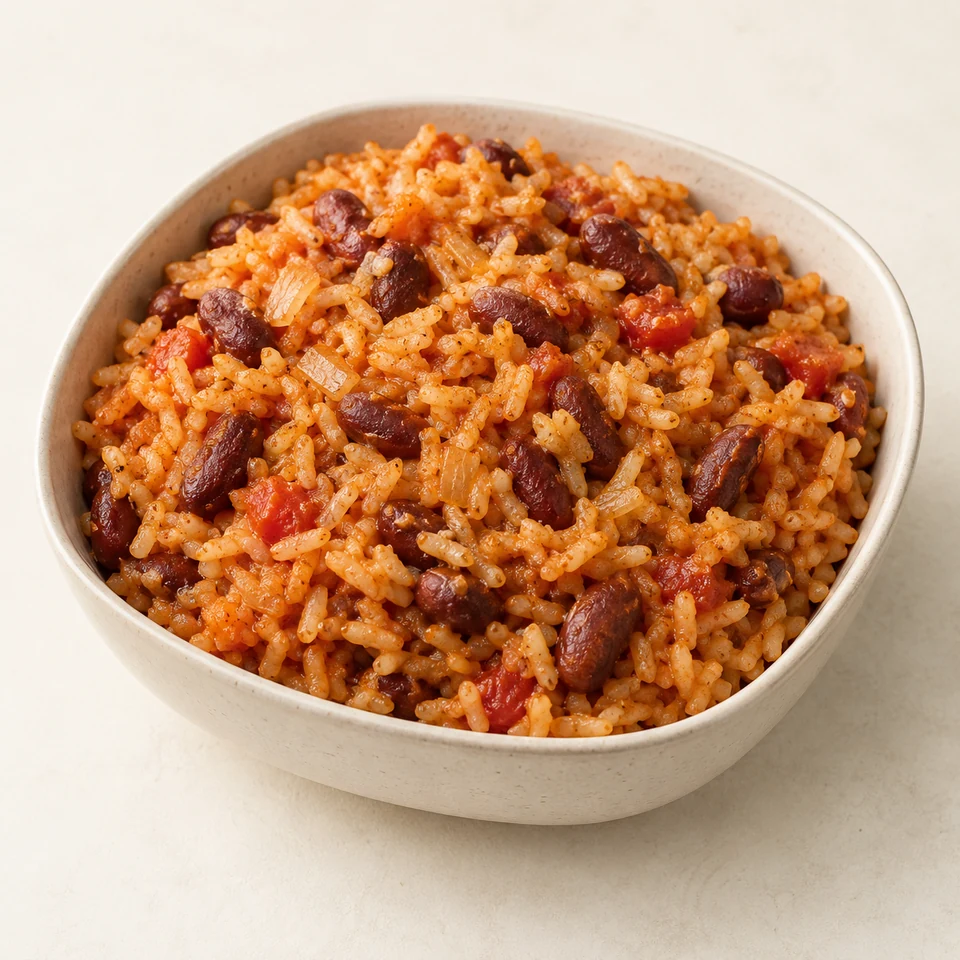
AI-generated illustration of one possible presentation. Recipes and ingredients vary; the image does not establish allergen content.
Sources & references
The primary recipe is Balai’s Djagacida à moda da Maria Joaquina Pires, supplied by Nham Nham – Sabores de Cabo Verde. Separate comparison sources are A Nação’s Djagacida and Darlene Longacre’s Jagacida (Jag) rice-and-bean recipe at International Cuisine. Their alternative foods and timings do not repair omissions in Maria’s formula. Food Standards Agency guidance is separate ingredient-category context and does not resolve the named local products or recipe identity.
Source limits: The selected maize formula remains separate from Darlene Longacre’s rice-based Jagacida recipe; the two spellings are not established here as equivalent names for one recipe.
Source limits: Congo bean species, couve identity, pimento variety and manteiga de terra product identity/formula unresolved.
Source limits: Two litres beans versus about 250 g bottom layer is not converted or reconciled as a yield.
Source limits: Bean-water reserved object/fate, onion allocation, cooking durations, finished taste/texture, exact course and temperature unspecified.