
Bebbux can describe more than one presentation
A snail dish on a Maltese menu deserves a more specific question than “What is bebbux?” Ch.eat’s selected recipe is titled Stuffat tal-Bebbux, or Garden Snail Stew. Its introduction distinguishes snails served with olive oil, garlic and parsley from a stewed preparation. That source provides an actual stew recipe, including its sauce and bread presentation. This guide follows that version rather than treating every Maltese snail dish as the same formula. [1]
Liz Ayling’s Red Bistro account separately describes seeing snail dishes in Maltese bars and at a village event. She mentions garlic, tomato, parsley and sometimes wine in those observed bar preparations. This is useful local context, but it is not her own complete recipe and does not supply missing details for Ch.eat’s stew. Open the Platesafe bebbux guide to compare the selected written version with what a kitchen says it is serving. Keep observed examples and the full selected recipe separately attributed. [2]
The selected sauce has several components
Ch.eat’s ingredient list includes garden snails, onion, garlic, carrot, tomato purée, tomato sauce or passata, red wine, seasonings, herbs, lemon rind, Worcestershire sauce and a gravy cube. It also lists a Maltese loaf, rosemary and olive oil for the bread preparation. The sauce is therefore more specific than a simple description of snails with garlic. A diner asking about ingredients needs to include the prepared sauce and seasoning products as well as the main animal ingredient. [1]
The recipe names Worcestershire sauce, a gravy cube and curry, but does not give their complete supplier formulas. Those are genuine product questions for a restaurant’s version. It would be inaccurate to fill in one familiar brand’s ingredients simply because you recognize a generic sauce or seasoning name. Ask which products are used and whether staff can check the actual labels. If a kitchen makes a substitute, record what it substitutes rather than continuing to describe the selected published formula as unchanged.
The loaf is a serving vessel with its own preparation
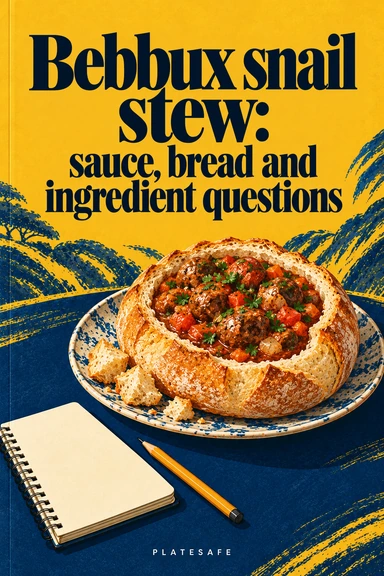
The source hollows out a Maltese loaf and cuts its crumb into small pieces. The bread is drizzled with olive oil, sprinkled with rosemary and baked until lightly golden. The stew is then served in the hollow loaf with parsley on top. That makes bread part of the selected serving presentation, not a side silently borrowed from a different source. The loaf’s complete dough formula is not provided, and the preparation instruction does not establish every ingredient in a restaurant’s bread. [1]
Ask whether the restaurant serves its snails inside bread, in a bowl with bread separately, or without a bread accompaniment. If you are avoiding a bread ingredient, removing loose crumb would not describe a stew already placed in the loaf. The arrangement matters to the actual plate. You can also ask whether rosemary and oil are used on the bread or only in the sauce. A component’s role is useful information when deciding what can be changed at serving and what is already part of the preparation.
Garden snails are not a verified species record
The selected source names garden snails but gives no scientific species identification. Preserve that level of detail rather than replacing it with a familiar species from another snail recipe. The official GOV.UK allergen-labelling page explicitly lists snails among molluscs. This supplies a direct relationship for the actually named ingredient: this sourced recipe contains a mollusc ingredient. It does not identify the precise species, supplier preparation or every allergen that might be present elsewhere in the stew. [1, 3]
For a restaurant enquiry, ask what snail product or supplier is used if species or preparation matters to you. Keep that reply distinct from a general category description. Liz Ayling’s local observations do not identify the species in Ch.eat’s recipe or in an unrelated restaurant bowl. The same principle applies to other mollusc dishes: a broad category can help structure a specific allergy discussion, while the individual food and product still need their own information. This guide offers no foraging or snail-preparation instructions.
Do not invent a tasting note from the sauce list
The recipe gives a simmering method and a lightly golden endpoint for the prepared bread, but it does not offer a detailed tasting account of the finished snails or sauce. Red wine, tomato and herbs tell you ingredients, not an exact degree of acidity, richness or chilli intensity. Likewise, “garden snail” does not establish a particular finished chew. If those characteristics determine whether you want the dish, ask the kitchen to describe its own serving rather than importing a generic escargot description. [1]
Useful questions are concrete: “Is the sauce strongly spiced?”, “Is it served with plenty of liquid?”, and “How would you describe the snails’ texture?” A photograph may help you understand the bread vessel or arrangement, but it cannot answer every flavour or product question. This is a case where a source-backed account remains useful even without a complete sensory description. It can identify the actual sauce components and serving phases while leaving the kitchen to describe its own taste and texture.
Ask about the complete stew and handling
For an allergy requirement, explain the specific ingredient or category you need to discuss and ask someone familiar with the recipe. Include the snails, prepared sauces, gravy cube, bread and finishing additions. The Food Standards Agency’s consumer advice also recommends asking about equipment, handling and substitutions. This FSA publication is marked as applying to England, Northern Ireland and Wales; the GOV.UK category example establishes the cited ingredient relationship, not a statement about Maltese restaurant law. [3, 4]
Keep a concise record of what the kitchen confirms and what remains unknown. If it offers a sauce substitution or a different presentation, ask whether that describes the whole prepared order. Omitting parsley or bread at the end does not answer every question about the simmered sauce. The selected recipe and the local observations help you anticipate the conversation, but neither guarantees another kitchen’s ingredients or handling. The useful result is a specific description of this bebbux preparation rather than a blanket assurance about snail dishes. [4]
Sources & references
Source pages checked 10 October 2026. Confirm the exact current recipe and preparation with the venue.