
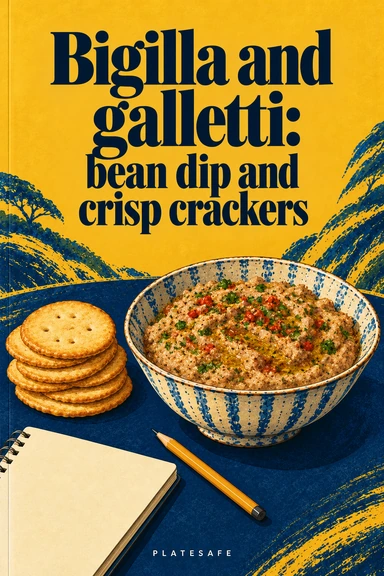
A bean dip and crackers are two preparations
Apron & Whisk publishes bigilla and galletti together as a Maltese pairing: a savoury, spicy dried broad-bean dip with light, crisp water crackers. It is a useful source because both parts of the pairing have their own recipe on the page. You can see the dip’s ingredients separately from the cracker dough, rather than assuming the accompaniment is included in a single bean-dip ingredient list. The contrast between thick bean paste and crisp crackers is directly described by the source. [1]
Open the Platesafe bigilla guide when you want to compare that pairing with an order. A restaurant may serve bread, crackers or a wider platter, and each choice changes what you need to ask about. Start by establishing whether you are ordering the dip alone, the dip with galletti or a plate with additional foods. This guide follows the source’s published dip and cracker recipes, while keeping its other serving suggestions distinct.
Keep the bean identity at the level the source gives
The narrative names dried broad beans as ful ta’ Ġirba, while the recipe card lists dried fava beans. Those are the source’s own labels. They are useful to preserve when asking what beans a kitchen uses, but they do not establish an exact botanical cultivar or supplier product on their own. The published dip also uses olive oil, garlic, salt, chilli flakes and parsley. Garnish instructions add more parsley, chilli and olive oil at serving. [1]
Ask about both the paste and its topping if you need a complete ingredient picture. A chilli placed visibly on top is not the only chilli in this selected preparation, because flakes are also mixed into the dip. Removing the garnish would therefore leave the paste’s seasoning unchanged. Likewise, a green garnish does not prove that herbs are absent from the blended component. The source provides a practical example of why the mixture and the finishing layer deserve separate questions. [1]
Thick paste is a stated endpoint
The recipe soaks and cooks the dried beans, then pulses them with seasonings and some reserved cooking water until they form a thick paste. More water can be used to adjust the consistency. The author also notes that preferences differ over thickness and spiciness. That combination gives you useful texture evidence while preserving variation: the selected endpoint is a paste, but a kitchen may make a looser or thicker version according to its own practice. [1]
If you are choosing a dip for sharing, ask whether the restaurant’s bigilla is thick enough to spread or served with a looser consistency. You can also ask how pronounced the garlic and chilli are. The source’s savoury and spicy description supports that conversation without imposing a fixed heat level. It does not provide a numeric chilli rating or a detailed account of smoothness versus small bean pieces. Those details can be supplied by the kitchen rather than invented from the blending instruction.
The galletti have a separate dough
The same page’s galletti recipe uses plain flour, semolina, water, butter, salt, sugar and yeast. It describes the finished crackers as light and crispy, and the method rolls the dough thinly before baking. Butter therefore belongs to this selected cracker recipe, even though the accompanying dip has its own separate ingredient list. A water-cracker name is not a complete formula and should not be treated as proof that water is the only relevant addition to flour. [1]
For an allergy requirement, ask which crackers are actually served and whether their full ingredients are available. The Food Standards Agency lists milk among its allergen categories; the butter in the published accompaniment provides a concrete dairy question. The exact flour products and any restaurant substitutions still need their own information. Do not infer a complete allergen declaration from the generic words plain flour or semolina, or assume another brand of galletti follows this homemade dough. [1, 2]
Serving suggestions do not all enter the same order
The author says bigilla can be served cold or slightly warm and suggests warm bread, crackers, platters and even using a diluted version as pasta sauce. Those are separate serving possibilities. They should not all be added to an ingredient account for the published dip-and-cracker pairing. If you see bigilla on a menu in a different role, ask how it is used: a spread, a small dip bowl or a sauce for another dish each requires understanding the accompanying food. [1]
For a platter, ask what arrives beside the dip and whether bread, cheese, cold cuts or other items are included. For a pasta version, ask about the pasta and any extra ingredients used to adjust the sauce. A bean-dip recipe can explain the base while leaving the rest of a meal unspecified. Keeping those questions separate also avoids a common shortcut: seeing a plant-based dip description and applying it to every food served around that dip.
Ask about this portion rather than the category
A useful enquiry might begin: “Is this bigilla made from dried broad beans, what is mixed into it, and what comes with it?” Follow up on the seasoning and garnish if those matter to your enjoyment. For an allergy requirement, name the specific ingredient and ask someone who knows the current preparation. The Food Standards Agency’s consumer guidance includes sauces, garnishes, equipment and substitutions. This FSA publication is marked as applying to England, Northern Ireland and Wales; its legal explanations should not be presented as Maltese restaurant law. [2]
The pairing’s appeal is well described by the source: savoury spicy bean paste alongside crisp crackers. You can use that description to choose a style of dish without claiming every version has the same thickness, heat or dough. Keep the kitchen’s reply attached to the actual dip, accompaniment and date, including anything it cannot confirm. An ingredient absent from one published component is not a guarantee about a complete restaurant plate. The source is a useful map for the conversation, while the order’s own ingredients and preparation remain the kitchen’s information. [1, 2]
Sources & references
Source pages checked 10 October 2026. Confirm the exact current recipe and preparation with the venue.