
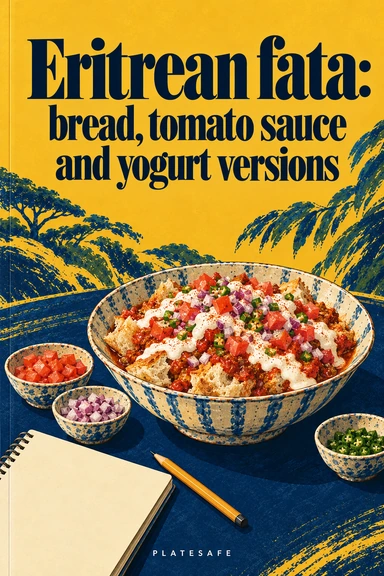
Fata through one author’s firsthand account
Cheryl Sternman Rule describes discovering fata while living in Eritrea. In her account, crusty bread meets a spicy tomato preparation and cooling yogurt. This is a particularly useful dish to research through a named source because the contrast is explicitly described: the yogurt provides relief against the hot tomato component. It is not a tasting note reconstructed solely from an ingredient list. Her published versions give you a way to understand that relationship while also showing why a recipe’s publication and date matter. [1, 3]
The Platesafe fata guide can help you compare those components with a restaurant menu. Start with bread, tomato preparation and yogurt, then ask what the kitchen actually uses. The name alone does not identify the bread formula, seasoning blend or yogurt product. This guide follows Rule’s Eritrean account; it does not use a similar spelling elsewhere to establish that another dish has the same identity. If a menu describes a different preparation, give its source and version a separate place in your notes.
Two publications can differ without one being a mistake
Rule’s Edible Seattle recipe offers plain or sourdough crusty rolls and specifies plain yogurt rather than Greek yogurt. The Saveur version instead lists full-fat Greek yogurt. Both publications use bread, a cooked tomato component, raw toppings and yogurt, but their yogurt specifications differ. That is enough reason to keep them as two attributed versions rather than silently selecting the preferred detail from each. A useful summary can describe the shared structure while stating which version supplies a specific ingredient. [1, 2]
Their spice instructions also deserve separate handling. Edible Seattle lists berbere and supplies a substitute using allspice, cayenne and hot Hungarian paprika. Saveur gives that substitute directly and specifically describes the allspice as ground. The generic word in one version should not be silently changed to match the more specific form in the other. At a restaurant, ask which blend is actually used. Neither publication tells you the formula of every commercial berbere product or the precise spice balance in a kitchen’s own mixture. [1, 2]
The sauce is cooked; several toppings remain separate
The Edible Seattle method cooks onion and garlic with most of the tomatoes, tomato paste, seasoning and water, aiming for a sauce that is fluid rather than watery. A remaining tomato, red onion and jalapeño are used at serving, along with yogurt. Saveur likewise keeps part of the tomato and onion for the final assembly. Those phases give a clearer picture than simply saying the dish contains tomatoes and onions. Some ingredients contribute to the cooked base while others arrive as distinct toppings. [1, 2]
This distinction can guide a specific enquiry. If raw onion or jalapeño matters to you, ask whether it is a removable garnish or part of the cooked preparation. If you are asking about yogurt, establish whether it is placed on top, mixed into the sauce or served separately by that kitchen. A garnish that can be omitted does not resolve a different ingredient already cooked into the base. Make the request about the actual preparation rather than assuming the arrangement in a source photograph matches your order.
Heat and cooling yogurt are supported contrasts
Rule’s story directly describes spicy tomato stew and the cooling, creamy contribution of yogurt. Her Edible Seattle recipe similarly presents a spicy tomato sauce with cooling yogurt. That is meaningful flavour and sensation evidence for her versions. It does not justify attaching a fixed chilli rating to every fata, since the seasoning and serving proportions can change. A menu question such as “How hot is your tomato sauce, and is the yogurt separate?” keeps the source-backed contrast while letting the restaurant describe its own intensity. [1, 3]
Bread adds another time-sensitive distinction. Edible Seattle says to serve before the bread becomes mushy and allows toasting soft rolls to develop a crust. Those instructions make the interval between assembly and eating relevant to texture. They do not mean the finished dish is uniformly crunchy: the bread also receives sauce. Ask whether the kitchen assembles the bowl when ordered or serves bread and sauce separately. That tells you more about the likely presentation than a general adjective applied to the dish across all versions. [1]
Check the full bread and yogurt ingredients
The selected recipes tell you which type of bread and yogurt their author prefers, but they do not provide complete bread-making formulas or identify a restaurant’s exact products. If you have a food-allergy requirement, ask about those products as well as the tomato sauce and spice mixture. Yogurt is a concrete part of these published versions, and milk is among the Food Standards Agency’s allergen categories. That observation supports a question about dairy in the source and in the actual order; it does not identify every possible formulation served under the name. [1, 2, 4]
For the bread, ask for its full ingredients rather than assuming a crusty appearance establishes its flour, fats or added ingredients. For the seasoning, ask whether the kitchen makes a blend or uses a packaged one. Include cooking oil and finishing additions if they matter to your requirement. The consumer advice recommends speaking to someone who understands the preparation and asking about equipment and handling. Its statutory explanations concern the UK, so they should not be presented as a description of restaurant law in Eritrea or elsewhere. [4]
Record the version you are actually offered
A useful short note might say: “This restaurant uses crusty rolls, a cooked tomato sauce, its own berbere mixture and yogurt on top; onion and jalapeño are added at serving.” That is more informative than saying only that you ordered fata. If the kitchen describes Greek yogurt, a different bread or a milder seasoning, preserve those answers. They describe this version, and they need not be forced into either published recipe. The sources show that even one author’s accounts can specify different choices. [1, 2]
Keep any dietary discussion beside that version note, including what the staff could confirm and what they could not explain. Removing a topping does not by itself answer questions about the sauce, bread or handling. A source-backed guide helps you anticipate these questions and understand the hot-sauce and cooling-yogurt contrast. The kitchen’s information describes the food it will serve. Using both kinds of information carefully gives you a more useful decision record without turning an attributed recipe into a universal guarantee. [4]
Sources & references
Source pages checked 10 October 2026. Confirm the exact current recipe and preparation with the venue.