
Understand the sauce before summarising the salad
Gado-gado is a useful dish to investigate through its sauce and serving components. A vegetable photograph tells you little about the mixture poured over the plate, and a sauce recipe tells you little about the exact vegetables or accompaniments selected for a meal. Keep both parts in view.
Nagi Maehashi’s RecipeTin Eats version describes a sweet-savoury peanut sauce and uses a Thai curry-paste shortcut.[1] Keep this attribution with the recipe rather than treating it as a universal gado-gado formula.
For cooking or ordering, begin with the exact version you have found. Save the author or business name, the current source and the selected sauce. Then add the vegetables, protein choice, garnishes and sides as separate components. This makes the whole plate more understandable than one broad salad label.
The preferred peanut butter branch is a specific choice
Nagi prefers natural peanut butter, permits smooth or crunchy, and gives different seasoning directions for commercial spreads.[1] Preserve the branch you choose instead of combining both sets of directions.
Peanut butter enters the sauce; chopped peanuts are a separate serving component.[1] The ingredient is identified in the source, rather than inferred from a photograph.
When comparing a different recipe or restaurant sauce, ask whether it uses whole peanuts, peanut butter or another identified product. Keep the current formula with that version. A named product can require its own ingredient statement even when the main food ingredient is clear.
Purchased paste and sweet soy sauce need their own identities
The sauce combines peanut butter, curry paste, kecap manis, chilli paste, garlic, lime, coconut milk, salt and water.[1] A purchased paste remains a compound ingredient whose complete formula needs its own product information.
Kecap manis is described as thick sweet soy sauce; dark soy and honey are an alternative.[1] Record the branch you actually use. Substitutes and originals should not appear together unless the selected recipe uses both.
This is also useful when asking a business about its sauce. Ask which paste and sauce products it uses and whether the current ingredient statements are available. A general recipe description elsewhere on the web cannot resolve the formula of the bottles or mixtures in that kitchen.
When several labels are involved, save each with its component name: sauce paste, sweet soy sauce, protein and crackers. This helps you ask one clear follow-up question at a time. If the business supplies only a general answer, preserve the words it used and the detail still missing rather than silently completing the formula.
The source describes a sauce that can be drizzled
The method thickens the sauce to a drizzling consistency and serves it warm; cooling thickens it further.[1] Keep the actual serving arrangement with your selected batch.
Keep consistency and flavour in different parts of your note. The sauce can have the author’s sweet-savoury description while its serving thickness is described separately. Do not turn a coconut ingredient into an invented statement about every version’s finished taste or texture.
For a home comparison, follow the selected recipe’s complete method and record any adjustment you actually make. For an ordered plate, ask how the sauce is served if that matters to the experience you want. A poured sauce and a bowl of sauce on the side give different serving arrangements, even if the sauce name is the same.
Keep the selected vegetables, eggs and protein separate
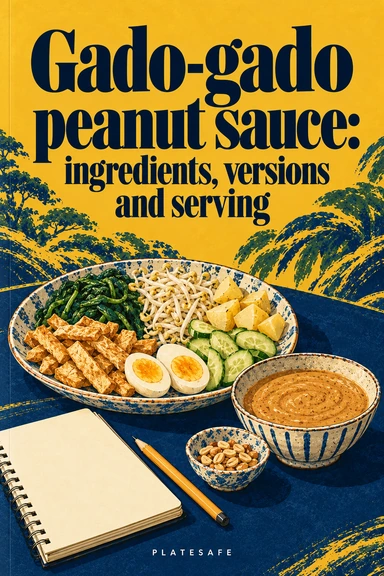
This example uses spinach, beansprouts, potato, cucumber and eggs, with tempeh or tofu.[1] These are selected components in a named recipe. A modified meal needs its own accurate account of what was chosen.
The selected protein is cooked until crispy; sauce is served separately.[1] Those are source-supported details. They do not establish the finished mouthfeel of every vegetable.
If you choose other vegetables or omit a component, keep that modification attached to your selected plate. Do not quietly transfer the original recipe’s inventory or description to a modified meal. Each version needs its own accurate account of what was selected.
Crackers and garnishes are separate components
Prawn crackers and sliced chilli are optional; the notes describe the crackers’ crunch.[1] Record whether you select either component, then keep its own recipe or product ingredients with the meal.
Save the side’s actual product or recipe with the meal. Keep a garnish used at the table separate from the sauce’s built-in ingredients. This makes it possible to understand a plate with extra chilli or crackers without rewriting the sauce formula.
A photograph can suggest what was served in one example, but it cannot identify every product or the exact choice made for another order. Use the selected recipe and current business information for those details, and preserve any missing answer.
Before ordering, separate confirmed ingredients from venue questions
The selected published version includes peanut butter and boiled eggs. Peanuts and eggs are also named in the FSA’s UK allergen information.[2] These are positive ingredient observations for this recipe; they do not identify every restaurant’s gado-gado.
For the exact dish you want, ask about the sauce formula, purchased pastes, selected protein, garnishes, crackers and cooking oil. Explain your food requirement directly and ask about preparation and possible cross-contact. The FSA recommends checking actual ingredients, equipment and substitutions; this article does not apply UK legal duties to a business elsewhere.[2]
Use Platesafe’s gado-gado record as a sourced starting reference and save the current venue answers in your food-focused trip worksheet. Keep the recipe attribution and research status visible. Where a product or preparation detail is unavailable, leave it unknown rather than treating the missing information as a safety finding.
Sources & references
Source pages checked 9 October 2026. Confirm the exact current recipe and preparation with the venue.