
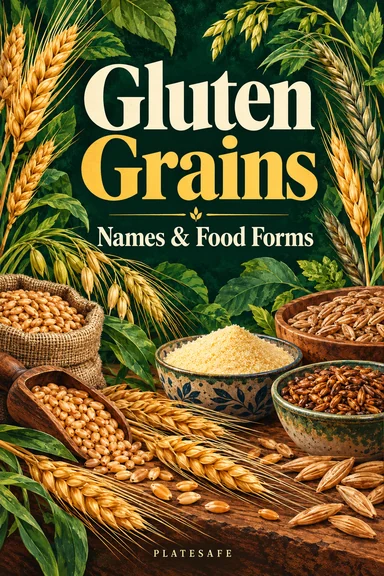
Read the grain source before the food name
Coeliac Australia identifies wheat, including varieties such as spelt, rye and barley as core grains to recognise on a gluten-free diet. Its healthcare guide also lists semolina, couscous and pasta among forms to check, and malted ingredients may come from barley. A menu word such as ‘grain bowl’ does not identify the actual grain. [1, 5]
Start with the gluten-free guide, then use wheat, barley and rye ingredient records to decode a name. Spelt and triticale deserve their own check instead of being treated as unfamiliar ‘alternative’ grains.
Read every component of a prepared food. A soup may contain noodles, a salad may have croutons, and a sauce may use a thickener. These are possible routes to ask about, not claims that a named dish always contains gluten.
| Source to check | Examples of forms | What to verify |
|---|---|---|
| Wheat and wheat varieties | Flour, spelt, semolina, couscous, pasta | The exact grain and any wheat declaration |
| Barley | Barley grain, malt extract or other malted ingredient | The source cereal and finished-product claim |
| Rye | Rye flour, rye bread or mixed-grain products | Every grain in the blend |
| Oats | Oat flour, porridge, oat drinks | Your clinical plan and the rules of the market where sold |
Oats need their own conversation
Coeliac Australia explains that oats contain avenin, a related protein, and that a small number of people with coeliac disease react even to pure oats. It recommends discussing an oat trial with a medical team. In Australia and New Zealand, foods containing oats or oat products cannot make a ‘gluten free’ claim under the current code; rules elsewhere differ. [2, 3]
Do not use ‘wheat-free’ as a synonym for gluten-free. It does not answer barley, rye or oat questions, or how a food was processed. Check the current label and your own clinical guidance. [2]
A product made from a traditionally gluten-containing grain may also have a manufacturing exemption or a regulated claim. Do not decide solely from a source word or a blog list; read the current finished-product declaration and claim under the local rules. [3]
Use the declaration and claim together
For applicable Australian and New Zealand packaged foods, FSANZ requires plain English allergen declarations. Wheat must be named; barley and rye must be declared when they contain gluten, and gluten appears in the summary where required. An Australian ‘gluten free’ claim has its own conditions, including no detectable gluten and no malted gluten-containing cereals or their products. [3, 4]
If ingredients, a ‘Contains’ summary and a gluten-free claim appear inconsistent, ask the manufacturer about that exact batch rather than estimating from a small quantity. For a restaurant, ask about noodles, flour in sauces, crumbs and preparation surfaces; the restaurant questions guide can help.
Coeliac disease is not the same diagnosis as wheat allergy. A person with wheat allergy should follow their allergy specialist’s wheat plan rather than using this page to infer which non-wheat grains they can eat. [1]
Sources & references
Source pages checked 18 October 2026. Confirm the exact current recipe and preparation with the venue.