
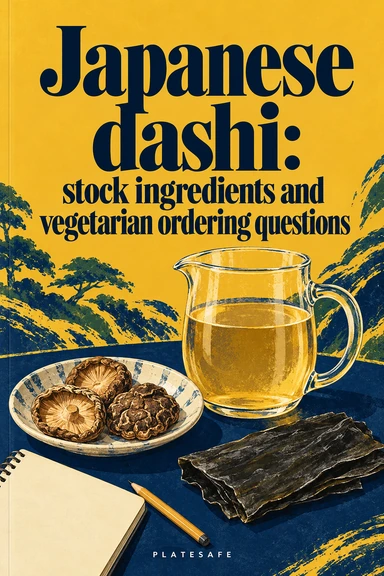
Dashi names describe a stock, not every ingredient in a meal
Dashi is a useful place to begin when you want to understand a Japanese soup, simmered dish or sauce. Ask which stock is used, then ask what is added to it. A familiar dish name or a vegetable topping does not supply the missing stock recipe.
Namiko Hirasawa Chen’s Just One Cookbook article gives several distinct dashi examples: kombu, shiitake, bonito, dried anchovy or sardine, and combinations of these ingredients.[1] The variety matters. Treating “dashi” as one fixed formula would hide the difference between a mushroom-and-kelp stock and a stock made with fish.
For a vegetarian or vegan requirement, explain the particular ingredients you exclude and ask about the actual stock. Japan National Tourism Organization specifically advises checking stocks and base ingredients, including when a dish looks vegetarian in a photograph.[2] A useful answer names the preparation; an unclear general label remains an open question.
One named example: shiitake kombu dashi
Chen’s selected Vegan Dashi recipe uses kombu, dried shiitake mushrooms and water. The card lists one 10 g piece of kombu, two dried mushrooms and four cups of water; its stated yield is one batch of about 800 ml.[1] The starting water and finished yield are separate quantities, so do not write 800 ml as though it were the card’s water input.
She describes this stock as umami-rich and says that adding the dried mushrooms contributes depth beyond kombu alone.[1] That is an attributed description of her version. It is more informative than an imagined tasting note inferred from an ingredient list, and it does not describe every restaurant’s stock.
Keep the selected recipe’s author, source and batch size together when saving it. If you later choose another dashi, give it a separate record. Combining the ingredients of several different versions can accidentally create a recipe that none of the sources actually made.
The stock-making method is part of the recipe
The recipe offers cold brewing, followed by an optional heating stage to extract more flavour. Its card requires at least 30 minutes of soaking and gives longer seasonal soaking examples. In the heated stage, the kombu and mushrooms are removed just before boiling, and the liquid is strained.[1]
Those stages answer different questions. The soaking ingredients describe what goes into the stock; straining describes what remains physically in the finished liquid. Removing a solid ingredient is not a reason to pretend it was never used. Write “used to make the stock” when that is the most accurate description.
If you are making this version at home, follow the author’s full method rather than a shortened ingredients-only summary. If you are researching a venue’s dish, use the method as a way to formulate questions about its own process. The online recipe does not show whether the venue cold brews, heats a stock or uses a purchased product.
Stock and finished soup need separate ingredient lists
A stock recipe can be complete while the meal made from it remains unidentified. Miso, noodles, vegetables, a garnish or a finishing sauce may be added later. Keep those additions in another part of your notes instead of treating the stock’s ingredient list as the list for the whole bowl.
An effective record has a stock entry and a finished-dish entry. The stock entry names its source ingredients and method. The finished-dish entry names the quantity used and the other ingredients added. If the recipe merely says “dashi” without identifying the kind, record that limit instead of filling it from a different article.
This also helps when comparing two recipes. You may find that the stock is similar but the seasoning and serving presentation differ, or that the same dish name is prepared with a different stock. Describe the difference that the sources actually establish. Do not attach one author’s flavour description to another author’s untested combination.
Purchased bases require product-specific questions
A restaurant may identify a purchased stock base rather than a homemade recipe. In that case, ask for the actual product name and current ingredient information. A packet labelled for a particular style can still need its own ingredient review; a general description of dashi cannot stand in for that packet.
Keep the product’s label and the finished dish together in your notes. If several ingredients are grouped into a compound base, preserve that grouping until the actual formula is available. A vague answer such as “seasoning” should not be expanded into a confident list of ingredients borrowed from a homemade recipe.
For a personal cooking comparison, you can choose one exact homemade stock and one identified product and document each separately. Record the dose used in the finished dish as well as the stock formula. That gives you a meaningful comparison without assuming that a full stock batch was used in one serving.
Ask about the stock before changing the topping
JNTO notes that meat or fish ingredients may be present even when they are not immediately visible, and advises being specific when explaining vegetarian or vegan requirements.[2] Removing a visible piece of meat does not answer the question about the stock used to prepare the dish.
Begin with the base: “Which stock is used for this item?” Follow with the seasoning and the selected additions. If staff offer a modification, ask which parts change and which remain the same. Keep the answer attached to that modified version rather than to the dish family as a whole.
A written explanation can support the conversation, but it should not replace confirmation that the business understands your requirement. Contact ahead where useful, especially for a set menu. Record a missing answer plainly; this article cannot turn uncertainty about a stock into a suitability decision.
A vegan recipe and allergen handling are separate questions
The FSA’s consumer guidance distinguishes vegan labelling from allergen information and explains that cross-contamination can still matter for a vegan-labelled product.[3] The cited guidance concerns the UK; it is not a statement of Japanese legal obligations.
Use that distinction when preparing questions. Identifying a plant-based recipe addresses the ingredients described by that source. It does not identify the handling of an unrelated product or the equipment used in a restaurant. Explain an allergy or intolerance separately from a preference for a vegan dish.
Ask about the complete meal and the actual preparation environment where those details matter to your requirement. Neither a vegetable photograph nor this named mushroom-and-kelp recipe supplies those answers for a different kitchen. Leave the uncertainty visible until the relevant business can answer it.
Make your next stock question easier
Use Platesafe’s soy sauce information when preparing seasoning questions, and the shoyu ramen record as an example of why a named dish still needs recipe attribution. Read the research status on each record and keep it separate from a restaurant’s current information.
For a food-focused trip, add a stock column to your planning worksheet. Name the source that supplies each answer and the date it was checked. If only the noodle or topping is identified, keep the stock field open.
For cooking at home, save the exact stock recipe alongside the finished dish you use it in. That simple separation preserves the author’s version, the quantity actually used and the additions that shape the meal. It makes future comparisons more useful than a single broad “dashi” label.
Sources & references
Source pages checked 9 October 2026. Confirm the exact current recipe and preparation with the venue.