
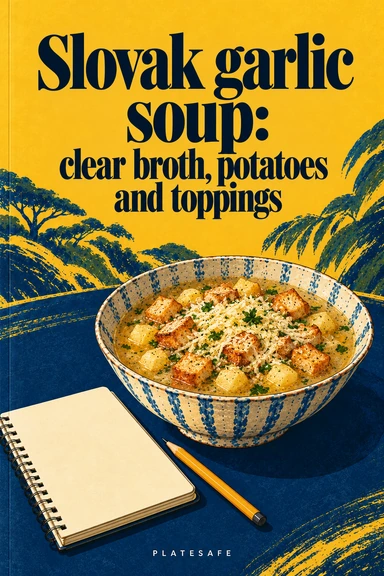
Two soup styles, one selected clear version
Cesnaková polievka, also called cesnačka in Lubos’s Slovak Cooking account, is garlic soup. His post distinguishes a creamy version from the clear version he actually makes. He describes eating garlic soup frequently while travelling in Slovakia, then gives his own selected recipe. The distinction between those two styles is a useful menu clue, but the clear bowl still needs an ingredient enquiry: clarity does not tell you whether butter, cheese, bread or another addition is present. [1]
This guide follows the clear recipe in that post. Open the Platesafe cesnakova polievka guide if you are comparing it with a menu. Start by asking whether the kitchen offers a clear or creamy preparation, and what its garnish and bread arrangement are. Do not replace the selected recipe with a commenter’s variation or a different soup served in a bread bowl. Those may be useful possibilities to investigate, but they describe different preparations.
Ten cloves do not establish a universal intensity
Lubos’s recipe lists ten garlic cloves, yet he directly describes his finished soup as having only a slight garlic taste. He contrasts that with restaurant bowls he encountered that were much more strongly garlicky. That is useful firsthand flavour evidence and a reminder that counting cloves alone does not establish how a served soup will taste. Batch size, preparation and a kitchen’s own recipe remain relevant, and a written quantity should not become a universal strength rating. [1]
If strong garlic is the feature you want, ask the restaurant whether its version is mild or pronounced. If you prefer a restrained flavour, the same question is more informative than judging the soup by its name. Keep the restaurant’s description tied to its bowl rather than repeating the selected source’s slight-garlic account as a promise. The author himself describes variation across his experience, so the source supports investigating intensity rather than flattening that variation into one fixed tasting note.
Water, potatoes and seasonings make up the base
The selected method briefly fries garlic in butter, then adds water, paprika, caraway, salt and diced potatoes. The potatoes are boiled until soft. Water is the stated cooking liquid; the source does not use a prepared stock in this particular recipe. These details can help you ask about a restaurant’s version, but they cannot establish that another clear garlic soup also uses water rather than meat or vegetable stock. The liquid needs its own question. [1]
Paprika and caraway are actual listed seasonings, while the recipe does not specify a complete paprika product or make a fixed heat claim. Ask whether the kitchen uses a hot or mild seasoning if that matters to your enjoyment. Potato softness is a directly stated cooking endpoint, not evidence that the entire bowl is a smooth puree. Lubos cuts potatoes into small cubes and describes a clear soup; changing that into a blended creamy soup would erase the form of his selected preparation. [1]
Bread and cheese are part of the serving
The soup is ladled over squares of toasted bread placed in a bowl. Lubos says he toasted his bread in butter in a frying pan, while also offering a toaster option. He then grates cheese into the soup, specifying Swiss cheese as his own choice, and mentions garnish such as parsley. That serving sequence is worth preserving: the bread is not a separate untouched side in the described bowl, and the cheese is a finishing addition rather than an ingredient in a creamy soup base. [1]
If the bread’s texture matters to you, ask whether the restaurant serves it inside the soup or separately. Toasted bread receives liquid in this selected arrangement, but the post does not supply a detailed description of its final mouthfeel. Similarly, a photographed garnish cannot identify a bread’s full flour and fat formula. Ask what product is used and how it is prepared if you need that information. The pan-butter and toaster alternatives belong to the bread phase, while butter used for the garlic remains part of the selected base.
Clear does not mean free of dairy
The published clear version uses butter and cheese. That makes it a particularly clear example of why appearance is an unreliable way to infer ingredients. A bowl without cream can still contain dairy elsewhere in its preparation. The Food Standards Agency lists milk among its allergen categories; the actual butter and cheese in a kitchen’s version need specific discussion if milk is relevant to your requirement. The guide is describing source ingredients, not making a claim about every restaurant that serves garlic soup. [1, 2]
Ask about the cooking fat, grated cheese, bread and any prepared stock, rather than stopping after “Is it creamy?” If the kitchen offers to omit cheese, establish what remains in the base and bread preparation. A change to one finishing element does not describe the whole bowl. The consumer advice also recommends asking someone who understands ingredients and handling about equipment and substitutions. This FSA publication is marked as applying to England, Northern Ireland and Wales; the practical prompts can help you organize the enquiry without assuming the same requirements everywhere. [2]
A useful menu note stays specific
A practical note might record the kitchen’s own answers under four headings: soup style, garlic intensity, cooking liquid and finishing additions. For example, “clear, mild garlic, water-based, with butter, toast and Swiss cheese” describes the selected written version more usefully than simply “garlic soup.” A restaurant may give a different set of answers. Keep those differences rather than treating them as errors to correct with an online recipe. They tell you what that kitchen means by the menu name. [1]
The source provides a straightforward dish account and useful firsthand flavour evidence. It does not provide medical advice, prove health benefits or describe all regional origins of garlic soup. For a dining decision, the actual ingredients, desired intensity and serving arrangement are the relevant points. Combine the recipe background with the kitchen’s current information, preserve anything unresolved, and keep an allergy discussion attached to the particular order. That produces a useful record without turning a clear-looking bowl into an ingredient or handling guarantee. [2]
Sources & references
Source pages checked 10 October 2026. Confirm the exact current recipe and preparation with the venue.