
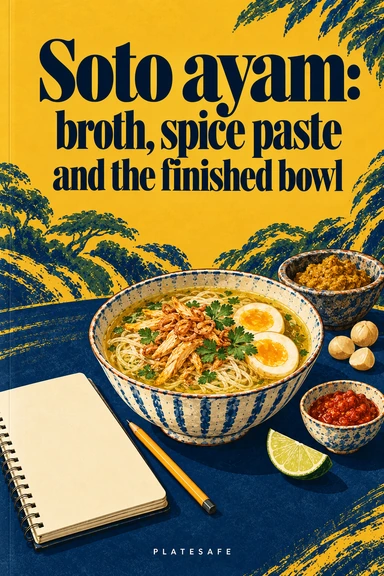
Read the bowl as broth, paste and serving components
Soto ayam is easier to understand when you separate the stock, spice paste, chicken, noodles and finishing ingredients. A photograph of a yellow chicken soup will not identify each component. A short ingredients summary can also miss the garnish or condiment that changes the selected meal.
This guide follows Glebe Kitchen’s published Indonesian-style chicken noodle soup. Its author presents a researched personal version, not a formula claimed for every regional soto ayam.[1] Keep that attribution with the ingredients and method. A different source may supply another useful version without replacing this one.
Begin a recipe note with five entries: soup base, paste, chicken preparation, noodles and serving additions. You can then see where an ingredient enters the dish and which parts need their own product or recipe information. That structure is also useful when preparing questions for a restaurant.
The base starts with an identified chicken stock
The selected recipe simmers chicken thighs with chicken stock, lemongrass, lime leaves and salt.[1] The named stock is itself a component. Its full formula is not established merely by writing chicken stock in a summary.
If you cook with a supplied stock, save the actual product label. If you make one separately, keep that recipe with the soup. In either case, record the amount used in the selected batch rather than treating a complete stock recipe as though all of it entered the soup.
For a venue question, ask which stock or soup base is used for the current item. Keep an incomplete formula grouped under the name the business provides until more information is available. A homemade stock from a different website cannot fill the gap for that kitchen.
The paste is a separate recipe phase
The selected paste uses shallots, garlic, ginger, macadamia nuts, turmeric, coriander powder, pepper, coconut milk and oil. The author identifies macadamias as a substitute for candlenuts.[1] Preserve that selected substitution rather than writing both nuts as mandatory ingredients.
The paste is prepared separately and then added to the broth.[1] That matters for the inventory: ingredients used to make a mixture remain part of the preparation even when the mixture is no longer visibly separated in the bowl.
When reading another soto recipe, look for its actual paste formula and any branch choices. Do not assume that the same soup name supplies the same nut, spice form or product. If a commercial paste is used, identify that current product rather than expanding it from this homemade example.
Keep sensory descriptions at the source’s level
The author describes the spicing as relatively delicate and discusses the effect of lemongrass and lime leaf in this version.[1] That is an attributed description of the selected preparation. It should not become a universal claim about every regional soto ayam.
The author describes the fried chicken as having a crisp texture and deeper chicken flavour after its lemongrass poaching. The serving instructions also describe soft egg yolks.[1] These are attributed component descriptions for this version; the source does not establish how long the chicken stays crisp after broth is poured over it.
For your own comparison, give flavour and texture separate fields. Record whether the description concerns the completed soup, an ingredient or a particular component. If the source provides only a method or an ingredient list, keep the missing finished description open instead of inventing it.
The chicken method and noodle product need their own notes
In this recipe the chicken is first simmered, then fried and shredded before assembly. Rice vermicelli is the named noodle ingredient.[1] Those are source-supported preparation and ingredient observations; the generic noodle name does not identify an exact packet’s complete formula.
For home cooking, follow the author’s full method and the relevant product directions. A shortened article cannot stand in for the recipe’s complete instructions. For an ordered meal, ask which chicken preparation and noodle product the business uses now.
Keep any modification with the actual version. If a different noodle or chicken preparation is selected, record that change instead of carrying over every description from the original recipe. The point is to understand the meal you actually prepare or order.
Garnishes and table additions complete the selected bowl
The source serves the noodles and chicken with egg, fried shallots and cilantro, with lime and sambal oelek at serving.[1] These additions deserve their own entries rather than being lost behind a general soup label.
Keep a garnish already included in the bowl separate from a condiment added to taste. If you choose a purchased fried shallot or chilli product, save its current ingredient information. A garnish’s appearance does not establish the product formula or how it was prepared.
For a comparison between two bowls, note the actual selected additions. A source’s suggested condiment is not evidence that every serving contained it. This makes it possible to compare the base preparation and the finished chosen meal without confusing the two.
Before ordering, ask about this version’s nuts, egg and mixtures
The published version includes macadamia nuts in the paste and eggs in the bowl. The FSA’s UK consumer guide names macadamia nuts among tree nuts and lists eggs separately.[2] These are positive ingredient observations for the selected recipe, not a suitability finding for another kitchen.
For the exact meal, ask about the stock, paste, noodles, garnishes and cooking oil, along with current substitutions and preparation. Explain your food requirement directly. The FSA recommends asking about possible cross-contact from equipment or ingredients; its legal statements are not applied here to a business outside the UK.[2]
Use Platesafe’s soto ayam record as a sourced starting point and keep current business answers in your food-focused trip worksheet. Read the recipe attribution and research status. Preserve unknown product and preparation details instead of treating a general soup description as a guarantee.
Sources & references
Source pages checked 10 October 2026. Confirm the exact current recipe and preparation with the venue.