
Belgian Endive
Belgian endive is a pale, tightly headed leafy vegetable commonly served raw in salads or cooked as a side dish.
About Belgian Endive
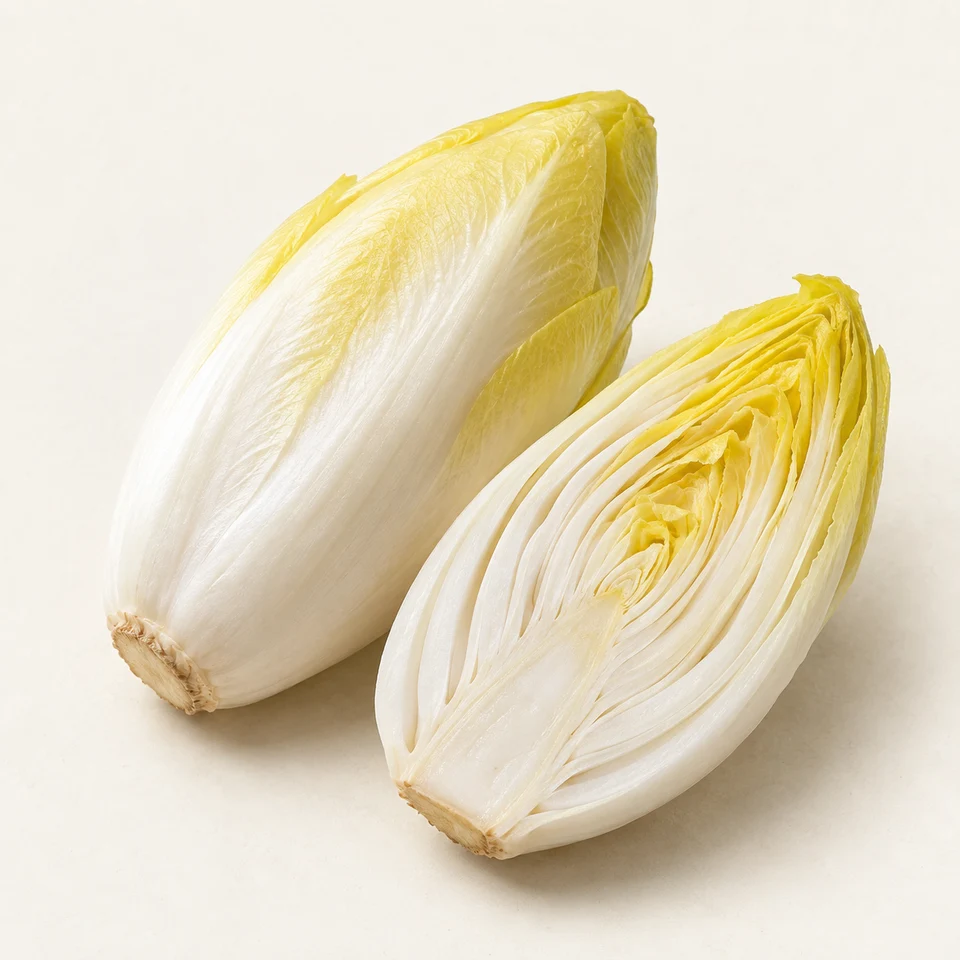
Belgian endive is a compact, elongated head of pale leaves produced from chicory. It is commonly separated into leaves for salads, appetisers, and dipping, or halved for use as a cooked side dish.
Raw leaves are crisp and juicy with a gently bitter flavour. Cooking softens their texture and mellows the bitterness, while browning adds a cooked surface character without changing the vegetable’s identity.
Heads are usually sold fresh and whole, with leaves ranging from white to light yellow and sometimes showing green tips. Trimming, halving, braising, roasting, grilling, or baking changes moisture, texture, and flavour.
- Ingredient type
- whole food
FOLLOW IT TO THE PLATE
Where will you meet it?
Explore the dishes that use this ingredient and their country and cuisine connections.
Explore linked dishesON A MENU OR LABEL
Find local names and written forms to help recognise this ingredient.
See local namesWhere belgian endive appears
1 linked foodsFind foods to recognise by country and type. Recipes and products vary; these are recorded ingredient connections.
Showing 1–1 of 1
Sides

Ingredient connections awaiting review · Coverage is still growing, including packaged snacks.
Name examples awaiting language review. Confirm the specific food or product.
Local names for belgian endive
Names and romanised forms to recognise on menus and labels.
witloof
chicon
endive de Bruxelles
Belgian Endive
Belgian endive
Belgischer Chicorée
endibia belga
endívia belga
indivia belga
endívia belga
cykoria belgijska
belgická čekanka
belgická čakanka
belgijska endivija
belgijski radič
andivă belgiană
belga endívia
belgisk endive
belgisk endive
belgisk endivie
belgialainen endiivi
бельгийский цикорий
belgiyskiy tsikóriy
бельгійський цикорій
belhiiskyi tsykorii
βελγικό αντίδι
velgikó antídi
Belçika hindibası
比利时菊苣
Bǐlìshí jújù
ベルギーエンダイブ
Berugī endaibu
벨기에 엔다이브
Belgie endaibeu
rau diếp xoăn Bỉ
velgikó antídi
Romanised form
Berugī endaibu
Romanised form
belhiiskyi tsykorii
Romanised form
Belgie endaibeu
Romanised form
Bǐlìshí jújù
Romanised form
belgiyskiy tsikóriy
Romanised form
Available names only. Languages may be spoken in other countries; a name alone does not identify every ingredient in a dish.
Name not available yet.
A name in English has not been added for belgian endive. Choose another language to see its available names.
Belgian Endive nutrition & diet
Belgian Endive nutritional value
Reference: Endive
Per 100 g of 100 g edible portion in the named official reference form.
- Calories
- 14kcal
- Protein
- 1.0g
- Carbs
- 1.1g
- Fat
- 0.1g
Official national food-composition reference. The displayed food form is part of the estimate; cultivar, recipe, brand, processing and preparation can change values.
Portions & preparation
Use the whole edible head after removing the base and any damaged outer leaves, and distinguish raw leaves from braised, roasted, grilled, or boiled preparations. Added butter, oil, cheese, sauces, and cooking-liquid retention belong to the finished dish rather than the plain vegetable reference.
Compare the right form: Reference a raw or cooked Belgian endive head, with the edible leaves and trimmed base specified; match braised, roasted, grilled, or boiled form.
Diet considerations
Belgian endive is a plant-derived leafy vegetable. Plain raw or cooked leaves fit plant-based patterns, while butter, cheese, cream, meat stock, or wrapped fillings change compatibility. Coatings, sauces, and portion size may alter carbohydrate patterns, so assess the assembled preparation rather than the leaf alone.
AI-authored reading notes · Awaiting editorial review. Measured values, where available, have a separate source above.
Dietary compatibility
- VeganNot established
- VegetarianNot established
- PescatarianNot established
- KetoNot established
- PaleoNot established
- Low-carbNot established
- HalalNot established
- KosherNot established
What these diet assessments mean
- Vegan · Not established
- The available profile does not establish the full composition or processing for this dietary pattern.
- Vegetarian · Not established
- The available profile does not establish the full composition or processing for this dietary pattern.
- Pescatarian · Not established
- The available profile does not establish the full composition or processing for this dietary pattern.
- Keto · Not established
- A defined serving and sourced carbohydrate data are needed before assessing this dietary pattern.
- Paleo · Not established
- The ingredient form and processing have not been assessed against this dietary pattern.
- Low-carb · Not established
- A defined serving and sourced carbohydrate data are needed before assessing this dietary pattern.
- Halal · Not established
- Sourcing, processing and any applicable certification have not been verified. A food name alone does not establish halal status.
- Kosher · Not established
- Sourcing, processing and any applicable certification have not been verified. A food name alone does not establish kosher status.
For the plain ingredient · Awaiting review. Diet compatibility is not allergy suitability or halal/kosher certification. Keto and low-carb depend on the portion.
AI-generated illustration for visual context. It does not identify a particular product or establish allergen content.
Sources & review
Nutrition reference: Swedish Food Agency Food Database, 2026-07-01 — 335 ↗. Values are scaled from 100 g of the recorded edible form. Individual portions have no assumed fixed weight.
Expanded overview, name examples and nutrition notes are database drafts awaiting editorial review. Numeric nutrition values, where shown, have their own source and food-form reference.
The ingredient description and dish connections come from the draft catalogue and may change after review.
Last recorded verification: .