
Black-Eyed Pea Flour
Black-eyed pea flour is flour milled from dried black-eyed peas and used in batters, doughs, and thickened dishes.
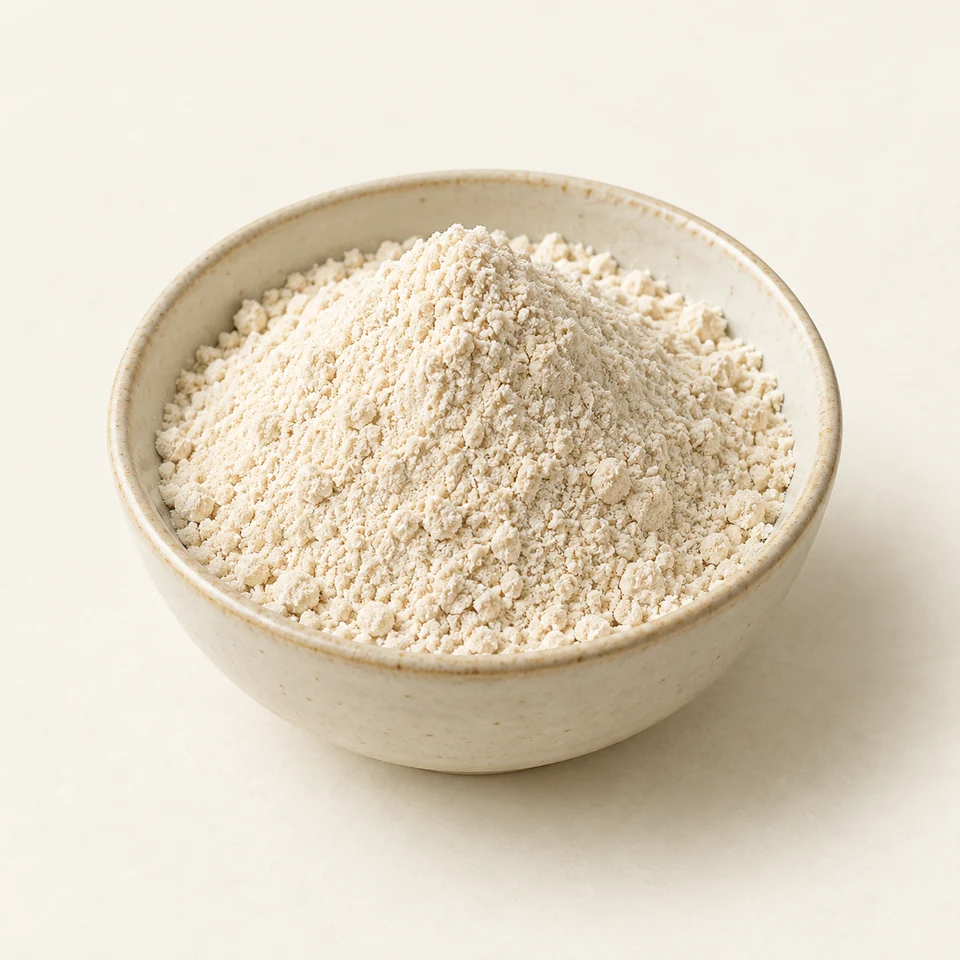
About Black-Eyed Pea Flour
Black-eyed pea flour is made by milling dried black-eyed peas into a powder. It is used in batters, doughs, pancakes, fritters, porridges, sauces, and other dishes where legume flour adds body, either alone or blended with other flours.
The flour is usually pale cream to light tan, with a legume-like aroma and a mild earthy taste that becomes fuller during cooking. Its texture may be fine or slightly coarse. Finer milling generally produces smoother batters and finished foods.
It is sold dry and powdered. Mixing it with liquid hydrates the particles, while cooking sets the mixture and develops its flavour. Sifting or using a finely milled flour can improve smoothness, whereas coarser flour gives more noticeable texture.
- Ingredient type
- flour
FOLLOW IT TO THE PLATE
Where will you meet it?
Explore the dishes that use this ingredient and their country and cuisine connections.
Explore linked dishesON A MENU OR LABEL
Find local names and written forms to help recognise this ingredient.
See local namesWhere black-eyed pea flour appears
1 linked foodsFind foods to recognise by country and type. Recipes and products vary; these are recorded ingredient connections.
Showing 1–1 of 1
Street food

Ingredient connections awaiting review · Coverage is still growing, including packaged snacks.
Name examples awaiting language review. Confirm the specific food or product.
Local names for black-eyed pea flour
Names and romanised forms to recognise on menus and labels.
black-eyed pea flour
farine de pois à œil noir
harina de frijol de carita
farinha de feijão-fradinho
Augenbohnenmehl
farina di fagioli dall’occhio
farina de mongeta d’ull negre
meel van black-eyed peas
mąka z fasoli z czarnym oczkiem
mouka z fazolí černé oko
făină de fasole cu ochi negru
feketeszeműbab-liszt
börülce unu
دقيق اللوبيا ذات العين السوداء
daqīq al-lubyā dhāt al-ayn al-sawdāʾ
黒目豆粉
kuromemameko
黑眼豆粉
hēiyǎndòu fěn
bột đậu mắt đen
tepung kacang tunggak bermata hitam
แป้งถั่วตาดำ
paeng thua ta dam
kuromemameko
Romanised form
daqīq al-lubyā dhāt al-ayn al-sawdāʾ
Romanised form
hēiyǎndòu fěn
Romanised form
paeng thua ta dam
Romanised form
Available names only. Languages may be spoken in other countries; a name alone does not identify every ingredient in a dish.
Name not available yet.
A name in English has not been added for black-eyed pea flour. Choose another language to see its available names.
Black-Eyed Pea Flour nutrition & diet
Black-Eyed Pea Flour nutritional value
Representative benchmark: Flour, not further specified
Per 100 g of 100 g edible portion in the named official reference form.
- Calories
- 353kcal
- Protein
- 10.7g
- Carbs
- 72.1g
- Fat
- 1.6g
Representative benchmark from a comparable official food-composition category; it is not a laboratory measurement of this exact ingredient. The displayed reference form must be considered, and species, cultivar, recipe, brand, processing and preparation can change values.
Portions & preparation
Match flour milled from black-eyed peas with the stated milling and treatment, such as whole, dehulled, roasted, or blended flour. Batters and doughs absorb liquid and may be cooked with oil. Finished breads, fritters, and thickened dishes require recipe-level evaluation rather than substitution of plain flour data.
Compare the right form: Confirm black-eyed pea identity and match whole or dehulled, roasted or unroasted, plain or blended flour, including the finished preparation.
Diet considerations
Black-eyed pea flour is plant-derived legume flour. Plain flour differs from blends containing wheat or other cereals, dairy, egg, meat seasoning, or animal fats. Batters, breads, and fritters often add oil and cereal ingredients, while the preparation method and portion influence carbohydrate patterns and dietary compatibility.
AI-authored reading notes · Awaiting editorial review. Measured values, where available, have a separate source above.
Dietary compatibility
- VeganTypically compatible
- VegetarianTypically compatible
- PescatarianTypically compatible
- KetoDepends on the version
- PaleoTypically incompatible
- Low-carbDepends on the version
- HalalNot established
- KosherNot established
What these diet assessments mean
- Vegan · Typically compatible
- The plain ingredient profile is plant, fungal or mineral based. Added ingredients in a prepared product need a separate check.
- Vegetarian · Typically compatible
- The plain ingredient profile is plant, fungal or mineral based. Added ingredients in a prepared product need a separate check.
- Pescatarian · Typically compatible
- The plain ingredient profile is plant, fungal or mineral based. Added ingredients in a prepared product need a separate check.
- Keto · Depends on the version
- Compatibility depends on the portion and preparation. A sourced carbohydrate amount for a defined serving is not available.
- Paleo · Typically incompatible
- This profile falls outside the conventional paleo pattern used here (grains and pseudograins, legumes, dairy or refined sugar).
- Low-carb · Depends on the version
- Compatibility depends on the portion and preparation. A sourced carbohydrate amount for a defined serving is not available.
- Halal · Not established
- Sourcing, processing and any applicable certification have not been verified. A food name alone does not establish halal status.
- Kosher · Not established
- Sourcing, processing and any applicable certification have not been verified. A food name alone does not establish kosher status.
For the plain ingredient · Awaiting review. Diet compatibility is not allergy suitability or halal/kosher certification. Keto and low-carb depend on the portion.
AI-generated illustration for visual context. It does not identify a particular product or establish allergen content.
Sources & review
Nutrition reference: Pacific Nutrient Database 2020 — 01.1.1.2.9_99 ↗. Values are scaled from 100 g of the recorded edible form. Individual portions have no assumed fixed weight.
Expanded overview, name examples and nutrition notes are database drafts awaiting editorial review. Numeric nutrition values, where shown, have their own source and food-form reference.
The ingredient description and dish connections come from the draft catalogue and may change after review.
Last recorded verification: .