
Blackcurrant
Blackcurrant is a tart, dark berry used fresh or in preserves, desserts, drinks, and sauces.
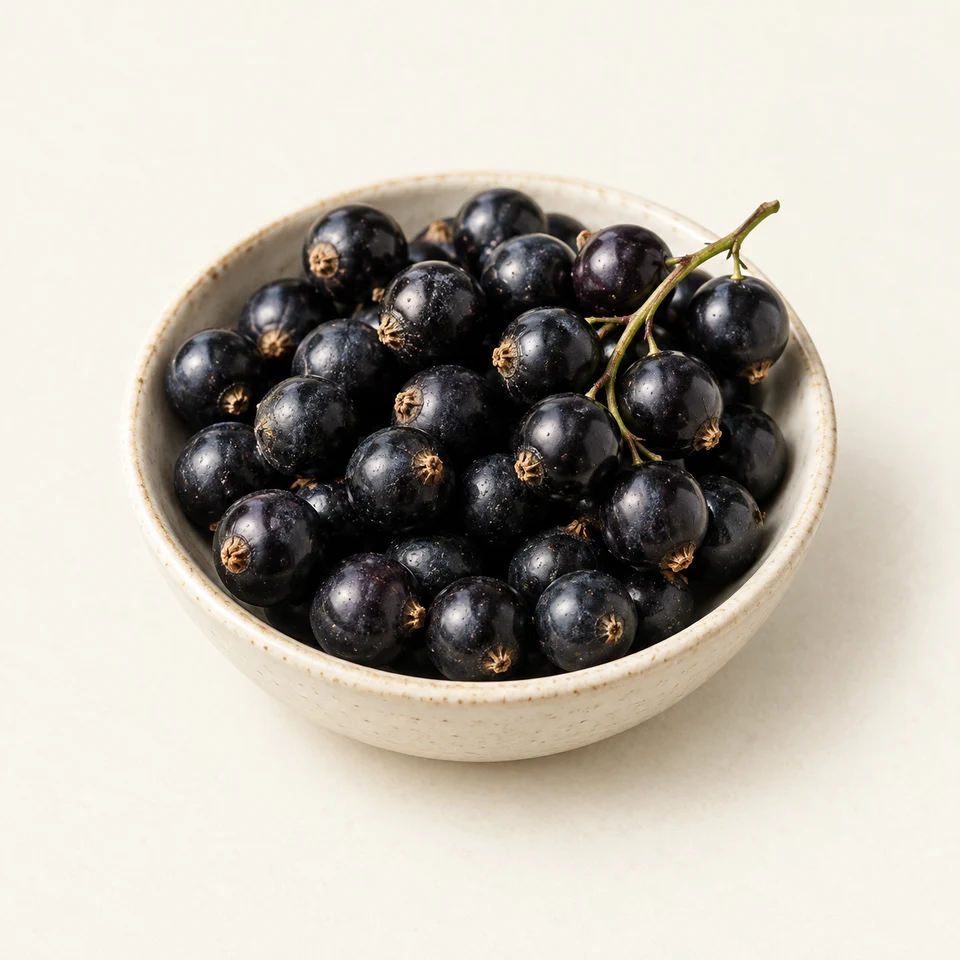
About Blackcurrant
Blackcurrant is the small, round fruit of a currant shrub, typically with a glossy dark-purple to nearly black skin and a cluster of tiny seeds inside. It is eaten fresh when available and used in jams, jellies, syrups, cordials, desserts, baked goods, and fruit sauces. Blackcurrant is different from blackberries, which are a separate type of aggregate fruit.
The berries have pronounced tartness, an aromatic character, and a juicy but slightly seedy texture. Their strong colour and sharp flavour remain prominent in cooked and preserved forms, although straining, puréeing, drying, or incorporating them into sweetened products changes the balance and texture.
Blackcurrants may be sold fresh, frozen, dried, or processed. Fresh and frozen berries retain their whole skins and seeds, while cooking softens them. Juices, sauces, jams, jellies, and strained preparations alter the fruit’s body and may remove some seeds or skins, so these forms are not identical to whole berries.
- Ingredient type
- whole food
Forms & related ingredients
FOLLOW IT TO THE PLATE
Where will you meet it?
Explore the dishes that use this ingredient and their country and cuisine connections.
Explore linked dishesON A MENU OR LABEL
Find local names and written forms to help recognise this ingredient.
See local namesWhere blackcurrant appears
2 linked foodsFind foods to recognise by country and type. Recipes and products vary; these are recorded ingredient connections.
Showing 1–2 of 2
Desserts

Ingredient connections awaiting review · Coverage is still growing, including packaged snacks.
Name examples awaiting language review. Confirm the specific food or product.
Local names for blackcurrant
Names and romanised forms to recognise on menus and labels.
cassis
Schwarze Johannisbeere
черная смородина
chernaya smorodina
黒すぐり
kuro-suguri
Blackcurrant
blackcurrant
чёрная смородина
chyornaya smorodina
grosella negra
ribes nero
groselha-preta
zwarte bes
czarna porzeczka
černý rybíz
čierne ríbezle
чорна смородина
chorna smorodyna
svarta vinbär
solbær
solbær
mustaherukka
fekete ribizli
siyah frenk üzümü
μαύρη σταφίδα
mávri stafída
coacăz negru
juodasis serbentas
upene
mávri stafída
Romanised form
kuro-suguri
Romanised form
Blackcurrant, Raw
Search alias · Not a confirmed translation
Cassis, cru
Search alias · Not a confirmed translation
Dried blackcurrants
Search alias · Not a confirmed translation
chorna smorodyna
Romanised form
chyornaya smorodina
Romanised form
Available names only. Languages may be spoken in other countries; a name alone does not identify every ingredient in a dish.
Name not available yet.
A name in English has not been added for blackcurrant. Choose another language to see its available names.
Blackcurrant nutrition & diet
Blackcurrant nutritional value
Currants, european black, raw
Per 100 g of the edible portion in the recorded food form.
- Calories
- 63kcal
- Protein
- 1.4g
- Carbs
- 15.4g
- Fat
- 0.4g
Per 100 g of the named reference food. Preparation, cultivar and product formulation can change these values; use the stated form when comparing.
Portions & preparation
Use a reference matching fresh blackcurrant fruit rather than juice, syrup, preserve, dried fruit, or a sweetened dessert. Identify whether stems and other inedible material have been removed. Cooking, straining, and added sugar change the prepared portion and should be recorded separately from the berries.
Compare the right form: Reference must match fresh blackcurrant berries as edible fruit, or a clearly identified cooked, frozen, dried, juiced, or preserved form.
Diet considerations
Blackcurrants are plant-derived fruit. Plain berries are compatible with plant-based diets, but dairy, gelatin, honey, coatings, cereal ingredients, or sweetened preserving recipes can alter compatibility. The carbohydrate pattern is portion-dependent and changes with juice, syrup, dried fruit, preserves, and desserts compared with whole berries.
AI-authored reading notes · Awaiting editorial review. Measured values, where available, have a separate source above.
Dietary compatibility
- VeganTypically compatible
- VegetarianTypically compatible
- PescatarianTypically compatible
- KetoDepends on the version
- PaleoTypically compatible
- Low-carbDepends on the version
- HalalNot established
- KosherNot established
What these diet assessments mean
- Vegan · Typically compatible
- The plain ingredient profile is plant, fungal or mineral based. Added ingredients in a prepared product need a separate check.
- Vegetarian · Typically compatible
- The plain ingredient profile is plant, fungal or mineral based. Added ingredients in a prepared product need a separate check.
- Pescatarian · Typically compatible
- The plain ingredient profile is plant, fungal or mineral based. Added ingredients in a prepared product need a separate check.
- Keto · Depends on the version
- Compatibility depends on the portion and preparation. A sourced carbohydrate amount for a defined serving is not available.
- Paleo · Typically compatible
- The plain form fits the conventional paleo food groups. Added ingredients and individual interpretations can differ.
- Low-carb · Depends on the version
- Compatibility depends on the portion and preparation. A sourced carbohydrate amount for a defined serving is not available.
- Halal · Not established
- Sourcing, processing and any applicable certification have not been verified. A food name alone does not establish halal status.
- Kosher · Not established
- Sourcing, processing and any applicable certification have not been verified. A food name alone does not establish kosher status.
For the plain ingredient · Awaiting review. Diet compatibility is not allergy suitability or halal/kosher certification. Keto and low-carb depend on the portion.
AI-generated illustration for visual context. It does not identify a particular product or establish allergen content.
Sources & review
Nutrition reference: USDA FoodData Central — Currants, european black, raw ↗. Values are scaled from 100 g of the recorded edible form. Individual portions have no assumed fixed weight.
Expanded overview, name examples and nutrition notes are database drafts awaiting editorial review. Numeric nutrition values, where shown, have their own source and food-form reference.
The ingredient description and dish connections come from the draft catalogue and may change after review.
Last recorded verification: .