
Karonda
karonda
Carandas is a small, tart South Asian fruit from Carissa plants, commonly cooked with sugar or seasoning into preserves and pickles.
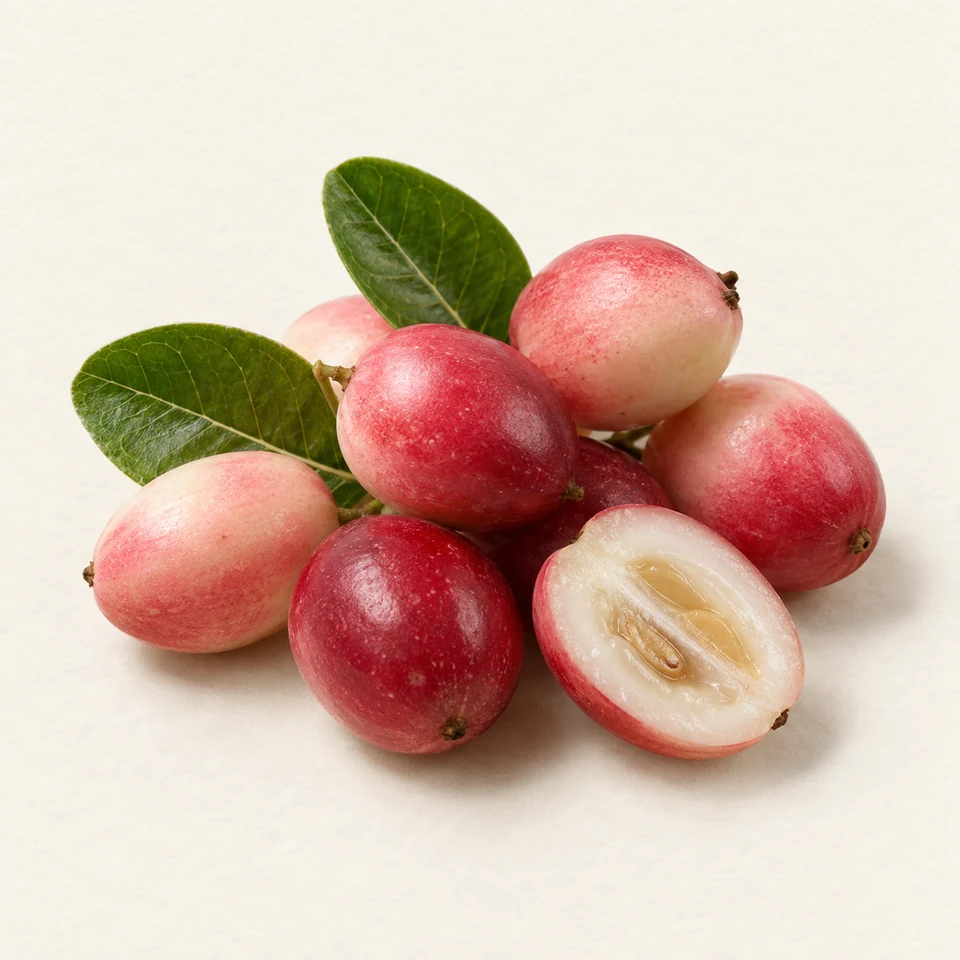
Carandas is a small, tart fruit known in South Asia and often called karonda. It grows on a thorny shrub and is used as a fruit ingredient rather than as a grain or spice. The fruit is typically gathered fresh and may also be sold preserved or processed; maturity and preparation affect its colour and taste.
Fresh fruits are generally small and firm, with skin that can range from greenish to red or dark purple as they mature. The flesh is tangy and may be quite astringent, especially before full ripeness. It is commonly cooked with sugar or seasoning into preserves, pickles, and other preparations, and is also used ripe as a fruit.
FOLLOW IT TO THE PLATE
Explore the dishes that use this ingredient and their country and cuisine connections.
Explore linked dishesON A MENU OR LABEL
Find local names and written forms to help recognise this ingredient.
See local namesFind foods to recognise by country and type. Recipes and products vary; these are recorded ingredient connections.
No linked foods are available for this ingredient yet.
Name examples awaiting language review. Confirm the specific food or product.
Names and romanised forms to recognise on menus and labels.
Karonda
karonda
Karanda
கரந்தை
karantai
Available names only. Languages may be spoken in other countries; a name alone does not identify every ingredient in a dish.
A name in English has not been added for carandas. Choose another language to see its available names.
Reference: Karonda fruit
Per 100 g of 100 g edible portion in the named official reference form.
Official national food-composition reference. The displayed food form is part of the estimate; cultivar, recipe, brand, processing and preparation can change values.
Fresh ripe and unripe fruit differ in maturity and taste, while cooked, sweetened, or preserved products include added ingredients; compare the same edible form.
For the plain ingredient · Awaiting review. Diet compatibility is not allergy suitability or halal/kosher certification. Keto and low-carb depend on the portion.
AI-generated illustration for visual context. It does not identify a particular product or establish allergen content.
Nutrition reference: Indian Food Composition Tables 2017 — E032 ↗. Values are scaled from 100 g of the recorded edible form. Individual portions have no assumed fixed weight.
Expanded overview, name examples and nutrition notes are database drafts awaiting editorial review. Numeric nutrition values, where shown, have their own source and food-form reference.
The ingredient description and dish connections come from the draft catalogue and may change after review.
Last recorded verification: .