
chard root
Chard root
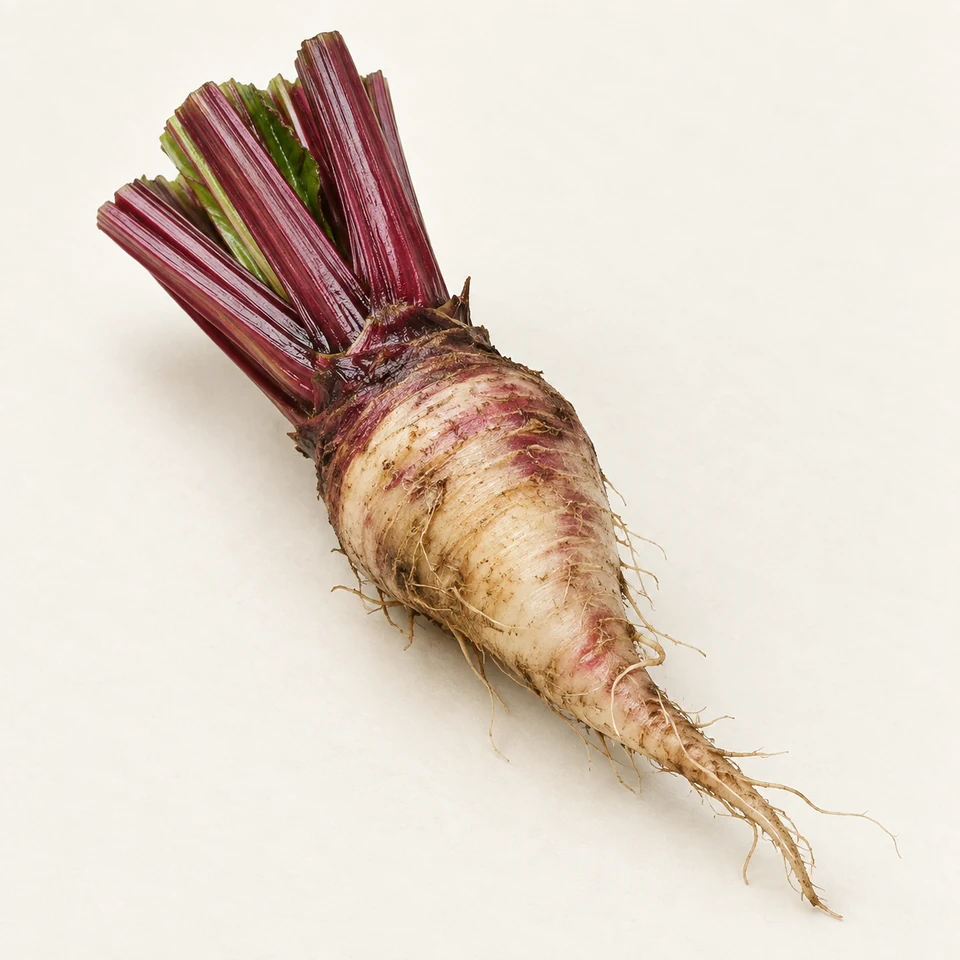
Chard root is the thickened root of a chard plant, a pale, firm ingredient that may be peeled, cooked tender and eaten as a vegetable.
About Chard root
Chard root refers to the thickened root of a chard plant, rather than its leafy blades or stalks. It is generally pale and firm, with a mild, earthy flavour and a dense texture. The term is less commonly used for a distinct market vegetable than names such as beetroot, so the exact variety and intended preparation may vary.
When used as food, the root can be cooked until tender and eaten as a vegetable. It may be peeled and cut before cooking. Chard varieties grown for leafy greens do not necessarily produce a large, marketable root, and the root should not be assumed to be interchangeable with the leaves or stalks.
- Ingredient type
- whole food
FOLLOW IT TO THE PLATE
Where will you meet it?
Explore the dishes that use this ingredient and their country and cuisine connections.
Explore linked dishesON A MENU OR LABEL
Find local names and written forms to help recognise this ingredient.
See local namesWhere chard root appears
0 linked foodsFind foods to recognise by country and type. Recipes and products vary; these are recorded ingredient connections.
Food connections are still being added.
No linked foods are available for this ingredient yet.
Name examples awaiting language review. Confirm the specific food or product.
Local names for chard root
Names and romanised forms to recognise on menus and labels.
root chard
Available names only. Languages may be spoken in other countries; a name alone does not identify every ingredient in a dish.
Name not available yet.
A name in English has not been added for chard root. Choose another language to see its available names.
Chard root nutrition & diet
Chard root nutritional value
Representative benchmark: Vegetables, not further specified
Representative nutrition benchmarkOfficial table values for a comparable food category, not a laboratory measurement of this exact ingredient.
Per 100 g of 100 g edible portion in the named official reference form.
- Calories
- 37kcal
- Protein
- 2.3g
- Carbs
- 4.1g
- Fat
- 0.4g
Representative benchmark from a comparable official food-composition category; it is not a laboratory measurement of this exact ingredient. The displayed reference form must be considered, and species, cultivar, recipe, brand, processing and preparation can change values.
Comparisons should specify the plant variety and distinguish the root from chard leaves and stalks. Raw and cooked root also differ in water content and texture.
Dietary compatibility
- VeganNot established
- VegetarianNot established
- PescatarianNot established
- KetoNot established
- PaleoNot established
- Low-carbNot established
- HalalNot established
- KosherNot established
What these diet assessments mean
- Vegan · Not established
- The available profile does not establish the full composition or processing for this dietary pattern.
- Vegetarian · Not established
- The available profile does not establish the full composition or processing for this dietary pattern.
- Pescatarian · Not established
- The available profile does not establish the full composition or processing for this dietary pattern.
- Keto · Not established
- A defined serving and sourced carbohydrate data are needed before assessing this dietary pattern.
- Paleo · Not established
- The ingredient form and processing have not been assessed against this dietary pattern.
- Low-carb · Not established
- A defined serving and sourced carbohydrate data are needed before assessing this dietary pattern.
- Halal · Not established
- Sourcing, processing and any applicable certification have not been verified. A food name alone does not establish halal status.
- Kosher · Not established
- Sourcing, processing and any applicable certification have not been verified. A food name alone does not establish kosher status.
For the plain ingredient · Awaiting review. Diet compatibility is not allergy suitability or halal/kosher certification. Keto and low-carb depend on the portion.
AI-generated illustration for visual context. It does not identify a particular product or establish allergen content.
Sources & review
Nutrition reference: Pacific Nutrient Database 2020 — 01.1.7.4.9_99 ↗. Values are scaled from 100 g of the recorded edible form. Individual portions have no assumed fixed weight.
Expanded overview, name examples and nutrition notes are database drafts awaiting editorial review. Numeric nutrition values, where shown, have their own source and food-form reference.
The ingredient description and dish connections come from the draft catalogue and may change after review.
Last recorded verification: .