
Dried Dates
Dried dates are preserved date fruits commonly eaten as snacks or used in desserts, sauces, and savory dishes.
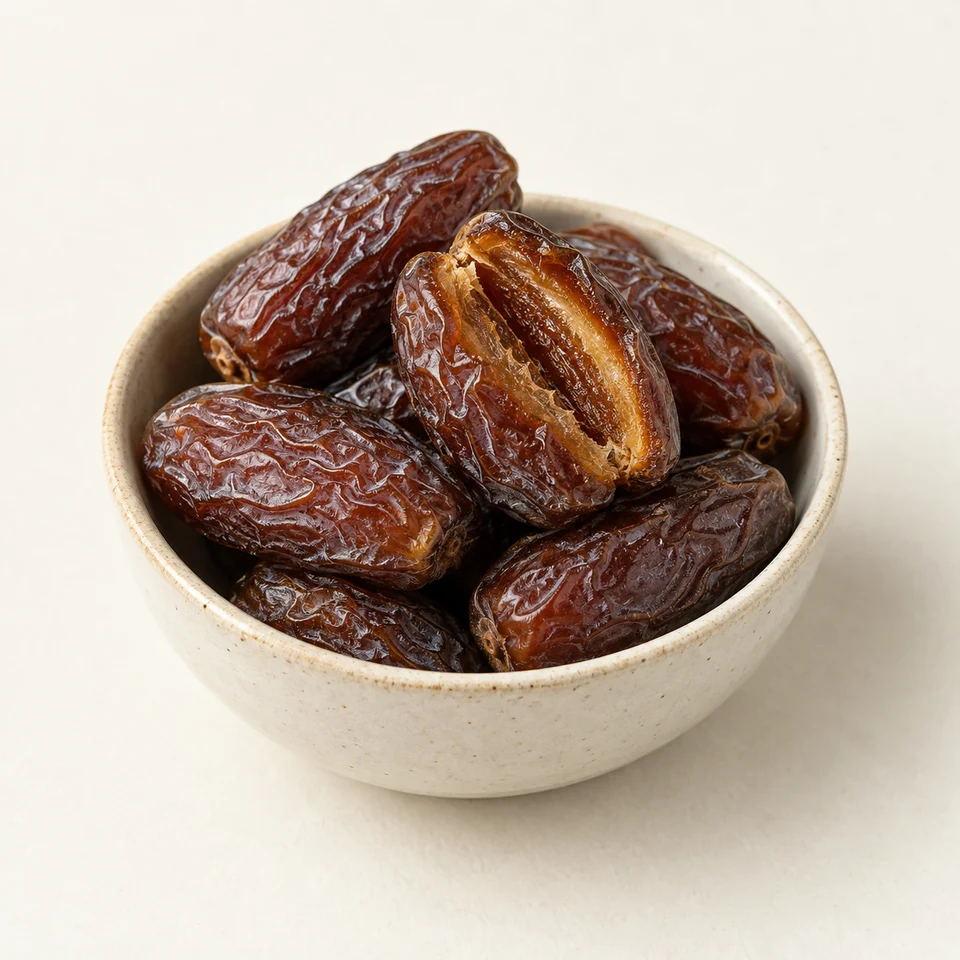
About Dried Dates
Dried dates are the dried fruits of date palms, sold whole, pitted, chopped, pressed, or sometimes as a paste. They are eaten as snacks and used in desserts, cakes, breads, confectionery, fillings, sauces, stews, grain dishes, and other sweet or savoury foods.
Their flavour is intensely sweet, fruity, and caramel-like. Texture ranges from soft and chewy to firmer, depending on cultivar and moisture level. The date cultivar and drying treatment are unspecified, so sensory differences among products cannot be attributed more precisely.
They are typically brown to nearly black, with wrinkled or glossy skins and soft, chewy to firm flesh. Some forms retain the pit, while others are mechanically pitted or processed into pieces or paste; chopping, pressing, and paste-making make the fruit more uniform and change its handling in recipes.
- Ingredient type
- whole food
FOLLOW IT TO THE PLATE
Where will you meet it?
Explore the dishes that use this ingredient and their country and cuisine connections.
Explore linked dishesON A MENU OR LABEL
Find local names and written forms to help recognise this ingredient.
See local namesWhere dried dates appears
1 linked foodsFind foods to recognise by country and type. Recipes and products vary; these are recorded ingredient connections.
Showing 1–1 of 1
Desserts
Ingredient connections awaiting review · Coverage is still growing, including packaged snacks.
Name examples awaiting language review. Confirm the specific food or product.
Local names for dried dates
Names and romanised forms to recognise on menus and labels.
dried dates
تمر مجفف
tamr mujaffaf
kuru hurma
dattes sèches
dátiles secos
tâmaras secas
datteri secchi
getrocknete Datteln
gedroogde dadels
αποξηραμένοι χουρμάδες
apoxiraménoi khourmádes
сушёные финики
sushonyye finiki
сушені фініки
susheni finiky
خرمای خشک
khormā-ye khoshk
सूखे खजूर
sūkhe khajūr
خشک کھجور
khushk khajūr
শুকনো খেজুর
shukno khejur
सुक्खा खजुर
sukkha khajur
乾燥ナツメヤシ
kansō natsuyashi
말린 대추야자
mallin daechuyaja
干椰枣
gān yēzǎo
kurma kering
kurma kering
tende zilizokaushwa
sukkha khajur
Romanised form
apoxiraménoi khourmádes
Romanised form
kansō natsuyashi
Romanised form
tamr mujaffaf
Romanised form
susheni finiky
Romanised form
mallin daechuyaja
Romanised form
shukno khejur
Romanised form
gān yēzǎo
Romanised form
sūkhe khajūr
Romanised form
khushk khajūr
Romanised form
sushonyye finiki
Romanised form
khormā-ye khoshk
Romanised form
Available names only. Languages may be spoken in other countries; a name alone does not identify every ingredient in a dish.
Name not available yet.
A name in English has not been added for dried dates. Choose another language to see its available names.
Dried Dates nutrition & diet
Dried Dates nutritional value
Dates, dried, flesh and skin
Per 100 g of the edible portion in the stated food form.
- Calories
- 235kcal
- Protein
- 2.4g
- Carbs
- 58.7g
- Fat
- 0.6g
Reference values apply to the named food form, not every preparation, variety or brand. CoFID 2021 food code 14-394. Carbohydrate follows the dataset’s available-carbohydrate convention. Contains public sector information licensed under the Open Government Licence v3.0: https://www.nationalarchives.gov.uk/doc/open-government-licence/version/3/.
Portions & preparation
Treat dried dates as a concentrated fruit ingredient and portion them according to whether they are eaten whole, chopped, pressed, or blended. Check for added syrup, sugar, oil, or a pitted versus unpitted form; preparation and recipe distribution can substantially change the edible amount.
Compare the right form: Match references to the same date variety and dried form, including pitted, unpitted, chopped, pressed, or sweetened edible fruit.
Diet considerations
Dried dates are plant-derived fruit and fit plant-based patterns when plain. Added coatings, fillings, dairy, gelatin, or other processing ingredients can change compatibility. Because moisture has been removed, the dried fruit supplies a portion-dependent carbohydrate pattern that differs from an equivalent volume of fresh dates.
AI-authored reading notes · Awaiting editorial review. Measured values, where available, have a separate source above.
Dietary compatibility
- VeganNot established
- VegetarianNot established
- PescatarianNot established
- KetoNot established
- PaleoNot established
- Low-carbNot established
- HalalNot established
- KosherNot established
What these diet assessments mean
- Vegan · Not established
- The available profile does not establish the full composition or processing for this dietary pattern.
- Vegetarian · Not established
- The available profile does not establish the full composition or processing for this dietary pattern.
- Pescatarian · Not established
- The available profile does not establish the full composition or processing for this dietary pattern.
- Keto · Not established
- A defined serving and sourced carbohydrate data are needed before assessing this dietary pattern.
- Paleo · Not established
- The ingredient form and processing have not been assessed against this dietary pattern.
- Low-carb · Not established
- A defined serving and sourced carbohydrate data are needed before assessing this dietary pattern.
- Halal · Not established
- Sourcing, processing and any applicable certification have not been verified. A food name alone does not establish halal status.
- Kosher · Not established
- Sourcing, processing and any applicable certification have not been verified. A food name alone does not establish kosher status.
For the plain ingredient · Awaiting review. Diet compatibility is not allergy suitability or halal/kosher certification. Keto and low-carb depend on the portion.
AI-generated illustration for visual context. It does not identify a particular product or establish allergen content.
Sources & review
Nutrition reference: UK Composition of Foods Integrated Dataset (CoFID), 2021 — Dates, dried, flesh and skin ↗. Values are scaled from 100 g of the recorded edible form. Individual portions have no assumed fixed weight.
Expanded overview, name examples and nutrition notes are database drafts awaiting editorial review. Numeric nutrition values, where shown, have their own source and food-form reference.
The ingredient description and dish connections come from the draft catalogue and may change after review.
Last recorded verification: .