
Green Papaya
Green papaya is unripe papaya with crisp flesh commonly shredded for salads, pickles, and savory preparations.
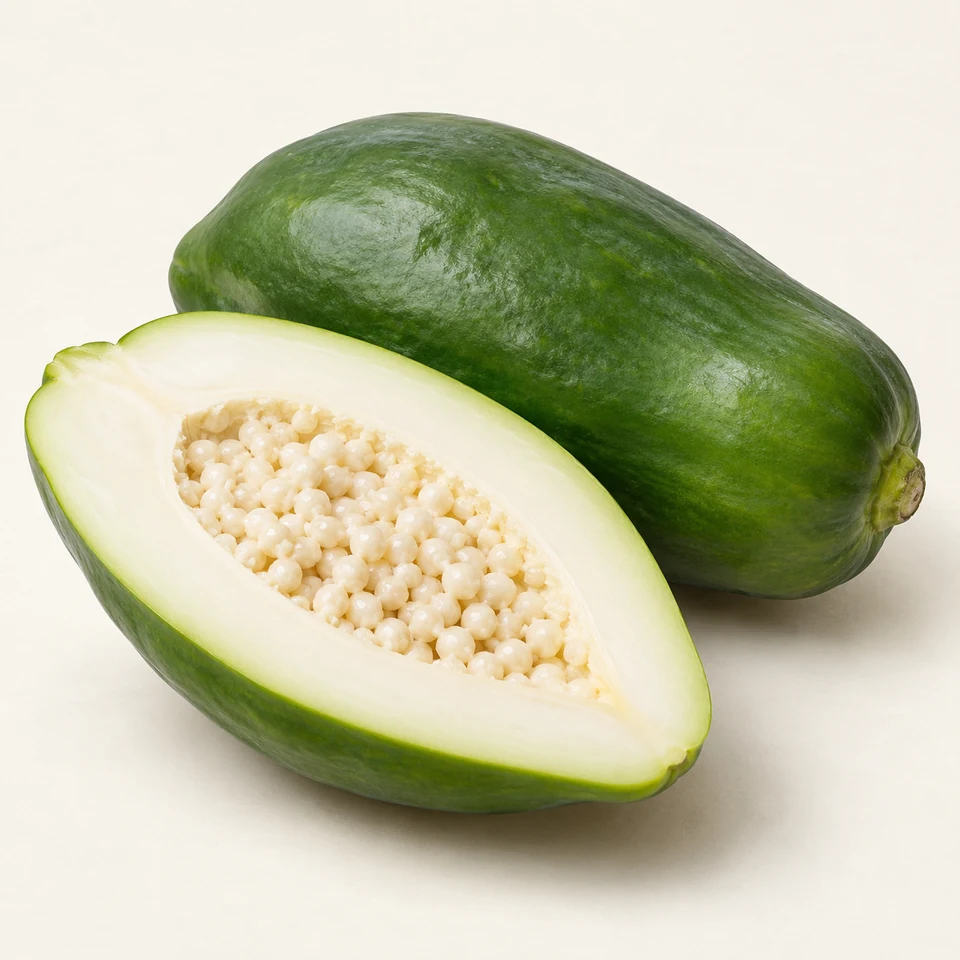
About Green Papaya
Green papaya is papaya harvested before ordinary eating ripeness, while its flesh remains firm and pale. It is peeled, seeded, shredded, julienned, sliced, or grated for salads, pickles, relishes, soups, stews, and other savoury preparations, where it readily absorbs dressings and cooking flavours.
The flesh is crisp and mildly flavoured, sometimes with a faintly resinous note, and has a texture closer to a firm vegetable than a soft ripe fruit. The skin is green and the interior pale green to whitish. Cooking softens the flesh, while salting can make it more yielding and seasoned.
It is sold whole or cut, and may be salted, dried, or pickled. Peeling and seeding prepare the fruit for shredding or slicing; julienning creates narrow pieces for salads, while grating produces a finer texture. Pickling and drying preserve it while changing its moisture and bite.
- Ingredient type
- whole food
FOLLOW IT TO THE PLATE
Where will you meet it?
Explore the dishes that use this ingredient and their country and cuisine connections.
Explore linked dishesON A MENU OR LABEL
Find local names and written forms to help recognise this ingredient.
See local namesWhere green papaya appears
16 linked foodsFind foods to recognise by country and type. Recipes and products vary; these are recorded ingredient connections.
Showing 13–16 of 16
Salads
Sauces

Street food
Ingredient connections awaiting review · Coverage is still growing, including packaged snacks.
Name examples awaiting language review. Confirm the specific food or product.
Local names for green papaya
Names and romanised forms to recognise on menus and labels.
green papaya
มะละกอดิบ
má-lá-kɔɔ dìp
青木瓜
qīng mùguā
कच्चा पपीता
kaccha papita
کچا پپیتا
kachā papītā
কাঁচা পেঁপে
kacha pepe
பச்சை பப்பாளி
pachchai pappāḷi
పచ్చి బొప్పాయి
pacchi boppāyi
ಹಸಿ ಪಪ್ಪಾಯಿ
hasi pappāyi
പച്ചപ്പപ്പായ
paccappappāya
कच्ची पपई
kacchī papai
કાચું પપૈયું
kāchuṁ papaiyuṁ
ਕੱਚਾ ਪਪੀਤਾ
kacchā papītā
काँचो मेवा
kāncho mewa
pepaya muda
betik muda
đu đủ xanh
青パパイヤ
ao papaiya
그린 파파야
geurin papaya
papaye verte
papaya verde
mamão verde
grüne Papaya
papaya verde
yeşil papaya
kāncho mewa
Romanised form
hasi pappāyi
Romanised form
ao papaiya
Romanised form
pachchai pappāḷi
Romanised form
geurin papaya
Romanised form
kacha pepe
Romanised form
qīng mùguā
Romanised form
kaccha papita
Romanised form
paccappappāya
Romanised form
kachā papītā
Romanised form
kāchuṁ papaiyuṁ
Romanised form
kacchī papai
Romanised form
má-lá-kɔɔ dìp
Romanised form
kacchā papītā
Romanised form
pacchi boppāyi
Romanised form
Available names only. Languages may be spoken in other countries; a name alone does not identify every ingredient in a dish.
Name not available yet.
A name in English has not been added for green papaya. Choose another language to see its available names.
Green Papaya nutrition & diet
Green Papaya nutritional value
Papaya, unripe, green flesh, raw
Per 100 g of the edible portion in the stated food form.
- Calories
- 27kcal
- Protein
- 0.9g
- Carbs
- 5.5g
- Fat
- 0.1g
Reference values apply to the named food form, not every preparation, variety or brand. CoFID 2021 food code 13-311. Carbohydrate follows the dataset’s available-carbohydrate convention. Contains public sector information licensed under the Open Government Licence v3.0: https://www.nationalarchives.gov.uk/doc/open-government-licence/version/3/.
Portions & preparation
Use the peeled, seeded, unripe flesh, commonly shredded or sliced; seeds, skin, and tough damaged areas are excluded. Raw salad, cooked, dried, salted, pickled, and sweetened forms require separate matching, because preparation ingredients and the edible portion can differ substantially.
Compare the right form: Match references to raw unripe papaya flesh, peeled and seed-free, or to the specified cooked, dried, pickled, salted, or sweetened form.
Diet considerations
This is a plant fruit from the papaya plant. Plain green papaya is plant-based, but salads and relishes may include fish sauce, shrimp, dried seafood, meat, or honey. Pickling, sugar, coatings, and accompanying noodles, rice, or other cereals can alter compatibility and the dish’s carbohydrate pattern.
AI-authored reading notes · Awaiting editorial review. Measured values, where available, have a separate source above.
Dietary compatibility
- VeganNot established
- VegetarianNot established
- PescatarianNot established
- KetoNot established
- PaleoNot established
- Low-carbNot established
- HalalNot established
- KosherNot established
What these diet assessments mean
- Vegan · Not established
- The available profile does not establish the full composition or processing for this dietary pattern.
- Vegetarian · Not established
- The available profile does not establish the full composition or processing for this dietary pattern.
- Pescatarian · Not established
- The available profile does not establish the full composition or processing for this dietary pattern.
- Keto · Not established
- A defined serving and sourced carbohydrate data are needed before assessing this dietary pattern.
- Paleo · Not established
- The ingredient form and processing have not been assessed against this dietary pattern.
- Low-carb · Not established
- A defined serving and sourced carbohydrate data are needed before assessing this dietary pattern.
- Halal · Not established
- Sourcing, processing and any applicable certification have not been verified. A food name alone does not establish halal status.
- Kosher · Not established
- Sourcing, processing and any applicable certification have not been verified. A food name alone does not establish kosher status.
For the plain ingredient · Awaiting review. Diet compatibility is not allergy suitability or halal/kosher certification. Keto and low-carb depend on the portion.
AI-generated illustration for visual context. It does not identify a particular product or establish allergen content.
Sources & review
Nutrition reference: UK Composition of Foods Integrated Dataset (CoFID), 2021 — Papaya, unripe, green flesh, raw ↗. Values are scaled from 100 g of the recorded edible form. Individual portions have no assumed fixed weight.
Expanded overview, name examples and nutrition notes are database drafts awaiting editorial review. Numeric nutrition values, where shown, have their own source and food-form reference.
The ingredient description and dish connections come from the draft catalogue and may change after review.
Last recorded verification: .