
Mung bean sprouts
Mung bean sprouts are young germinated mung beans commonly eaten raw or cooked in stir-fries, soups, and salads.
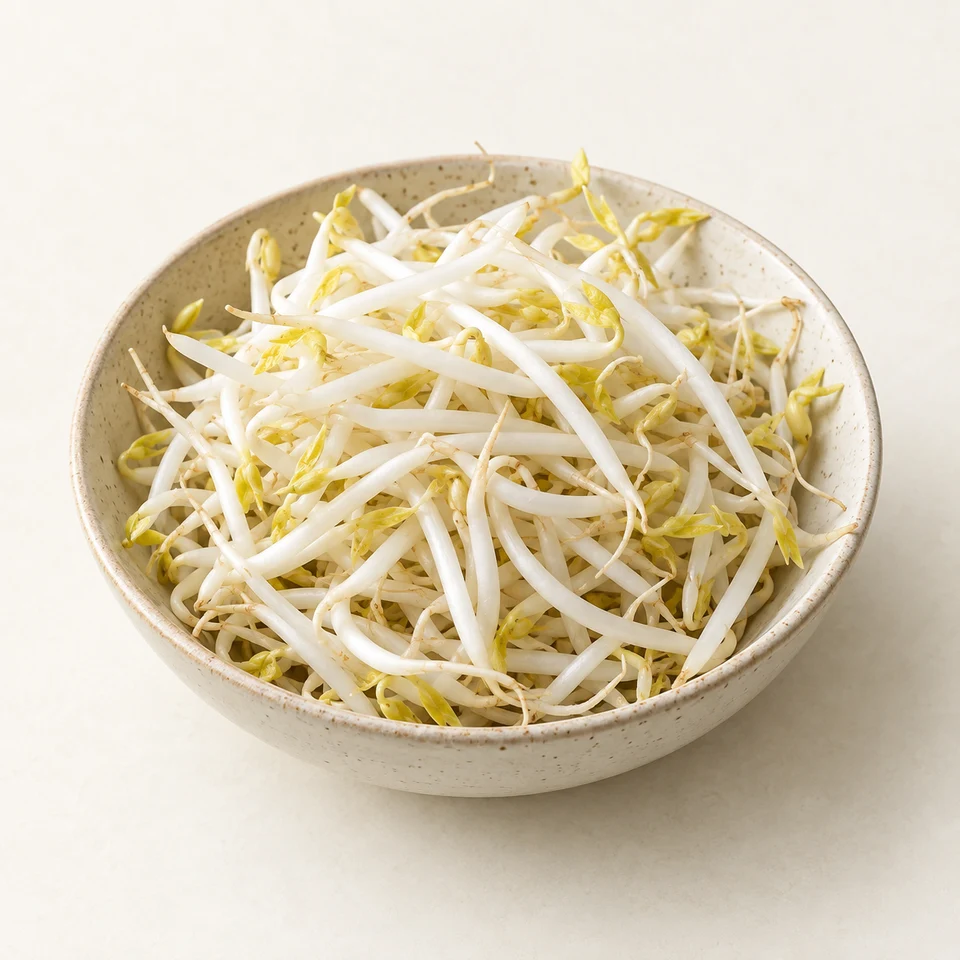
About Mung bean sprouts
Mung bean sprouts are the tender shoots produced by germinating mung beans. They are commonly eaten raw in salads and fresh rolls, or briefly cooked in stir-fries, soups, noodle dishes, and fillings. They are usually sold fresh and whole, with roots sometimes attached.
They have a crisp, juicy texture and a mild, fresh flavour. Longer cooking softens their crunch and can make them watery, while quick heating preserves more of their characteristic crispness. Products may differ according to their stage of growth.
Mung bean sprouts have a short, pale stem and a small yellow-green seed coat or pair of leaves. They may be sold trimmed or packed for convenience, or with roots attached. Raw serving preserves their crunch; brief cooking softens them, while longer cooking makes them more watery.
- Ingredient type
- whole food
FOLLOW IT TO THE PLATE
Where will you meet it?
Explore the dishes that use this ingredient and their country and cuisine connections.
Explore linked dishesON A MENU OR LABEL
Find local names and written forms to help recognise this ingredient.
See local namesWhere mung bean sprouts appears
25 linked foodsFind foods to recognise by country and type. Recipes and products vary; these are recorded ingredient connections.
Showing 25–25 of 25
Other dishes

Ingredient connections awaiting review · Coverage is still growing, including packaged snacks.
Name examples awaiting language review. Confirm the specific food or product.
Local names for mung bean sprouts
Names and romanised forms to recognise on menus and labels.
Mung bean sprouts
绿豆芽
lǜdòuyá
숙주나물
sukju-namul
Giá đỗ
绿豆芽
lǜdòuyá
緑豆もやし
ryokutō moyashi
tauge kacang hijau
tauge kacang hijau
मूंग के अंकुर
mūng ke aṅkur
মুগ অঙ্কুর
mug aṅkur
ถั่วงอก
thūa-ngɔ̂k
germes de haricot mungo
brotes de frijol mungo
Mungbohnensprossen
rebentos de feijão-mungo
maş fasulyesi filizi
ryokutō moyashi
Romanised form
sukju-namul
Romanised form
mug aṅkur
Romanised form
lǜdòuyá
Romanised form
mūng ke aṅkur
Romanised form
thūa-ngɔ̂k
Romanised form
Available names only. Languages may be spoken in other countries; a name alone does not identify every ingredient in a dish.
Name not available yet.
A name in English has not been added for mung bean sprouts. Choose another language to see its available names.
Mung bean sprouts nutrition & diet
Mung bean sprouts nutritional value
Mung beans, mature seeds, sprouted, raw
Per 100 g of the edible portion in the recorded food form.
- Calories
- 30kcal
- Protein
- 3.0g
- Carbs
- 5.9g
- Fat
- 0.2g
Per 100 g of the named reference food. Preparation, cultivar and product formulation can change these values; use the stated form when comparing.
Portions & preparation
Record whether the sprouts are raw, briefly blanched, steamed, stir-fried, or included in soup, and consider the edible sprout portion rather than discarded roots or packaging moisture. Preparation with oil, sauces, noodles, meat, or other vegetables should be represented separately.
Compare the right form: Match references to mung-bean sprouts in the same raw or cooked state, including whether roots, seed remnants, or packaged additions remain edible.
Diet considerations
Mung-bean sprouts are plant-derived germinated legumes. Compatibility changes with cooking fats, sauces, marinades, meat, seafood, egg, and cereal-based dishes. Raw sprouts and cooked preparations are distinct forms; noodles, rice, bread, or sweet sauces served alongside create different carbohydrate patterns.
AI-authored reading notes · Awaiting editorial review. Measured values, where available, have a separate source above.
Dietary compatibility
- VeganNot established
- VegetarianNot established
- PescatarianNot established
- KetoNot established
- PaleoNot established
- Low-carbNot established
- HalalNot established
- KosherNot established
What these diet assessments mean
- Vegan · Not established
- The available profile does not establish the full composition or processing for this dietary pattern.
- Vegetarian · Not established
- The available profile does not establish the full composition or processing for this dietary pattern.
- Pescatarian · Not established
- The available profile does not establish the full composition or processing for this dietary pattern.
- Keto · Not established
- A defined serving and sourced carbohydrate data are needed before assessing this dietary pattern.
- Paleo · Not established
- The ingredient form and processing have not been assessed against this dietary pattern.
- Low-carb · Not established
- A defined serving and sourced carbohydrate data are needed before assessing this dietary pattern.
- Halal · Not established
- Sourcing, processing and any applicable certification have not been verified. A food name alone does not establish halal status.
- Kosher · Not established
- Sourcing, processing and any applicable certification have not been verified. A food name alone does not establish kosher status.
For the plain ingredient · Awaiting review. Diet compatibility is not allergy suitability or halal/kosher certification. Keto and low-carb depend on the portion.
AI-generated illustration for visual context. It does not identify a particular product or establish allergen content.
Sources & review
Nutrition reference: USDA FoodData Central — Mung beans, mature seeds, sprouted, raw ↗. Values are scaled from 100 g of the recorded edible form. Individual portions have no assumed fixed weight.
Expanded overview, name examples and nutrition notes are database drafts awaiting editorial review. Numeric nutrition values, where shown, have their own source and food-form reference.
The ingredient description and dish connections come from the draft catalogue and may change after review.
Last recorded verification: .