
Odika kernel
Odika kernel is the seed of the wild mango tree, traditionally ground to thicken and flavor soups and stews in Central Africa.
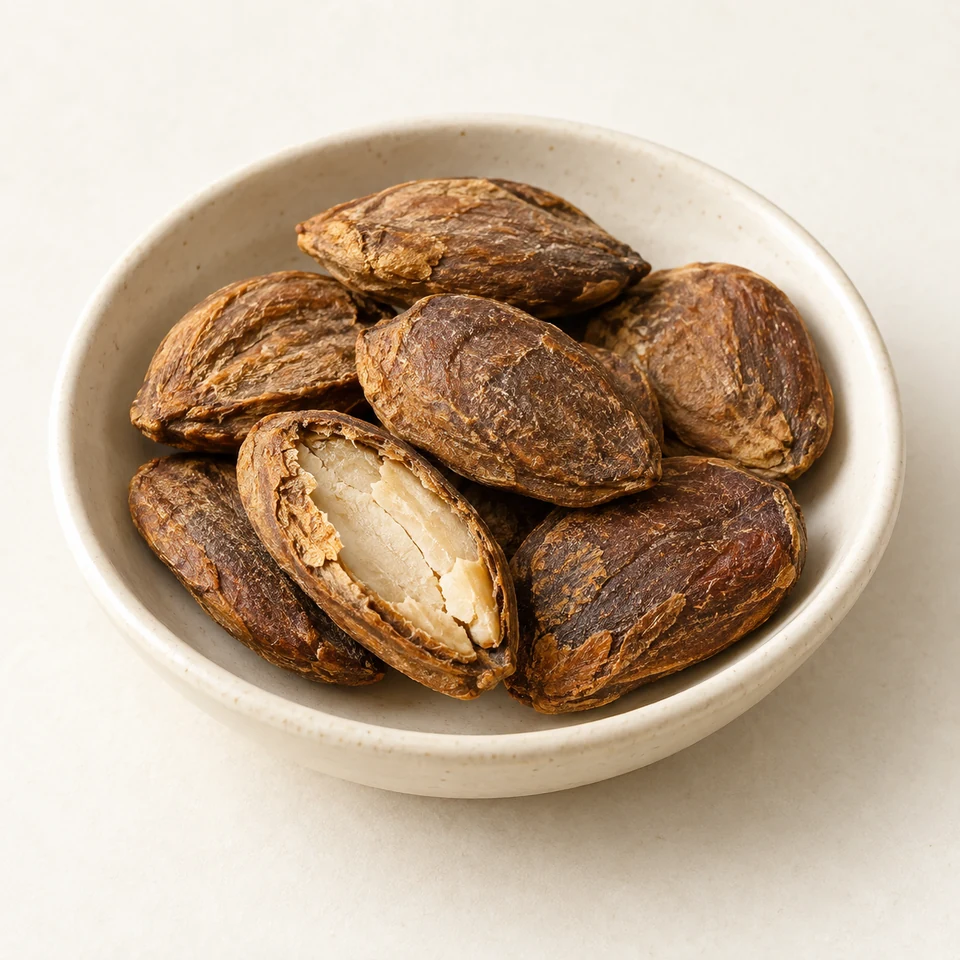
About Odika kernel
Odika kernel is the seed kernel of a fruit commonly called wild mango and is used as a regional thickening and flavouring ingredient. In Central African cooking, it is ground or pounded and added to soups and stews, where it thickens the liquid and contributes body and savoury depth.
Dried kernels are hard, with a pale to brown interior and a firm, oily texture. Once ground, they form a dense meal or paste with a pronounced nutty, earthy flavour. The available information does not establish one exact botanical species for the regional term “odika.”
Odika may be sold whole, split, dried, powdered, or as a prepared paste. Drying, grinding, and the amount incorporated change its appearance and thickening strength; a ground form disperses into the cooking liquid more readily than a whole kernel.
- Ingredient type
- whole food
FOLLOW IT TO THE PLATE
Where will you meet it?
Explore the dishes that use this ingredient and their country and cuisine connections.
Explore linked dishesON A MENU OR LABEL
Find local names and written forms to help recognise this ingredient.
See local namesWhere odika kernel appears
1 linked foodsFind foods to recognise by country and type. Recipes and products vary; these are recorded ingredient connections.
Showing 1–1 of 1
Main dishes

Ingredient connections awaiting review · Coverage is still growing, including packaged snacks.
Name examples awaiting language review. Confirm the specific food or product.
Local names for odika kernel
Names and romanised forms to recognise on menus and labels.
Odika kernel
odika kernel
Available names only. Languages may be spoken in other countries; a name alone does not identify every ingredient in a dish.
Name not available yet.
A name in English has not been added for odika kernel. Choose another language to see its available names.
Odika kernel nutrition & diet
Odika kernel nutritional value
Dikanut, kernel, dried, raw — WAFCT 06_008
Per 100 g of the edible portion in the named food form.
- Calories
- 650kcal
- Protein
- 7.6g
- Carbs
- 5.5g
- Fat
- 62.6g
Per 100 g edible portion. Source: Vincent et al., FAO/INFOODS Food Composition Table for Western Africa (2019). Carbohydrate is available carbohydrate calculated by difference; square-bracketed fat in the source uses continuous-extraction analysis. Values describe this reference form, not every recipe, cultivar or preparation.
Portions & preparation
Establish whether the ingredient is the kernel of Irvingia gabonensis or another locally named wild-mango seed, and whether it is whole, dried, roasted, or ground. Use the edible kernel portion in the prepared dish. Traditional soup use may disperse it through a thickened broth, affecting portion interpretation.
Compare the right form: Match references to the identified wild-mango kernel species and processing state—whole, dried, roasted, or ground—used as an edible soup ingredient.
Diet considerations
Odika kernel is plant-derived if the identity described is a wild-mango seed, but the local name requires confirmation. Compatibility changes when it is incorporated into stock containing meat or fish, or combined with dairy or cereal ingredients. A ground soup thickener should not be assumed interchangeable with ogbono seed without identity verification.
AI-authored reading notes · Awaiting editorial review. Measured values, where available, have a separate source above.
Dietary compatibility
- VeganNot established
- VegetarianNot established
- PescatarianNot established
- KetoNot established
- PaleoNot established
- Low-carbNot established
- HalalNot established
- KosherNot established
What these diet assessments mean
- Vegan · Not established
- The available profile does not establish the full composition or processing for this dietary pattern.
- Vegetarian · Not established
- The available profile does not establish the full composition or processing for this dietary pattern.
- Pescatarian · Not established
- The available profile does not establish the full composition or processing for this dietary pattern.
- Keto · Not established
- A defined serving and sourced carbohydrate data are needed before assessing this dietary pattern.
- Paleo · Not established
- The ingredient form and processing have not been assessed against this dietary pattern.
- Low-carb · Not established
- A defined serving and sourced carbohydrate data are needed before assessing this dietary pattern.
- Halal · Not established
- Sourcing, processing and any applicable certification have not been verified. A food name alone does not establish halal status.
- Kosher · Not established
- Sourcing, processing and any applicable certification have not been verified. A food name alone does not establish kosher status.
For the plain ingredient · Awaiting review. Diet compatibility is not allergy suitability or halal/kosher certification. Keto and low-carb depend on the portion.
AI-generated illustration for visual context. It does not identify a particular product or establish allergen content.
Sources & review
Nutrition reference: FAO/INFOODS Food Composition Table for Western Africa (2019) — 06_008 ↗. Values are scaled from 100 g of the recorded edible form. Individual portions have no assumed fixed weight.
Expanded overview, name examples and nutrition notes are database drafts awaiting editorial review. Numeric nutrition values, where shown, have their own source and food-form reference.
The ingredient description and dish connections come from the draft catalogue and may change after review.
Last recorded verification: .