
Piccalilli
piccalilli
British mustard-turmeric pickle of chopped vegetables.
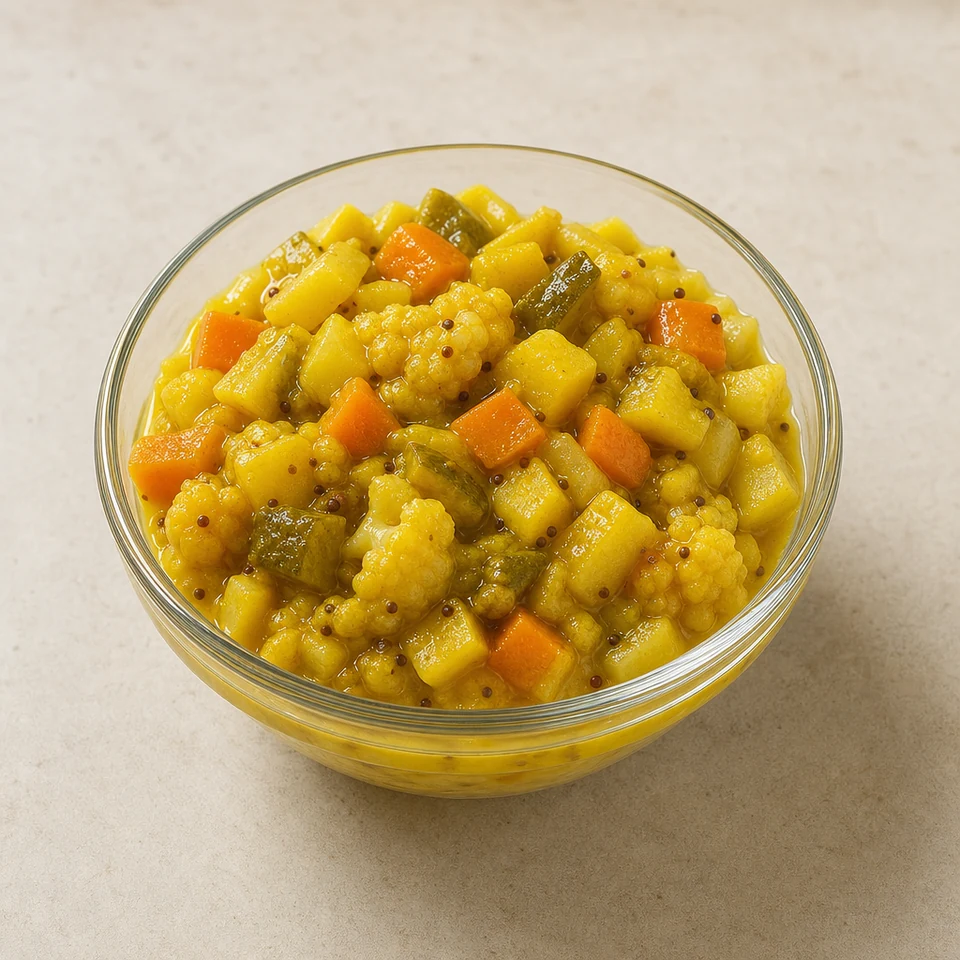
Piccalilli is a British pickle made from chopped vegetables preserved in a sharp, seasoned vinegar mixture. Mustard and turmeric are characteristic ingredients, and it is commonly served with cold meats, cheese, bread, pies, and other savoury foods. It can also be used as part of a relish selection or sandwich filling.
Its flavour is tangy, pungent, and mustardy, with turmeric lending earthy spice and a bright yellow colour. The texture is usually chunky rather than smooth, with distinct pieces of vegetables that may remain crisp or become softer depending on the recipe, pickling time, and cut size.
Piccalilli is generally sold in jars, either with a thick coating of pickle paste or with some vinegar visible around the vegetables. Common ingredients include cauliflower, onion, cucumber, beans, or other firm vegetables. It is eaten cold, usually drained or spooned directly from the jar.
FOLLOW IT TO THE PLATE
Explore the dishes that use this ingredient and their country and cuisine connections.
Explore linked dishesON A MENU OR LABEL
Find local names and written forms to help recognise this ingredient.
See local namesFind foods to recognise by country and type. Recipes and products vary; these are recorded ingredient connections.
No linked foods are available for this ingredient yet.
Name examples awaiting language review. Confirm the specific food or product.
Names and romanised forms to recognise on menus and labels.
Piccalilli
piccalilli
Available names only. Languages may be spoken in other countries; a name alone does not identify every ingredient in a dish.
A name in English has not been added for piccalilli. Choose another language to see its available names.
Reference: Piccalilli
Per 100 g of the edible portion of the stated reference food.
Reference example for the named food and preparation, per 100 g edible portion. This is not a universal value for every recipe or brand; packaged products should be compared with their own label. CoFID 2021 food code 17-702. Carbohydrate follows the dataset’s available-carbohydrate convention. Contains public sector information licensed under the Open Government Licence v3.0: https://www.nationalarchives.gov.uk/doc/open-government-licence/version/3/.
Match the specific piccalilli recipe and drained or undrained serving form. Chopped vegetables, mustard, turmeric, vinegar, sugar, salt, and thickening ingredients vary by producer and region. Assess the relish separately from cheese, meats, sandwiches, or other foods it accompanies.
Compare the right form: Match commercially jarred or homemade piccalilli, specifying vegetable mix, mustard sauce, drained status, and the edible serving portion.
Piccalilli is plant-based when its vegetables and sauce contain no animal additions, but the recipe must be checked. Compatibility changes with dairy, egg, gelatin, or other additions and with cereal-based accompaniments such as sandwiches or pastry. Sugar, salt, and thickener choices also vary by formulation.
AI-authored reading notes · Awaiting editorial review. Measured values, where available, have a separate source above.
For the plain ingredient · Awaiting review. Diet compatibility is not allergy suitability or halal/kosher certification. Keto and low-carb depend on the portion.
AI-generated illustration for visual context. It does not identify a particular product or establish allergen content.
Nutrition reference: UK Composition of Foods Integrated Dataset (CoFID), 2021 — Piccalilli ↗. Values are scaled from 100 g of the recorded edible form. Individual portions have no assumed fixed weight.
Expanded overview, name examples and nutrition notes are database drafts awaiting editorial review. Numeric nutrition values, where shown, have their own source and food-form reference.
The ingredient description and dish connections come from the draft catalogue and may change after review.
Last recorded verification: .