
Plaice
Plaice is a flatfish commonly fried, baked, grilled, or poached.
About Plaice
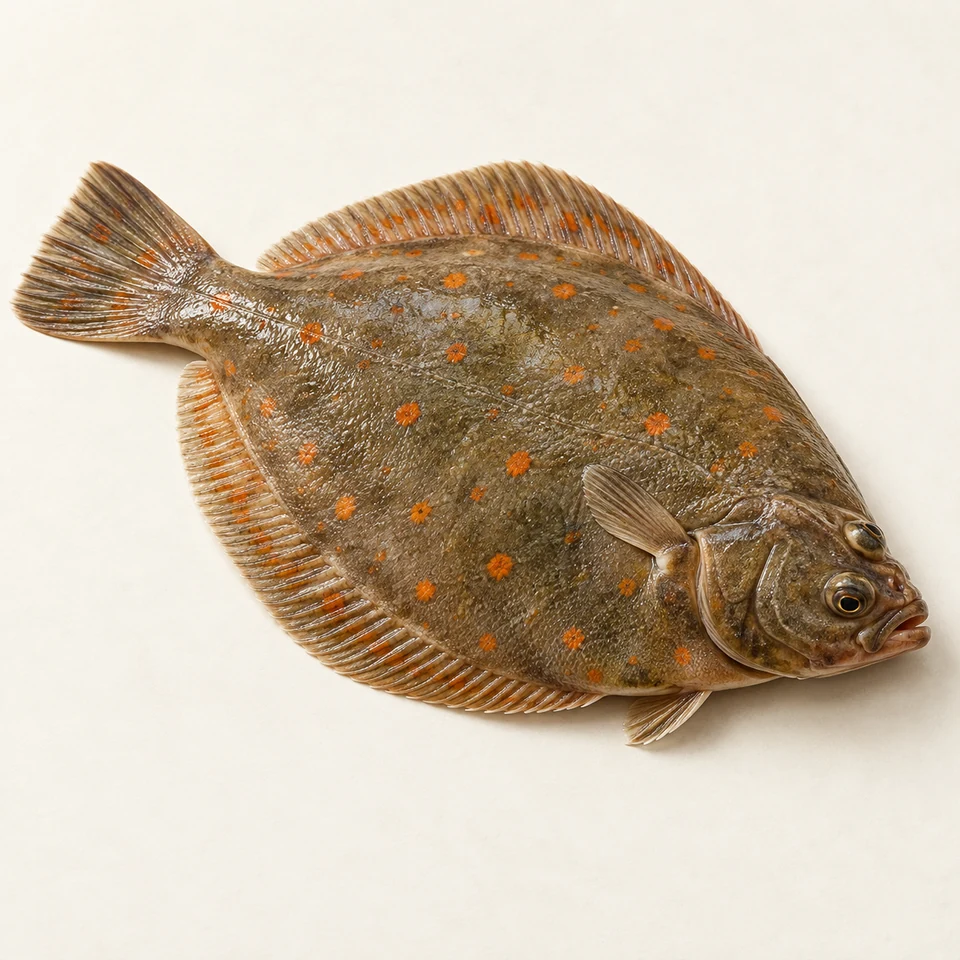
Plaice is a flat-bodied edible fish with both eyes on one side and a thin, laterally compressed body. It is commonly fried, baked, grilled, or poached, and can be used in simple fish dishes where its tender flesh cooks quickly. “Plaice” is a common market name whose exact species and regional usage may vary.
Its flesh is pale, lean, and delicate, with a mild flavour and fine flakes. Texture and appearance vary with size, freshness, whether the skin is retained, and whether the fish has been filleted. These details also affect how the fish behaves during frying, baking, grilling, or poaching.
Plaice is sold whole, cleaned, or as skin-on or skinless fillets, fresh or frozen. Cleaning and filleting remove bones and alter the shape; retaining skin changes the visible surface. Cooking firms the flesh, while battering or frying adds an exterior texture not present in the plain fish.
- Ingredient type
- whole food
FOLLOW IT TO THE PLATE
Where will you meet it?
Explore the dishes that use this ingredient and their country and cuisine connections.
Explore linked dishesON A MENU OR LABEL
Find local names and written forms to help recognise this ingredient.
See local namesWhere plaice appears
1 linked foodsFind foods to recognise by country and type. Recipes and products vary; these are recorded ingredient connections.
Showing 1–1 of 1
Main dishes

Ingredient connections awaiting review · Coverage is still growing, including packaged snacks.
Name examples awaiting language review. Confirm the specific food or product.
Local names for plaice
Names and romanised forms to recognise on menus and labels.
plaice
plie
schol
Scholle
solla
platessa
solha
rødspætte
rødspette
raudspette
rödspätta
skarkoli
stornia
европейская камбала
yevropeyskaya kambala
європейська камбала
yevropeiska kambala
punakampela
Carrelet ou plie ou plie commune, cru
Search alias · Not a confirmed translation
plaice, alaska
Search alias · Not a confirmed translation
plaice, european
Search alias · Not a confirmed translation
Plaice, flesh only, baked
Search alias · Not a confirmed translation
Plaice, flesh only, raw
Search alias · Not a confirmed translation
Plaice, flesh only, steamed
Search alias · Not a confirmed translation
Plaice, flesh only, steamed, fillets weighed with bones and skin
Search alias · Not a confirmed translation
Plaice, in batter, fried in blended oil
Search alias · Not a confirmed translation
Plaice, in batter, fried in retail blend oil
Search alias · Not a confirmed translation
Plaice, in batter, fried in sunflower oil
Search alias · Not a confirmed translation
Plaice, in breadcrumbs, baked
Search alias · Not a confirmed translation
yevropeiska kambala
Romanised form
yevropeyskaya kambala
Romanised form
Available names only. Languages may be spoken in other countries; a name alone does not identify every ingredient in a dish.
Name not available yet.
A name in English has not been added for plaice. Choose another language to see its available names.
Plaice nutrition & diet
Plaice nutritional value
Plaice, flesh only, raw
Per 100 g of the edible portion in the stated food form.
- Calories
- 76kcal
- Protein
- 16.4g
- Carbs
- 0.0g
- Fat
- 1.2g
Reference values apply to the named food form, not every preparation, variety or brand. CoFID 2021 food code 16-381. Carbohydrate follows the dataset’s available-carbohydrate convention. Contains public sector information licensed under the Open Government Licence v3.0: https://www.nationalarchives.gov.uk/doc/open-government-licence/version/3/.
Portions & preparation
Use the edible flesh portion and specify whether skin, bones, and any breading are included. Cooking method matters: poaching, baking, grilling, and frying introduce different accompanying ingredients. Reference data should distinguish plain plaice from fillets coated in flour, crumbs, batter, butter, or sauce.
Compare the right form: Reference data must match the plaice species or marketed fish, edible flesh, and preparation, including whether skin, bones, breading, batter, or sauce remains.
Diet considerations
Plaice is animal-derived fish. Plain fillets differ from versions prepared with butter, dairy sauces, egg wash, flour, breadcrumbs, or shared-fryer coatings. Breading and batter introduce cereal ingredients and alter the portion-dependent carbohydrate pattern; marinades and accompaniments may also change compatibility. Species and product labeling matter.
AI-authored reading notes · Awaiting editorial review. Measured values, where available, have a separate source above.
Dietary compatibility
- VeganTypically incompatible
- VegetarianTypically incompatible
- PescatarianTypically compatible
- KetoMay be compatible
- PaleoMay be compatible
- Low-carbMay be compatible
- HalalNot established
- KosherNot established
What these diet assessments mean
- Vegan · Typically incompatible
- The ingredient profile identifies an animal-derived food or derivative.
- Vegetarian · Typically incompatible
- The profile identifies animal flesh, seafood or a derivative excluded by a vegetarian diet.
- Pescatarian · Typically compatible
- Seafood fits this pescatarian definition. Added meat-based stock or other ingredients would need checking separately.
- Keto · May be compatible
- The plain form may fit a carbohydrate-restricted diet. Check the portion, added sugar, coatings and sauces against the nutrition values above.
- Paleo · May be compatible
- May fit a paleo pattern, depending on the cut or form, processing and added ingredients.
- Low-carb · May be compatible
- The plain form may fit a carbohydrate-restricted diet. Check the portion, added sugar, coatings and sauces against the nutrition values above.
- Halal · Not established
- Sourcing, processing and any applicable certification have not been verified. A food name alone does not establish halal status.
- Kosher · Not established
- Sourcing, processing and any applicable certification have not been verified. A food name alone does not establish kosher status.
For the plain ingredient · Awaiting review. Diet compatibility is not allergy suitability or halal/kosher certification. Keto and low-carb depend on the portion.
AI-generated illustration for visual context. It does not identify a particular product or establish allergen content.
Sources & review
Nutrition reference: UK Composition of Foods Integrated Dataset (CoFID), 2021 — Plaice, flesh only, raw ↗. Values are scaled from 100 g of the recorded edible form. Individual portions have no assumed fixed weight.
Expanded overview, name examples and nutrition notes are database drafts awaiting editorial review. Numeric nutrition values, where shown, have their own source and food-form reference.
The ingredient description and dish connections come from the draft catalogue and may change after review.
Last recorded verification: .