
Pork Pigtail
Pork pigtail is the tail of a pig, commonly salted, smoked, braised, or added to stews and beans.
About Pork Pigtail
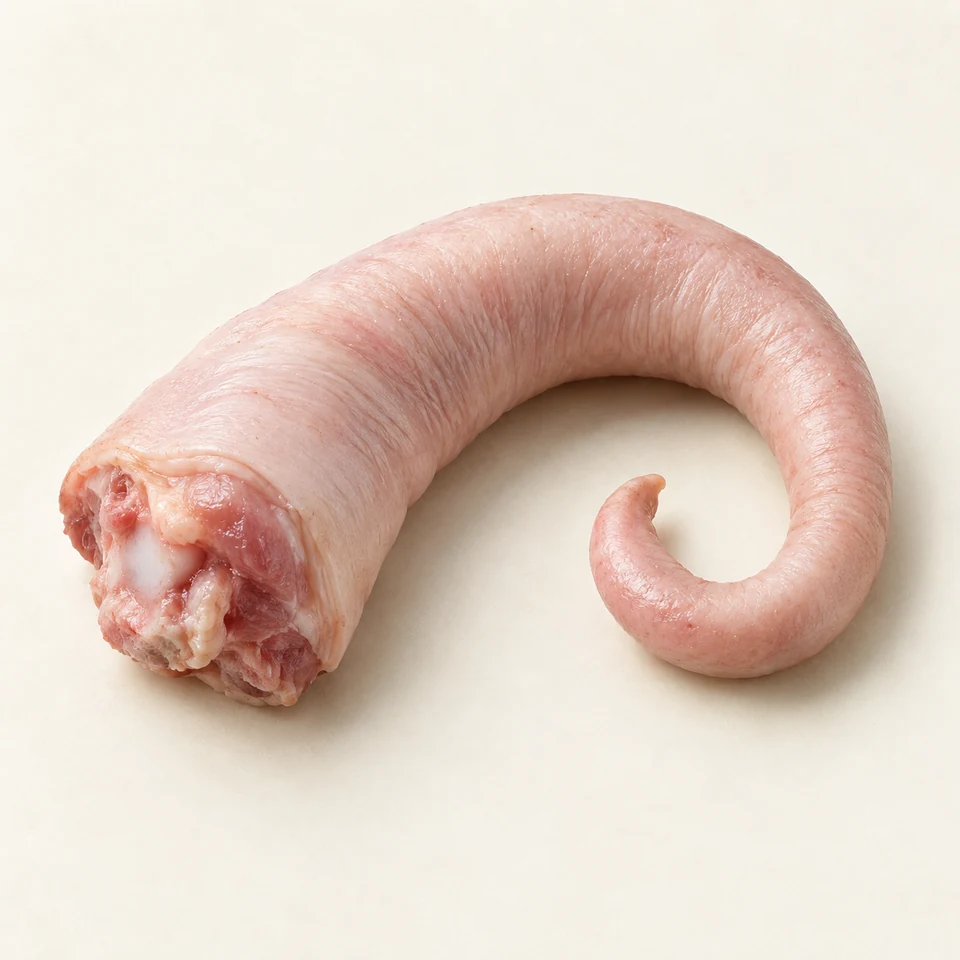
Pork pigtail is the complete or substantially complete tail of a pig, including skin, fat, connective tissue, and small bones. It is commonly simmered with beans, greens, soups, or stews, and may be braised after salting or smoking. The piece is used as a flavourful, slow-cooked pork ingredient rather than a conventional muscle cut.
The tail has a savoury pork flavour, with rendered fat contributing richness. Slow cooking softens the skin and connective tissue, while salted or smoked versions add their corresponding seasoning. Because it contains small bones and varying attached tissue, its cooked texture is not uniform throughout.
Pork pigtail is narrow, jointed, and irregularly curved. It may be sold fresh, salted, or smoked, and presented whole, jointed, or cut into shorter sections. Salting, smoking, braising, and simmering change its colour, seasoning, surface, and tenderness, while the amount of skin, fat, and bone retained varies by market.
- Ingredient type
- whole food
FOLLOW IT TO THE PLATE
Where will you meet it?
Explore the dishes that use this ingredient and their country and cuisine connections.
Explore linked dishesON A MENU OR LABEL
Find local names and written forms to help recognise this ingredient.
See local namesWhere pork pigtail appears
1 linked foodsFind foods to recognise by country and type. Recipes and products vary; these are recorded ingredient connections.
Showing 1–1 of 1
Soups
Ingredient connections awaiting review · Coverage is still growing, including packaged snacks.
Name examples awaiting language review. Confirm the specific food or product.
Local names for pork pigtail
Names and romanised forms to recognise on menus and labels.
pork pigtail
queue de porc
rabo de cerdo
rabo de porco
Schweineschwanz
coda di maiale
varkensstaart
cua de porc
coadă de porc
domuz kuyruğu
猪尾巴
zhū wěiba
豚の尾
buta no o
돼지꼬리
dwaeji-kkori
ekor babi
ekor babi
ذيل الخنزير
dhayl al-khinzīr
buta no o
Romanised form
dhayl al-khinzīr
Romanised form
dwaeji-kkori
Romanised form
zhū wěiba
Romanised form
Available names only. Languages may be spoken in other countries; a name alone does not identify every ingredient in a dish.
Name not available yet.
A name in English has not been added for pork pigtail. Choose another language to see its available names.
Pork Pigtail nutrition & diet
Pork Pigtail nutritional value
Pork, fresh, variety meats and by-products, tail, raw
Per 100 g of the edible portion in the recorded food form.
- Calories
- 378kcal
- Protein
- 17.8g
- Carbs
- 0.0g
- Fat
- 33.5g
Reference values for the specific food form shown. Other varieties, brands and preparations can differ.
Portions & preparation
Specify whether the tail is fresh, salted, smoked, or otherwise preserved, and whether skin, bone, and attached fat are included. Braising and stewing produce a different edible portion from crisp or fried preparation. Record soaking, trimming, and the surrounding dish because beans, sauces, and vegetables are separate components.
Compare the right form: Match references to pig tail with the same fresh or preserved state, cooked method, and inclusion of skin, bone, and attached fat.
Diet considerations
This is animal-derived pig tail, including skin, connective tissue, fat, and bone according to preparation. Salted or smoked versions differ from fresh braised forms. Stews may contain beans, grains, starches, or sweet sauces, which change compatibility and carbohydrate patterns; evaluate the complete recipe rather than the tail alone.
AI-authored reading notes · Awaiting editorial review. Measured values, where available, have a separate source above.
Dietary compatibility
- VeganTypically incompatible
- VegetarianTypically incompatible
- PescatarianTypically incompatible
- KetoMay be compatible
- PaleoMay be compatible
- Low-carbMay be compatible
- HalalTypically incompatible
- KosherTypically incompatible
What these diet assessments mean
- Vegan · Typically incompatible
- The ingredient profile identifies an animal-derived food or derivative.
- Vegetarian · Typically incompatible
- The profile identifies animal flesh, seafood or a derivative excluded by a vegetarian diet.
- Pescatarian · Typically incompatible
- The profile identifies land-animal meat or a derivative, which is excluded by this pescatarian definition.
- Keto · May be compatible
- The plain form may fit a carbohydrate-restricted diet. Check the portion, added sugar, coatings and sauces against the nutrition values above.
- Paleo · May be compatible
- May fit a paleo pattern, depending on the cut or form, processing and added ingredients.
- Low-carb · May be compatible
- The plain form may fit a carbohydrate-restricted diet. Check the portion, added sugar, coatings and sauces against the nutrition values above.
- Halal · Typically incompatible
- This profile identifies pork or a pork-derived ingredient.
- Kosher · Typically incompatible
- This profile identifies pork or a pork-derived ingredient.
For the plain ingredient · Awaiting review. Diet compatibility is not allergy suitability or halal/kosher certification. Keto and low-carb depend on the portion.
AI-generated illustration for visual context. It does not identify a particular product or establish allergen content.
Sources & review
Nutrition reference: USDA FoodData Central — Pork, fresh, variety meats and by-products, tail, raw ↗. Values are scaled from 100 g of the recorded edible form. Individual portions have no assumed fixed weight.
Expanded overview, name examples and nutrition notes are database drafts awaiting editorial review. Numeric nutrition values, where shown, have their own source and food-form reference.
The ingredient description and dish connections come from the draft catalogue and may change after review.
Last recorded verification: .