
Shirataki Noodles
Shirataki noodles are translucent, low-calorie noodles commonly served in soups, stir-fries, and noodle dishes.
About Shirataki Noodles
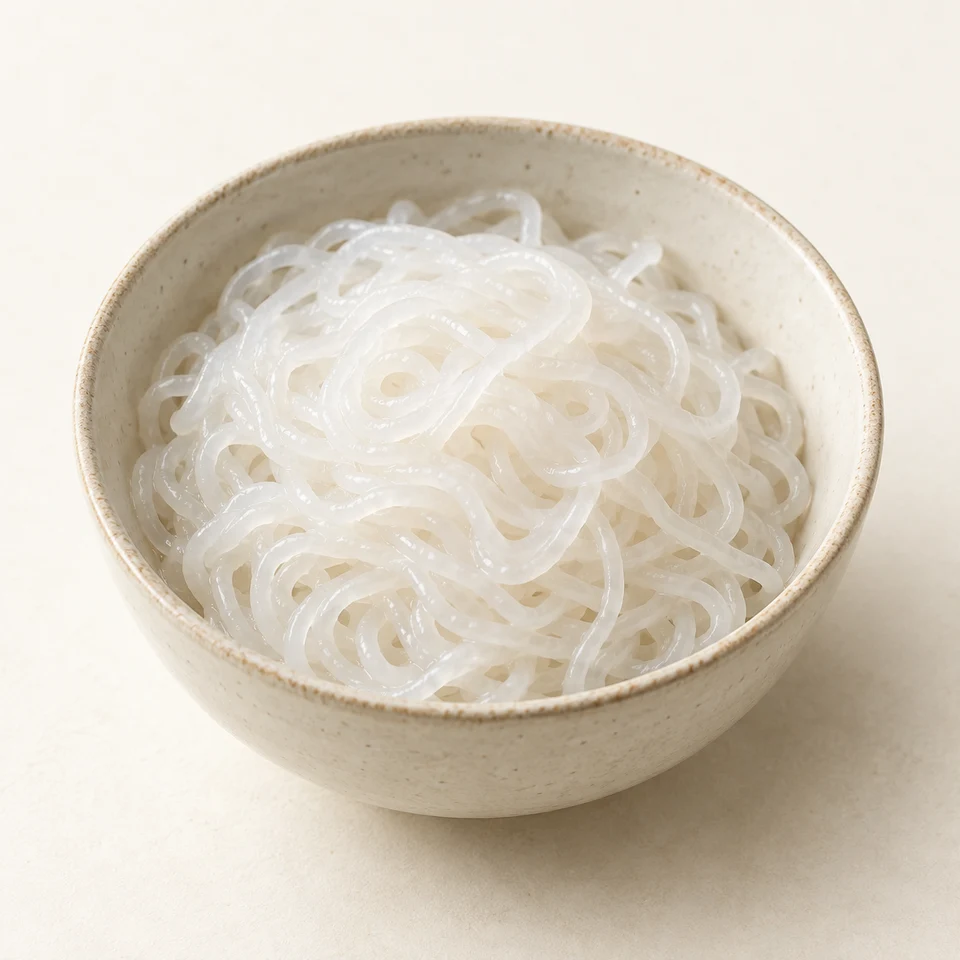
Shirataki noodles are translucent noodles made from konjac-based dough, shaped into strands, ribbons, or other noodle-like forms. They are commonly rinsed and heated in soups, stir-fries, hot-pot dishes, simmered preparations, and noodle dishes, where they absorb surrounding sauces and broths.
They have little inherent flavor and a slippery, springy, gelatinous texture. Thickness, cut, firmness, and the proportion of other ingredients vary by product, so texture is not completely uniform. Packaged noodles may also have a distinctive odor before preparation.
They are most often sold hydrated in water-filled packages, though dried or blended versions also exist. Rinsing, blanching, or dry-frying can reduce the packaged odor; heating softens and seasons them, while dry-frying can make the surface less wet and alter firmness.
- Ingredient type
- whole food
FOLLOW IT TO THE PLATE
Where will you meet it?
Explore the dishes that use this ingredient and their country and cuisine connections.
Explore linked dishesON A MENU OR LABEL
Find local names and written forms to help recognise this ingredient.
See local namesWhere shirataki noodles appears
1 linked foodsFind foods to recognise by country and type. Recipes and products vary; these are recorded ingredient connections.
Showing 1–1 of 1
Main dishes
Ingredient connections awaiting review · Coverage is still growing, including packaged snacks.
Name examples awaiting language review. Confirm the specific food or product.
Local names for shirataki noodles
Names and romanised forms to recognise on menus and labels.
しらたき
Shirataki
蒟蒻麺
Jǔruò miàn
곤약면
Gonyangmyeon
Shirataki Noodles
shirataki noodles
nouilles shirataki
Shirataki-Nudeln
fideos shirataki
noodles shirataki
macarrão shirataki
shirataki-noedels
лапша ширатаки
lapsha shirataki
makaron shirataki
shirataki eriştesi
mì shirataki
mi shirataki
mi shirataki
เส้นชิราตากิ
sen chí-rā-tā-ki
Shirataki
Romanised form
shirataki noodle
Search alias · Not a confirmed translation
Gonyangmyeon
Romanised form
Jǔruò miàn
Romanised form
lapsha shirataki
Romanised form
sen chí-rā-tā-ki
Romanised form
Available names only. Languages may be spoken in other countries; a name alone does not identify every ingredient in a dish.
Name not available yet.
A name in English has not been added for shirataki noodles. Choose another language to see its available names.
Shirataki Noodles nutrition & diet
Shirataki Noodles nutritional value
Konjac, noodles — MEXT 02005
Per 100 g of the edible portion in the explicitly named reference form.
- Calories
- 7kcal
- Protein
- 0.2g
- Carbs
- 3.0g
- Fat
- Trace
Trace: the source reports a very small amount per 100 g, not zero. No exact quantity is available to calculate for a different portion.
Per 100 g edible portion. Values use MEXT 2023 with March 2026 corrections; the English food name is matched by food code from the official English edition. Carbohydrate is total carbohydrate by difference. Values in parentheses in the source are estimates reported by MEXT. This reference does not cover other preparations or brands.
Portions & preparation
Establish whether these are plain shirataki strands, blocks, rice-shaped pieces, or a blended noodle, and record them as packaged or rinsed and cooked. Liquid, seasoning, and added starch vary. Reference the edible noodle portion separately from the broth, sauce, oil, vegetables, or protein served with it.
Compare the right form: Match plain konjac-based noodles by shape and drained preparation; verify whether the product includes starch, tofu, or other blend components.
Diet considerations
Shirataki commonly refers to a konjac-based noodle, but product identity and blend ingredients must be confirmed. Plain versions are not cereal noodles; added rice, starch, wheat, egg, dairy, or animal-based seasonings change compatibility. The finished dish may also acquire a different carbohydrate pattern from sauces, coatings, or accompanying grains.
AI-authored reading notes · Awaiting editorial review. Measured values, where available, have a separate source above.
Dietary compatibility
- VeganNot established
- VegetarianNot established
- PescatarianNot established
- KetoNot established
- PaleoNot established
- Low-carbNot established
- HalalNot established
- KosherNot established
What these diet assessments mean
- Vegan · Not established
- The available profile does not establish the full composition or processing for this dietary pattern.
- Vegetarian · Not established
- The available profile does not establish the full composition or processing for this dietary pattern.
- Pescatarian · Not established
- The available profile does not establish the full composition or processing for this dietary pattern.
- Keto · Not established
- A defined serving and sourced carbohydrate data are needed before assessing this dietary pattern.
- Paleo · Not established
- The ingredient form and processing have not been assessed against this dietary pattern.
- Low-carb · Not established
- A defined serving and sourced carbohydrate data are needed before assessing this dietary pattern.
- Halal · Not established
- Sourcing, processing and any applicable certification have not been verified. A food name alone does not establish halal status.
- Kosher · Not established
- Sourcing, processing and any applicable certification have not been verified. A food name alone does not establish kosher status.
For the plain ingredient · Awaiting review. Diet compatibility is not allergy suitability or halal/kosher certification. Keto and low-carb depend on the portion.
AI-generated illustration for visual context. It does not identify a particular product or establish allergen content.
Sources & review
Nutrition reference: MEXT Standard Tables of Food Composition in Japan, 2023 supplement, corrected March 2026 ↗. Values are scaled from 100 g of the recorded edible form. Individual portions have no assumed fixed weight.
Expanded overview, name examples and nutrition notes are database drafts awaiting editorial review. Numeric nutrition values, where shown, have their own source and food-form reference.
The ingredient description and dish connections come from the draft catalogue and may change after review.
Last recorded verification: .