
skim milk powder
Skim Milk Powder
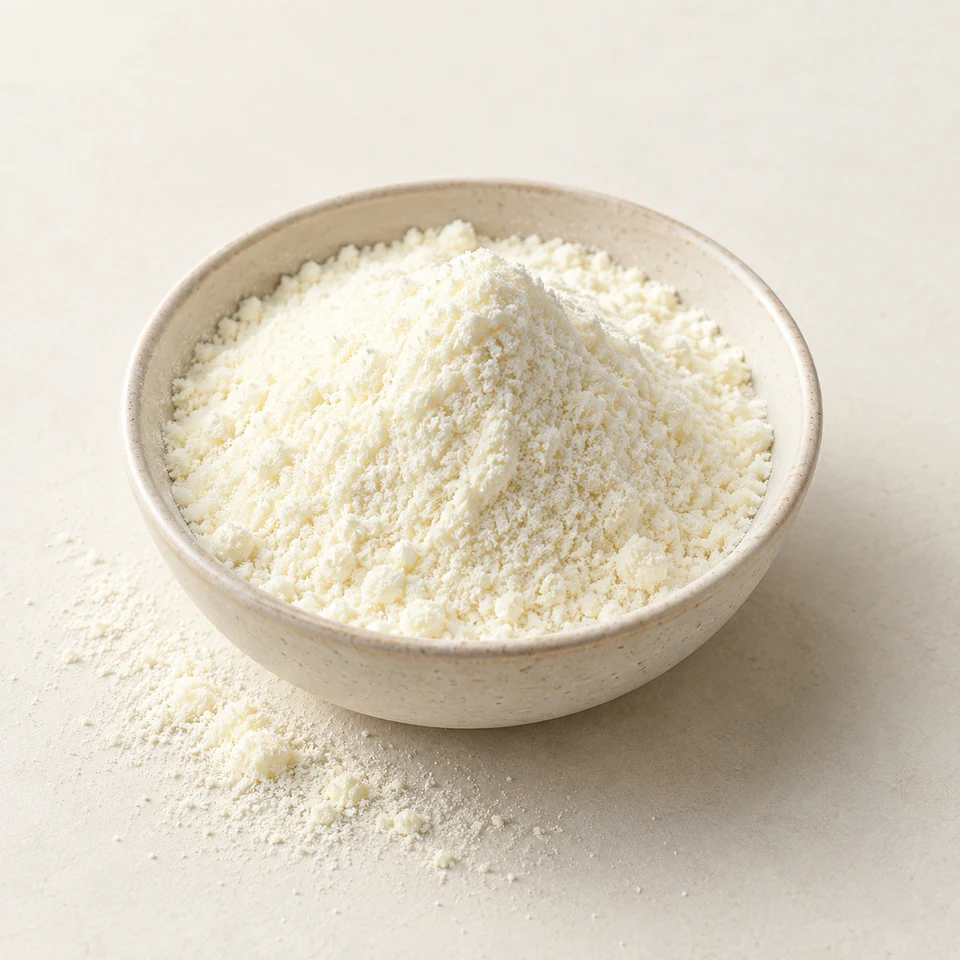
Dried skim milk powder.
About Skim Milk Powder
Skim milk powder is milk from which most milk fat has been removed and which has then been dehydrated into a dry powder. It is used directly in baking, confectionery, beverages, sauces, cultured dairy products, and processed foods, or reconstituted with water.
The powder is usually off-white to cream-coloured, fine, and free-flowing when dry. Its flavour is milky and lightly sweet, with cooked or caramel-like notes that can become more noticeable during drying or storage. Reconstituted powder is smoother and more fluid than the dry product.
It may be sold in bags, tubs, or other packaged dry forms, including instantised products. Particle size, heat treatment, instantisation, and residual moisture affect dispersibility and flavour. Adding water changes it from a loose powder into a pourable milk-like preparation.
- Ingredient type
- powder
- Form
- powder
FOLLOW IT TO THE PLATE
Where will you meet it?
Explore the dishes that use this ingredient and their country and cuisine connections.
Explore linked dishesON A MENU OR LABEL
Find local names and written forms to help recognise this ingredient.
See local namesWhere skim milk powder appears
0 linked foodsFind foods to recognise by country and type. Recipes and products vary; these are recorded ingredient connections.
Food connections are still being added.
No linked foods are available for this ingredient yet.
Name examples awaiting language review. Confirm the specific food or product.
Local names for skim milk powder
Names and romanised forms to recognise on menus and labels.
lait écrémé en poudre
Magermilchpulver
rasvaton maitojauhe
skummjölkspulver
skummetmælkspulver
skummetmelkpulver
magere melkpoeder
undanrennuduft
leche desnatada en polvo
leite em pó desnatado
latte scremato in polvere
llet desnatada en pols
odtłuszczone mleko w proszku
sušené odstředěné mléko
sušené odtučnené mlieko
sovány tejpor
lapte praf degresat
обезмаслено мляко на прах
obezmasleno mlyako na prakh
сухое обезжиренное молоко
sukhoe obezzhirennoe moloko
сухе знежирене молоко
sukhe znezhyrene moloko
αποβουτυρωμένο γάλα σε σκόνη
apovoutyroméno gála se skóni
yağsız süt tozu
مسحوق الحليب منزوع الدسم
masḥūq al-ḥalīb manzūʿ al-dasam
پودر شیر بدون چربی
pودر shir bedun-e charbi
脱脂奶粉
tuōzhī nǎifěn
脱脂粉乳
dasshi funyū
탈지분유
talji bunyu
स्किम्ड मिल्क पाउडर
skimḍ milk pāuḍar
স্কিমড মিল্ক পাউডার
skimḍ milk pāuḍār
கொழுப்பு நீக்கிய பால் பவுடர்
koḻuppu nīkiya pāl pavṭar
కొవ్వు తీసిన పాల పొడి
kovvu tīsina pāla poḍi
കൊഴുപ്പ് നീക്കിയ പാൽപ്പൊടി
koḻupp nīkkiya pālppoṭi
સ્કિમ્ડ મિલ્ક પાઉડર
skimḍ milk pāuḍar
स्किम्ड मिल्क पावडर
skimḍ milk pāvaḍar
سکمڈ ملک پاؤڈر
skimḍ milk pāʾuḍar
susu bubuk skim
susu tepung skim
sữa bột tách béo
นมผงขาดมันเนย
nom phong khat man nuei
apovoutyroméno gála se skóni
Romanised form
dasshi funyū
Romanised form
Lait en poudre, demi-écrémé
Search alias · Not a confirmed translation
Lait en poudre, écrémé
Search alias · Not a confirmed translation
Skimmed Milk Powder
Search alias · Not a confirmed translation
koḻuppu nīkiya pāl pavṭar
Romanised form
masḥūq al-ḥalīb manzūʿ al-dasam
Romanised form
sukhe znezhyrene moloko
Romanised form
talji bunyu
Romanised form
skimḍ milk pāuḍār
Romanised form
tuōzhī nǎifěn
Romanised form
skimḍ milk pāuḍar
Romanised form
koḻupp nīkkiya pālppoṭi
Romanised form
skimḍ milk pāʾuḍar
Romanised form
sukhoe obezzhirennoe moloko
Romanised form
obezmasleno mlyako na prakh
Romanised form
pودر shir bedun-e charbi
Romanised form
skimḍ milk pāuḍar
Romanised form
skimḍ milk pāvaḍar
Romanised form
nom phong khat man nuei
Romanised form
kovvu tīsina pāla poḍi
Romanised form
Available names only. Languages may be spoken in other countries; a name alone does not identify every ingredient in a dish.
Name not available yet.
A name in English has not been added for skim milk powder. Choose another language to see its available names.
Skim Milk Powder nutrition & diet
Skim Milk Powder nutritional value
Milk, cow, powder, skim
Per 100 g of the edible portion in the stated food form.
- Calories
- 363kcal
- Protein
- 34.9g
- Carbs
- 56.0g
- Fat
- 0.8g
Reference values apply to the named food form, not every preparation, variety or brand. © Food Standards Australia New Zealand. AFCD Release 3, food F005652. Available carbohydrate excludes sugar alcohols; energy converted from kJ to kcal (÷4.184). Australian data may not be appropriate for use in other countries. There are limitations associated with food composition databases. Food composition data used in the database or databases may represent an average of the nutrient content of a particular sample of foods and ingredients, determined at a particular time. The nutrient composition of foods and ingredients can vary substantially between batches and brands because of a number of factors, including changes in season, processing practices and ingredient source, and methods of calculation. Data licensed under the FSANZ Data User Licence Agreement, based on CC BY-SA 3.0 AU: https://www.foodstandards.gov.au/science-data/monitoringnutrients/afcd/datauserlicenceagreement.
Portions & preparation
Reference dry skim-milk powder before reconstitution and state the intended dilution when comparing a prepared drink. Powder used in baking, sauces, or confectionery should be assessed with the complete recipe, because added sugar, flour, fat, and portion size can define the final product.
Compare the right form: Use plain dry skim-milk powder made from cow’s milk, distinguishing it from instant, fortified, flavored, infant, or blended dairy powders and from reconstituted milk.
Diet considerations
Skim-milk powder is animal-derived dairy from cow’s milk. Compatibility changes with added lactose, sugar, cereal ingredients, cocoa, fats, or non-dairy components in commercial blends. Reconstituted milk, dry powder used as a concentrated ingredient, and baked or sweetened applications create different carbohydrate patterns and require recipe-specific interpretation.
AI-authored reading notes · Awaiting editorial review. Measured values, where available, have a separate source above.
Dietary compatibility
- VeganTypically incompatible
- VegetarianTypically compatible
- PescatarianTypically compatible
- KetoDepends on the version
- PaleoTypically incompatible
- Low-carbDepends on the version
- HalalNot established
- KosherNot established
What these diet assessments mean
- Vegan · Typically incompatible
- The ingredient profile identifies an animal-derived food or derivative.
- Vegetarian · Typically compatible
- Permitted by the lacto-ovo vegetarian pattern used here, in its plain form.
- Pescatarian · Typically compatible
- Permitted by the pescatarian pattern used here, in its plain form.
- Keto · Depends on the version
- Compatibility depends on the portion and preparation. A sourced carbohydrate amount for a defined serving is not available.
- Paleo · Typically incompatible
- This profile falls outside the conventional paleo pattern used here (grains and pseudograins, legumes, dairy or refined sugar).
- Low-carb · Depends on the version
- Compatibility depends on the portion and preparation. A sourced carbohydrate amount for a defined serving is not available.
- Halal · Not established
- Sourcing, processing and any applicable certification have not been verified. A food name alone does not establish halal status.
- Kosher · Not established
- Sourcing, processing and any applicable certification have not been verified. A food name alone does not establish kosher status.
For the plain ingredient · Awaiting review. Diet compatibility is not allergy suitability or halal/kosher certification. Keto and low-carb depend on the portion.
AI-generated illustration for visual context. It does not identify a particular product or establish allergen content.
Sources & review
Nutrition reference: Australian Food Composition Database, Release 3, 2025 — Milk, cow, powder, skim ↗. Values are scaled from 100 g of the recorded edible form. Individual portions have no assumed fixed weight.
Expanded overview, name examples and nutrition notes are database drafts awaiting editorial review. Numeric nutrition values, where shown, have their own source and food-form reference.
The ingredient description and dish connections come from the draft catalogue and may change after review.
Last recorded verification: .