
Split Mung Bean
Split mung beans are hulled, split mung legumes commonly used in dals, porridges, and soups.
About Split Mung Bean
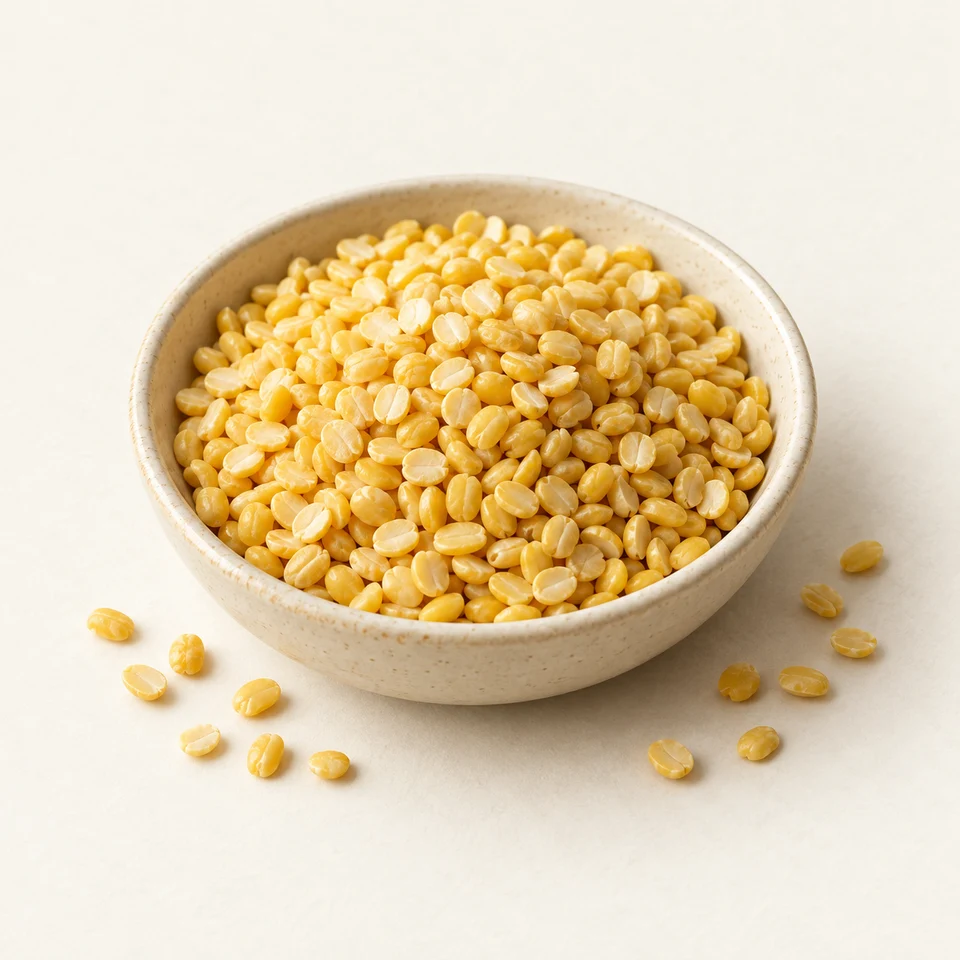
Split mung beans are mung beans with their seed coats removed and the kernels divided into pieces. They are a small dry pulse used in dals, soups, stews, porridges, savoury fillings, and legume-based batters. Their quick-cooking character makes them useful when a recipe calls for a tender pulse that can readily break down.
The dry pieces are usually pale yellow to yellow. Their flavour is mild, lightly sweet, and gently earthy. Boiling produces a tender, soft texture that can remain partly distinct or become creamy with longer cooking and stirring. Soaking shortens cooking and promotes more even hydration.
They are sold mainly as dry hulled, split pieces, with variations in polishing and split size. Boiling hydrates and softens them; grinding produces flour, batter, or paste. In cooked dishes they may be left chunky, mashed, or blended smooth, depending on the desired consistency.
- Ingredient type
- whole food
FOLLOW IT TO THE PLATE
Where will you meet it?
Explore the dishes that use this ingredient and their country and cuisine connections.
Explore linked dishesON A MENU OR LABEL
Find local names and written forms to help recognise this ingredient.
See local namesWhere split mung bean appears
1 linked foodsFind foods to recognise by country and type. Recipes and products vary; these are recorded ingredient connections.
Showing 1–1 of 1
Main dishes
Ingredient connections awaiting review · Coverage is still growing, including packaged snacks.
Name examples awaiting language review. Confirm the specific food or product.
Local names for split mung bean
Names and romanised forms to recognise on menus and labels.
Split mung bean
Moong dal
मूंग दाल
Moong daal
مونگ کی دال
Mūng kī dāl
मुगाची डाळ
Mugācī ḍāḷ
મગની દાળ
Maganī dāḷ
মুগ ডাল
Mug ḍāl
பாசிப்பருப்பு
Pāc̱ipparuppu
ಹೆಸರು ಬೇಳೆ
Hesaru beḷe
పెసర పప్పు
Pesara pappu
ചെറുപയർ പരിപ്പ്
Cerupayar parippu
मुगको दाल
Mugko dāl
මුං පරිප්පු
Muṅ parippu
Mugko dāl
Romanised form
Hesaru beḷe
Romanised form
Pāc̱ipparuppu
Romanised form
Mug ḍāl
Romanised form
Muṅ parippu
Romanised form
Cerupayar parippu
Romanised form
Mūng kī dāl
Romanised form
Maganī dāḷ
Romanised form
Mugācī ḍāḷ
Romanised form
Pesara pappu
Romanised form
Available names only. Languages may be spoken in other countries; a name alone does not identify every ingredient in a dish.
Name not available yet.
A name in English has not been added for split mung bean. Choose another language to see its available names.
Split Mung Bean nutrition & diet
Split Mung Bean nutritional value
Beans, mung, dahl, dried, raw
Per 100 g of the edible portion in the stated food form.
- Calories
- 291kcal
- Protein
- 26.8g
- Carbs
- 46.3g
- Fat
- 1.1g
Reference values apply to the named food form, not every preparation, variety or brand. CoFID 2021 food code 13-098. Carbohydrate follows the dataset’s available-carbohydrate convention. Contains public sector information licensed under the Open Government Licence v3.0: https://www.nationalarchives.gov.uk/doc/open-government-licence/version/3/.
Portions & preparation
Use the dry, hulled, split mung bean after sorting and rinsing. Soaking is optional in many preparations but can alter cooking time and texture; simmer until tender. Keep plain cooked beans distinct from dal, porridge, sprouts, fried batters, and recipes with oil, salt, or dairy.
Compare the right form: Match references to dry hulled split mung beans or cooked split mung beans, stating soaking, cooking method, retained liquid, and recipe additions.
Diet considerations
This is a plant-origin legume. Plain split mung bean can fit vegetarian and vegan patterns, but prepared dishes may contain ghee, butter, dairy, meat stock, or animal toppings. Ground, fermented, or fried forms differ from boiled beans, and carbohydrate patterns depend on portion and cereal accompaniments.
AI-authored reading notes · Awaiting editorial review. Measured values, where available, have a separate source above.
Dietary compatibility
- VeganTypically compatible
- VegetarianTypically compatible
- PescatarianTypically compatible
- KetoDepends on the version
- PaleoTypically incompatible
- Low-carbDepends on the version
- HalalNot established
- KosherNot established
What these diet assessments mean
- Vegan · Typically compatible
- The plain ingredient profile is plant, fungal or mineral based. Added ingredients in a prepared product need a separate check.
- Vegetarian · Typically compatible
- The plain ingredient profile is plant, fungal or mineral based. Added ingredients in a prepared product need a separate check.
- Pescatarian · Typically compatible
- The plain ingredient profile is plant, fungal or mineral based. Added ingredients in a prepared product need a separate check.
- Keto · Depends on the version
- Compatibility depends on the portion and preparation. A sourced carbohydrate amount for a defined serving is not available.
- Paleo · Typically incompatible
- This profile falls outside the conventional paleo pattern used here (grains and pseudograins, legumes, dairy or refined sugar).
- Low-carb · Depends on the version
- Compatibility depends on the portion and preparation. A sourced carbohydrate amount for a defined serving is not available.
- Halal · Not established
- Sourcing, processing and any applicable certification have not been verified. A food name alone does not establish halal status.
- Kosher · Not established
- Sourcing, processing and any applicable certification have not been verified. A food name alone does not establish kosher status.
For the plain ingredient · Awaiting review. Diet compatibility is not allergy suitability or halal/kosher certification. Keto and low-carb depend on the portion.
AI-generated illustration for visual context. It does not identify a particular product or establish allergen content.
Sources & review
Nutrition reference: UK Composition of Foods Integrated Dataset (CoFID), 2021 — Beans, mung, dahl, dried, raw ↗. Values are scaled from 100 g of the recorded edible form. Individual portions have no assumed fixed weight.
Expanded overview, name examples and nutrition notes are database drafts awaiting editorial review. Numeric nutrition values, where shown, have their own source and food-form reference.
The ingredient description and dish connections come from the draft catalogue and may change after review.
Last recorded verification: .