
Steamed Rice
Steamed rice is rice cooked with water until tender and served as a staple accompaniment or dish base.
About Steamed Rice
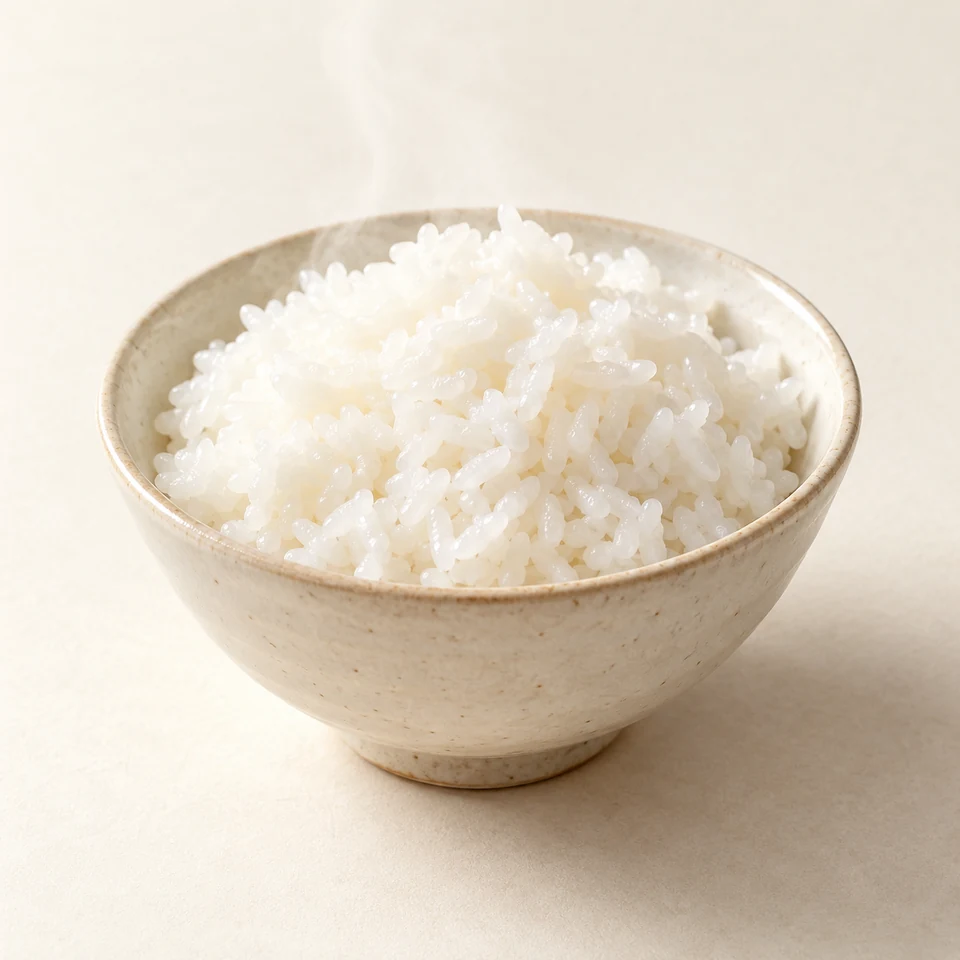
Steamed rice is rice cooked with water until the grains become tender, usually by absorbing water in a covered vessel or by cooking above water in steam. Its appearance ranges from separate, defined grains to a softer, more cohesive mass, depending on rice variety, water ratio, and cooking method.
It is served as a staple accompaniment, used as a base for other foods, or eaten as a simple rice dish. The ingredient may be made from white, brown, glutinous, aromatic, short-grain, or long-grain rice; these forms differ in colour, aroma, stickiness, and texture even when all are steamed.
Steamed rice is sold or served as a cooked preparation, while the underlying rice may be white, brown, glutinous, aromatic, short-grain, or long-grain. Water absorption and cooking method change the grains from dry and hard to tender, with results ranging from separate grains to a softer, cohesive mass.
- Ingredient type
- whole food
FOLLOW IT TO THE PLATE
Where will you meet it?
Explore the dishes that use this ingredient and their country and cuisine connections.
Explore linked dishesON A MENU OR LABEL
Find local names and written forms to help recognise this ingredient.
See local namesWhere steamed rice appears
3 linked foodsFind foods to recognise by country and type. Recipes and products vary; these are recorded ingredient connections.
Showing 1–3 of 3
Main dishes

Rice dishes
Ingredient connections awaiting review · Coverage is still growing, including packaged snacks.
Name examples awaiting language review. Confirm the specific food or product.
Local names for steamed rice
Names and romanised forms to recognise on menus and labels.
Steamed Rice
steamed rice
riz cuit à la vapeur
gedämpfter Reis
arroz al vapor
riso al vapore
arroz cozido no vapor
gestoomde rijst
arròs al vapor
ρύζι στον ατμό
ryzí ston atmó
buharda pişmiş pirinç
рис на пару
ris na paru
рис на парі
rys na pari
ryż na parze
rýže vařená v páře
párolt rizs
蒸米饭
zhēng mǐfàn
蒸しご飯
mushi-gohan
찐밥
jjinbap
cơm hấp
ข้าวนึ่ง
khâao nʉ̂ng
nasi kukus
nasi kukus
भाप में पका चावल
bhāp meṃ pakā chāval
ভাপে রান্না করা ভাত
bhāpe রান্নā kôra bhāt
ryzí ston atmó
Romanised form
mushi-gohan
Romanised form
rys na pari
Romanised form
jjinbap
Romanised form
bhāpe রান্নā kôra bhāt
Romanised form
zhēng mǐfàn
Romanised form
bhāp meṃ pakā chāval
Romanised form
ris na paru
Romanised form
khâao nʉ̂ng
Romanised form
Available names only. Languages may be spoken in other countries; a name alone does not identify every ingredient in a dish.
Name not available yet.
A name in English has not been added for steamed rice. Choose another language to see its available names.
Steamed Rice nutrition & diet
Steamed Rice nutritional value
Reference: Rice, polished, steamed
Per 100 g of the edible portion in the named reference form.
- Calories
- 132.99999999999997kcal
- Protein
- 2.3g
- Carbs
- 30.3g
- Fat
- 0.2g
Per 100 g edible portion. Rojroongwasinkul et al. (2013), Mahidol University and Wageningen University, SMILING Thai Food Composition Table. Energy is the source-calculated energy; carbohydrate is available carbohydrate by difference. Original 2013 reference values, not a current product label or a universal recipe.
Portions & preparation
Match the reference to the rice variety, cooked form, and edible portion actually served. Steaming with water differs from rice cooked in broth, coconut milk, oil, or seasoned mixtures. Grain length, milling, cooling, and later frying or mixing can also change the food being compared.
Compare the right form: Match references to the identified rice variety after steaming, specifying cooked edible grains, added liquid or fat, and whether the rice is plain or seasoned.
Diet considerations
Plain steamed rice is plant-derived and cereal-based. Compatibility changes when it is cooked with meat, seafood, dairy, or animal-derived broth, or served with such additions. Rice-based dishes can include other cereals, sauces, or coatings, and portion size strongly shapes carbohydrate patterns.
AI-authored reading notes · Awaiting editorial review. Measured values, where available, have a separate source above.
Dietary compatibility
- VeganTypically compatible
- VegetarianTypically compatible
- PescatarianTypically compatible
- KetoDepends on the version
- PaleoTypically incompatible
- Low-carbDepends on the version
- HalalNot established
- KosherNot established
What these diet assessments mean
- Vegan · Typically compatible
- The plain ingredient profile is plant, fungal or mineral based. Added ingredients in a prepared product need a separate check.
- Vegetarian · Typically compatible
- The plain ingredient profile is plant, fungal or mineral based. Added ingredients in a prepared product need a separate check.
- Pescatarian · Typically compatible
- The plain ingredient profile is plant, fungal or mineral based. Added ingredients in a prepared product need a separate check.
- Keto · Depends on the version
- Compatibility depends on the portion and preparation. A sourced carbohydrate amount for a defined serving is not available.
- Paleo · Typically incompatible
- This profile falls outside the conventional paleo pattern used here (grains and pseudograins, legumes, dairy or refined sugar).
- Low-carb · Depends on the version
- Compatibility depends on the portion and preparation. A sourced carbohydrate amount for a defined serving is not available.
- Halal · Not established
- Sourcing, processing and any applicable certification have not been verified. A food name alone does not establish halal status.
- Kosher · Not established
- Sourcing, processing and any applicable certification have not been verified. A food name alone does not establish kosher status.
For the plain ingredient · Awaiting review. Diet compatibility is not allergy suitability or halal/kosher certification. Keto and low-carb depend on the portion.
AI-generated illustration for visual context. It does not identify a particular product or establish allergen content.
Sources & review
Nutrition reference: Thai Food Composition Table, SMILING 2013 — 01015 ↗. Values are scaled from 100 g of the recorded edible form. Individual portions have no assumed fixed weight.
Expanded overview, name examples and nutrition notes are database drafts awaiting editorial review. Numeric nutrition values, where shown, have their own source and food-form reference.
The ingredient description and dish connections come from the draft catalogue and may change after review.
Last recorded verification: .