
Swede
Swede is a firm root vegetable that is commonly boiled, roasted, mashed, or added to stews.
About Swede
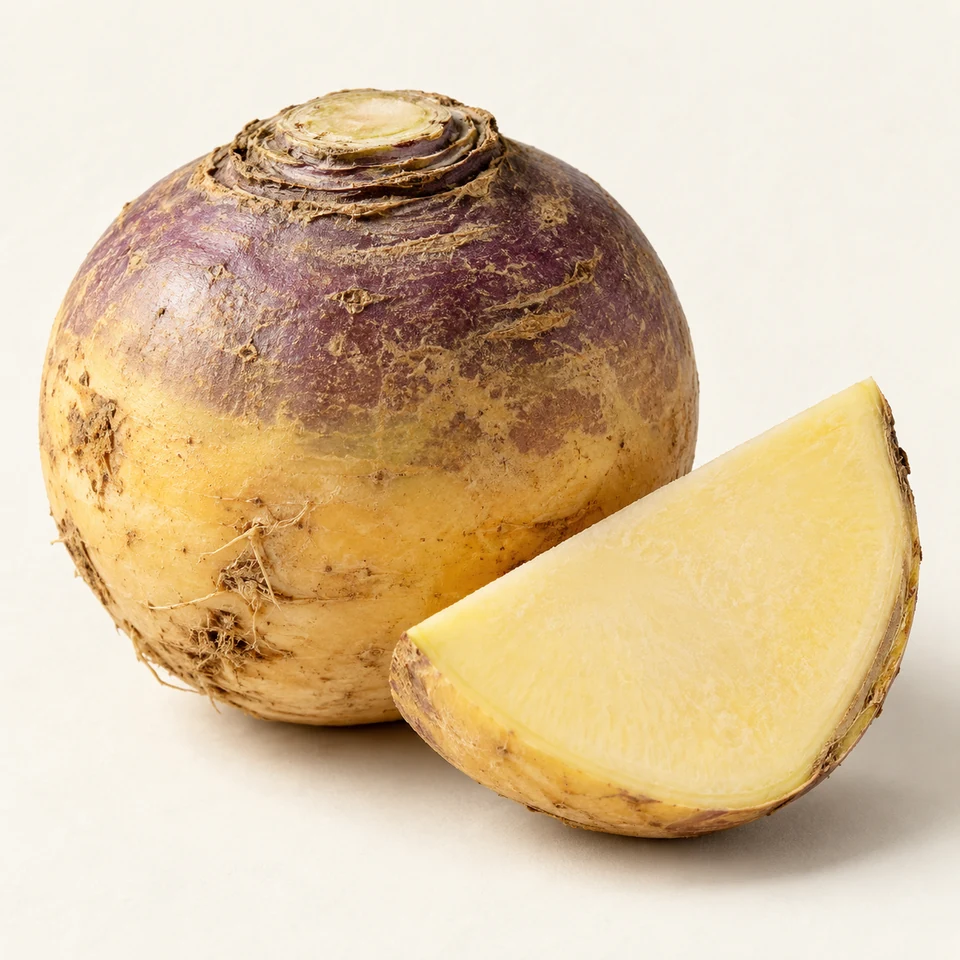
Swede is the swollen root of a turnip-like crop, also called rutabaga, and is commonly boiled, steamed, roasted, mashed, fried, or added to soups and stews. The peeled root has dense, firm flesh.
Raw swede is mildly peppery and cabbage-like; cooking makes it softer and sweeter. The interior may be creamy yellow to pale yellow, while texture and flavour vary with size, maturity, and cooking method.
It is commonly sold whole, halved, cubed, or pre-cut. The thick skin may be purple-shouldered, greenish, or yellow-brown and is generally removed; boiling, roasting, mashing, or frying changes the root’s firmness and surface texture.
- Ingredient type
- whole food
FOLLOW IT TO THE PLATE
Where will you meet it?
Explore the dishes that use this ingredient and their country and cuisine connections.
Explore linked dishesON A MENU OR LABEL
Find local names and written forms to help recognise this ingredient.
See local namesWhere swede appears
2 linked foodsFind foods to recognise by country and type. Recipes and products vary; these are recorded ingredient connections.
Showing 1–2 of 2
Sides
Street food

Ingredient connections awaiting review · Coverage is still growing, including packaged snacks.
Name examples awaiting language review. Confirm the specific food or product.
Local names for swede
Names and romanised forms to recognise on menus and labels.
rutabaga
kålrot
navet jaune
Steckrübe
Swede
swede
rutabaga
koolraap
kålroe
kålrot
lanttu
rófa
brukiew
tuřín
kvaka
karórépa
nap suedez
colinabo
rutabaga
rutabaga
брюква
bryukva
бруква
brukva
брюква
bryukva
брикуља
brikulja
repa
griežtis
kāļi
kaalikas
γογγύλι
gongýli
şalgam
gongýli
Romanised form
Swede, flesh only, boiled in unsalted water
Search alias · Not a confirmed translation
Swede, flesh only, raw
Search alias · Not a confirmed translation
Swede, peeled, fresh, boiled, drained
Search alias · Not a confirmed translation
Swede, peeled, fresh, raw
Search alias · Not a confirmed translation
brukva
Romanised form
bryukva
Romanised form
bryukva
Romanised form
brikulja
Romanised form
Available names only. Languages may be spoken in other countries; a name alone does not identify every ingredient in a dish.
Name not available yet.
A name in English has not been added for swede. Choose another language to see its available names.
Swede nutrition & diet
Swede nutritional value
Swede, peeled, fresh, raw
Per 100 g of the edible portion in the stated food form.
- Calories
- 22.2kcal
- Protein
- 0.9g
- Carbs
- 3.7g
- Fat
- 0.0g
Reference values apply to the named food form, not every preparation, variety or brand. © Food Standards Australia New Zealand. AFCD Release 3, food F009021. Available carbohydrate excludes sugar alcohols; energy converted from kJ to kcal (÷4.184). Australian data may not be appropriate for use in other countries. There are limitations associated with food composition databases. Food composition data used in the database or databases may represent an average of the nutrient content of a particular sample of foods and ingredients, determined at a particular time. The nutrient composition of foods and ingredients can vary substantially between batches and brands because of a number of factors, including changes in season, processing practices and ingredient source, and methods of calculation. Data licensed under the FSANZ Data User Licence Agreement, based on CC BY-SA 3.0 AU: https://www.foodstandards.gov.au/science-data/monitoringnutrients/afcd/datauserlicenceagreement.
Portions & preparation
Use the peeled edible root, excluding tough skin, tops, and damaged areas. Raw, boiled, roasted, mashed, and stewed forms differ in water content and serving texture, while added butter, cream, oil, or stock belongs to the preparation. Record swede separately when it is combined with potato or other roots.
Compare the right form: Match the reference to peeled swede root in the stated raw or cooked form, with added fat, stock, dairy, or other vegetables specified.
Diet considerations
Swede is a plant-derived root vegetable. Compatibility changes when mashed with butter or dairy, cooked in animal stock, glazed with honey, or combined with cereal ingredients in bakes or dumplings. Its carbohydrate pattern is portion-dependent and also reflects whether it replaces or accompanies potato, grains, or other starchy foods.
AI-authored reading notes · Awaiting editorial review. Measured values, where available, have a separate source above.
Dietary compatibility
- VeganTypically compatible
- VegetarianTypically compatible
- PescatarianTypically compatible
- KetoDepends on the version
- PaleoTypically compatible
- Low-carbDepends on the version
- HalalNot established
- KosherNot established
What these diet assessments mean
- Vegan · Typically compatible
- The plain ingredient profile is plant, fungal or mineral based. Added ingredients in a prepared product need a separate check.
- Vegetarian · Typically compatible
- The plain ingredient profile is plant, fungal or mineral based. Added ingredients in a prepared product need a separate check.
- Pescatarian · Typically compatible
- The plain ingredient profile is plant, fungal or mineral based. Added ingredients in a prepared product need a separate check.
- Keto · Depends on the version
- Compatibility depends on the portion and preparation. A sourced carbohydrate amount for a defined serving is not available.
- Paleo · Typically compatible
- The plain form fits the conventional paleo food groups. Added ingredients and individual interpretations can differ.
- Low-carb · Depends on the version
- Compatibility depends on the portion and preparation. A sourced carbohydrate amount for a defined serving is not available.
- Halal · Not established
- Sourcing, processing and any applicable certification have not been verified. A food name alone does not establish halal status.
- Kosher · Not established
- Sourcing, processing and any applicable certification have not been verified. A food name alone does not establish kosher status.
For the plain ingredient · Awaiting review. Diet compatibility is not allergy suitability or halal/kosher certification. Keto and low-carb depend on the portion.
AI-generated illustration for visual context. It does not identify a particular product or establish allergen content.
Sources & review
Nutrition reference: Australian Food Composition Database, Release 3, 2025 — Swede, peeled, fresh, raw ↗. Values are scaled from 100 g of the recorded edible form. Individual portions have no assumed fixed weight.
Expanded overview, name examples and nutrition notes are database drafts awaiting editorial review. Numeric nutrition values, where shown, have their own source and food-form reference.
The ingredient description and dish connections come from the draft catalogue and may change after review.
Last recorded verification: .