
Vegetable shortening
Vegetable shortening is a solid cooking fat used for frying, baking, and producing flaky pastry.
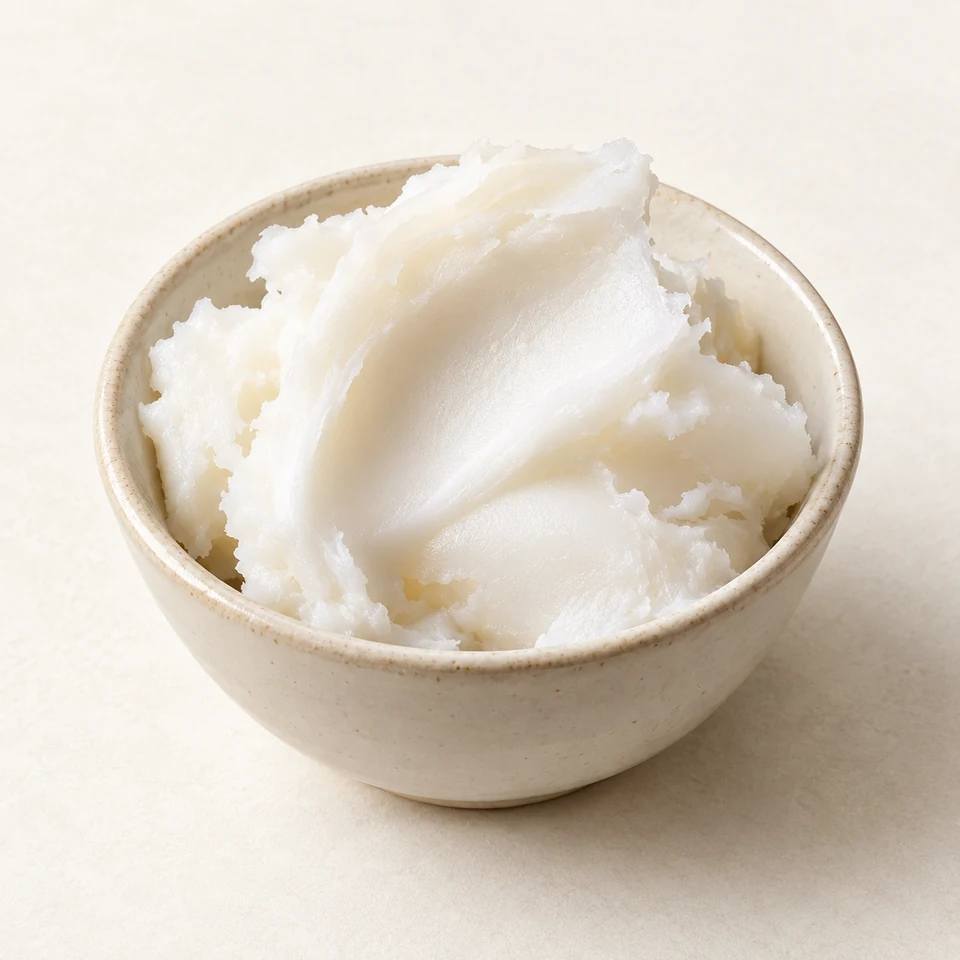
About Vegetable shortening
Vegetable shortening is a solid or semi-solid cooking fat made from processed vegetable oils. It is used for frying, baking, biscuits, pie pastry, and other preparations where a solid fat helps produce tenderness or flaky layers. The term covers several formulations made from one or more vegetable oils.
It is generally pale, smooth, and neutral in flavour. Its firmness is designed for easy measuring and mixing at room temperature, while melting behaviour varies with formulation. Creamed into dough, cut into flour, or melted for frying, it contributes different textures to the finished food.
Vegetable shortening is commonly sold in tubs or wrapped blocks. It may be blended, fractionated, or otherwise processed to adjust firmness and handling. Warming softens it and sufficient heat melts it into a clear or lightly coloured frying fat. Solid shortening is distinct from liquid vegetable oil in ordinary kitchen use.
- Ingredient type
- oil
FOLLOW IT TO THE PLATE
Where will you meet it?
Explore the dishes that use this ingredient and their country and cuisine connections.
Explore linked dishesON A MENU OR LABEL
Find local names and written forms to help recognise this ingredient.
See local namesWhere vegetable shortening appears
2 linked foodsFind foods to recognise by country and type. Recipes and products vary; these are recorded ingredient connections.
Showing 1–2 of 2
Desserts

Breads
Semita
Optional additionIngredient connections awaiting review · Coverage is still growing, including packaged snacks.
Name examples awaiting language review. Confirm the specific food or product.
Local names for vegetable shortening
Names and romanised forms to recognise on menus and labels.
vegetable shortening
manteca vegetal
shortening végétal
Pflanzenfett
grasso vegetale
gordura vegetal
greix vegetal
plantaardig vet
vegetabiliskt fett
vegetabilsk fedt
vegetabilsk fett
kasvirasva
tłuszcz roślinny
rostlinný tuk
rastlinný tuk
biljna mast
биљна маст
biljna mast
растительный жир
rastitelnyy zhir
рослинний жир
roslynnyi zhyr
növényi zsiradék
grăsime vegetală
растителна мазнина
rastitelna maznina
ショートニング
shōtoningu
쇼트닝
syoteuning
植物起酥油
zhíwù qǐsūyóu
shōtoningu
Romanised form
vegetable shortening (artificially-colored)
Search alias · Not a confirmed translation
vegetable shortening (hydrogenated)
Search alias · Not a confirmed translation
roslynnyi zhyr
Romanised form
syoteuning
Romanised form
zhíwù qǐsūyóu
Romanised form
rastitelnyy zhir
Romanised form
rastitelna maznina
Romanised form
biljna mast
Romanised form
Available names only. Languages may be spoken in other countries; a name alone does not identify every ingredient in a dish.
Name not available yet.
A name in English has not been added for vegetable shortening. Choose another language to see its available names.
Vegetable shortening nutrition & diet
Vegetable shortening nutritional value
Shortening, vegetable, household, composite
Per 100 g of the edible portion in the recorded food form.
- Calories
- 884kcal
- Protein
- 0.0g
- Carbs
- 0.0g
- Fat
- 100.0g
Reference values for the specific food form shown. Other varieties, brands and preparations can differ.
Portions & preparation
Use the actual solid shortening portion and identify whether it is hydrogenated, non-hydrogenated, flavored, or blended. Baking, frying, and pastry distribute the fat differently, and some remains in the pan or dough. A shortening product should not be treated as equivalent to liquid vegetable oil without confirming formulation and use.
Compare the right form: Match references to the exact solid vegetable-shortening formulation, including hydrogenation status, blend, salted status, and whether measured before or after cooking.
Diet considerations
Vegetable shortening is generally plant-oil-derived, but the formulation and manufacturing context determine compatibility. Flavorings or blends may include animal-derived ingredients, while pastry, batter, and fried foods can contain dairy, eggs, or cereal ingredients. The shortening itself does not establish the carbohydrate pattern of the finished food.
AI-authored reading notes · Awaiting editorial review. Measured values, where available, have a separate source above.
Dietary compatibility
- VeganNot established
- VegetarianNot established
- PescatarianNot established
- KetoNot established
- PaleoNot established
- Low-carbNot established
- HalalNot established
- KosherNot established
What these diet assessments mean
- Vegan · Not established
- The available profile does not establish the full composition or processing for this dietary pattern.
- Vegetarian · Not established
- The available profile does not establish the full composition or processing for this dietary pattern.
- Pescatarian · Not established
- The available profile does not establish the full composition or processing for this dietary pattern.
- Keto · Not established
- A defined serving and sourced carbohydrate data are needed before assessing this dietary pattern.
- Paleo · Not established
- The ingredient form and processing have not been assessed against this dietary pattern.
- Low-carb · Not established
- A defined serving and sourced carbohydrate data are needed before assessing this dietary pattern.
- Halal · Not established
- Sourcing, processing and any applicable certification have not been verified. A food name alone does not establish halal status.
- Kosher · Not established
- Sourcing, processing and any applicable certification have not been verified. A food name alone does not establish kosher status.
For the plain ingredient · Awaiting review. Diet compatibility is not allergy suitability or halal/kosher certification. Keto and low-carb depend on the portion.
AI-generated illustration for visual context. It does not identify a particular product or establish allergen content.
Sources & review
Nutrition reference: USDA FoodData Central — Shortening, vegetable, household, composite ↗. Values are scaled from 100 g of the recorded edible form. Individual portions have no assumed fixed weight.
Expanded overview, name examples and nutrition notes are database drafts awaiting editorial review. Numeric nutrition values, where shown, have their own source and food-form reference.
The ingredient description and dish connections come from the draft catalogue and may change after review.
Last recorded verification: .