
Winter melon
Winter melon is a mild, watery gourd commonly simmered in soups, stews, and braises.
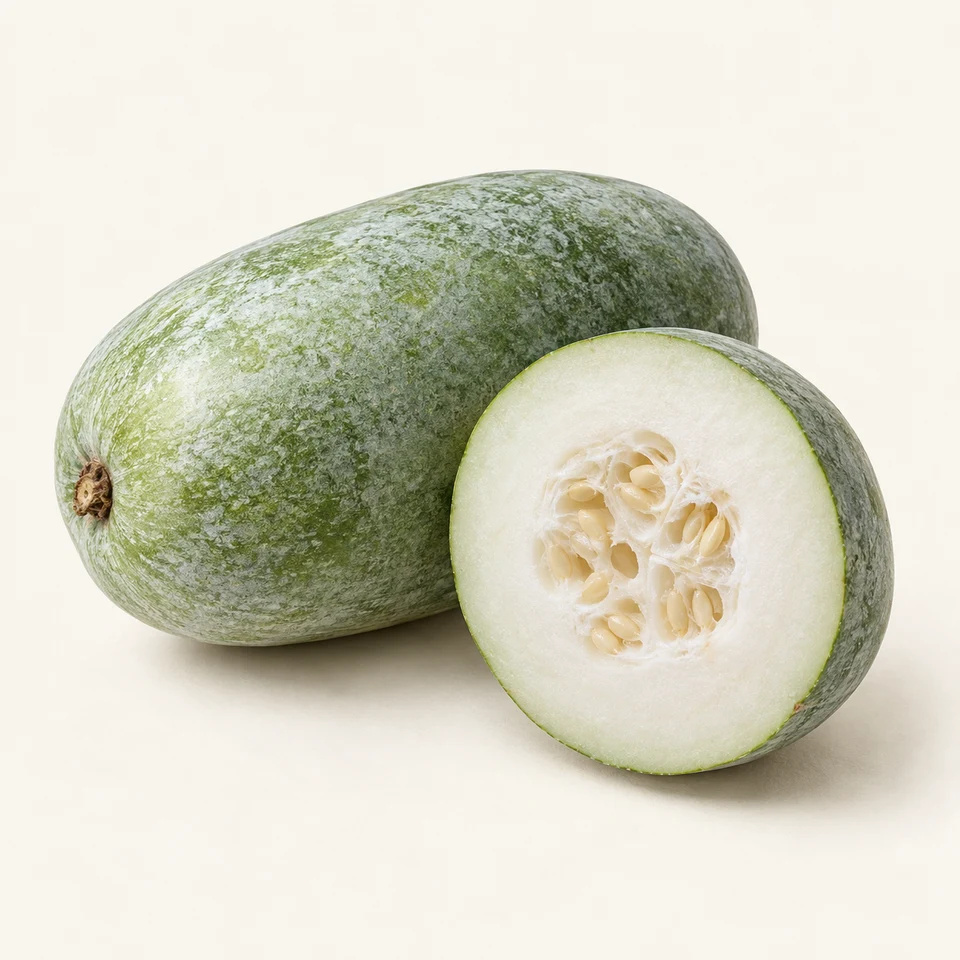
About Winter melon
Winter melon is the mature fruit of a large gourd, usually sold with a pale green, waxy rind and white, firm, watery flesh surrounding a central seed cavity. Its flavour is mild and lightly vegetal, and it is commonly used in soups, braises, stews, and steamed dishes. The flesh absorbs surrounding broth or sauce during cooking.
Raw winter melon has firm, watery flesh with a mild flavour. Cooking softens it and makes it tender without completely losing its shape. Because it takes on surrounding flavours, its finished taste and texture depend substantially on the broth, sauce, or other ingredients used with it.
Winter melon may be sold whole, in sections, or already peeled and cut. Preparation commonly involves peeling, seeding, and cutting into pieces. Preserved or candied forms exist but are distinct preparations; cooking changes the fresh flesh from firm and watery to softer, more tender, and broth-infused.
- Ingredient type
- whole food
FOLLOW IT TO THE PLATE
Where will you meet it?
Explore the dishes that use this ingredient and their country and cuisine connections.
Explore linked dishesON A MENU OR LABEL
Find local names and written forms to help recognise this ingredient.
See local namesWhere winter melon appears
2 linked foodsFind foods to recognise by country and type. Recipes and products vary; these are recorded ingredient connections.
Showing 1–2 of 2
Sides

Desserts
Ingredient connections awaiting review · Coverage is still growing, including packaged snacks.
Name examples awaiting language review. Confirm the specific food or product.
Local names for winter melon
Names and romanised forms to recognise on menus and labels.
冬瓜
dōngguā
동과
donggwa
とうがん
tōgan
Winter melon
winter melon
bí đao
ฟักเขียว
fak khiao
kundur
kundur
நீர்ப்பூசணிக்காய்
nīrppūcaṇikkāy
চালকুমড়া
cālakumāṛā
पेठा
peṭhā
कुभिण्डो
kubhiṇḍo
ಬೂದು ಕುಂಬಳಕಾಯಿ
būdu kumbḷakāyi
കുമ്പളങ്ങ
kumbaḷaṅṅa
පුහුල්
puhul
ฟัก
fak
courge cireuse
Wintermelone
zucca invernale
melão de inverno
melón de invierno
wintermeloen
зимняя дыня
zimnyaya dynya
الدباء الشتوي
al-dubbāʾ al-shitawī
kubhiṇḍo
Romanised form
būdu kumbḷakāyi
Romanised form
tōgan
Romanised form
Winter melon, cooked
Search alias · Not a confirmed translation
fak
Romanised form
nīrppūcaṇikkāy
Romanised form
al-dubbāʾ al-shitawī
Romanised form
donggwa
Romanised form
cālakumāṛā
Romanised form
puhul
Romanised form
dōngguā
Romanised form
peṭhā
Romanised form
kumbaḷaṅṅa
Romanised form
zimnyaya dynya
Romanised form
fak khiao
Romanised form
Available names only. Languages may be spoken in other countries; a name alone does not identify every ingredient in a dish.
Name not available yet.
A name in English has not been added for winter melon. Choose another language to see its available names.
Winter melon nutrition & diet
Winter melon nutritional value
Waxgourd, (chinese preserving melon), raw
Per 100 g of the edible portion in the recorded food form.
- Calories
- 13kcal
- Protein
- 0.4g
- Carbs
- 3.0g
- Fat
- 0.2g
Reference values for the specific food form shown. Other varieties, brands and preparations can differ.
Portions & preparation
Use the peeled, seeded edible flesh and distinguish raw from simmered, braised, or preserved preparations. Cooking changes water content and serving weight, while soups may add broth, meat, seafood, tofu, starch thickeners, oil, or seasonings that should be assessed separately.
Compare the right form: Match references to peeled and seeded winter-melon flesh in the same raw or cooked state; preserved, candied, and prepared soup forms need separate references.
Diet considerations
Winter melon is plant-derived. Compatibility changes when prepared with meat, seafood, egg, dairy, animal broth, or cereal-based thickeners, and preserved versions may include sweeteners or other ingredients. The plain gourd and a soup serving have different portion-dependent carbohydrate patterns because the recipe determines the final composition.
AI-authored reading notes · Awaiting editorial review. Measured values, where available, have a separate source above.
Dietary compatibility
- VeganTypically compatible
- VegetarianTypically compatible
- PescatarianTypically compatible
- KetoDepends on the version
- PaleoTypically compatible
- Low-carbDepends on the version
- HalalNot established
- KosherNot established
What these diet assessments mean
- Vegan · Typically compatible
- The plain ingredient profile is plant, fungal or mineral based. Added ingredients in a prepared product need a separate check.
- Vegetarian · Typically compatible
- The plain ingredient profile is plant, fungal or mineral based. Added ingredients in a prepared product need a separate check.
- Pescatarian · Typically compatible
- The plain ingredient profile is plant, fungal or mineral based. Added ingredients in a prepared product need a separate check.
- Keto · Depends on the version
- Compatibility depends on the portion and preparation. A sourced carbohydrate amount for a defined serving is not available.
- Paleo · Typically compatible
- The plain form fits the conventional paleo food groups. Added ingredients and individual interpretations can differ.
- Low-carb · Depends on the version
- Compatibility depends on the portion and preparation. A sourced carbohydrate amount for a defined serving is not available.
- Halal · Not established
- Sourcing, processing and any applicable certification have not been verified. A food name alone does not establish halal status.
- Kosher · Not established
- Sourcing, processing and any applicable certification have not been verified. A food name alone does not establish kosher status.
For the plain ingredient · Awaiting review. Diet compatibility is not allergy suitability or halal/kosher certification. Keto and low-carb depend on the portion.
AI-generated illustration for visual context. It does not identify a particular product or establish allergen content.
Sources & review
Nutrition reference: USDA FoodData Central — Waxgourd, (chinese preserving melon), raw ↗. Values are scaled from 100 g of the recorded edible form. Individual portions have no assumed fixed weight.
Expanded overview, name examples and nutrition notes are database drafts awaiting editorial review. Numeric nutrition values, where shown, have their own source and food-form reference.
The ingredient description and dish connections come from the draft catalogue and may change after review.
Last recorded verification: .