This Portugal guide explains the recorded bread connection for sesame and gives practical questions about recipes and preparation.
Editorial draft based on recorded food connections. Country-specific recipe connections await independent review; label research is identified separately below. This is not a list of suitable meals.
Understanding the food context
Understanding sesame in Portugal
This Portugal reference brings together recorded dishes and ingredients to help you prepare questions about sesame. It describes catalogue connections, not the suitability of a restaurant meal.
The current catalogue has no matching dish connections for this concern. That is a research gap, not evidence that local dishes exclude the ingredient.
IngredientsFollow the components
Read the ingredient connections and check the product actually used.
DishesInvestigate the local version
Recorded dishes are examples to discuss, not suitability recommendations.
Eating outAsk about preparation
Get an answer for your particular order, including shared equipment.
Sesame recorded in bread
The supplied ingredient example is bread, where sesame may be added as a topping or ingredient in some formulations. The record does not connect sesame with a named Portuguese dish.
Bread formulations vary, so ask whether sesame is present in the specific loaf, roll, crumb, or serving rather than assuming every bread is the same.
Ask the kitchen Does this bread contain sesame?
No named sesame dish example
No dish entry was supplied for sesame in Portugal. This leaves a clear gap: the available records do not identify a named preparation whose recipe can be described as containing or avoiding sesame.
Ask about bread used alongside a meal as well as sesame added to sauces, toppings, or garnishes. The particular recipe and serving need direct clarification.
These ingredients are linked to dishes recorded for Portugal and to this food concern. A link is a prompt to check the exact product, not a statement about every recipe.
Questions about sesame in bread
Ask whether sesame is mixed into the bread, placed on top, or included in a crumb or other bread-based component. The supplied entry allows these possibilities but does not make them universal.
Clarify the exact bread formulation and ask whether the same product is used for sandwiches, toast, crumbs, or garnish. Avoid treating “bread” as a complete ingredient description.
Sesame may be added as a topping or ingredient in some breads.
Recorded examples, recipes vary
Dish notes for Portugal
There are no matching dish notes in the catalogue yet. Missing data does not establish ingredient absence.
No recorded sesame dish connection
No named dish was recorded with sesame. Therefore, this guide cannot identify a Portuguese dish as containing or excluding sesame from the supplied records.
Ask whether bread accompanies the dish and whether sesame is added during plating. Also ask about sauces, toppings, crumbs, and garnishes used in the particular serving.
Ask the kitchen Does the dish include sesame bread?
EU rules require 14 allergen categories used as ingredients to be identified. On packaged food, these stand out within the ingredients list through type, style or background.
Sesame is included in the regulated allergen categories.
The label describes ingredients; precautionary “may contain” wording concerns unintended presence. Read the whole label and ask about anything unclear. This summary covers the shared EU framework; local enforcement and translations are not assessed here.
Recorded ingredient names are linked below where available. Local-language terminology and translated restaurant requests still need separate checking; an English summary is not a translation card.
Keep the name connected to the actual product
Check the exact food and its form. For sesame, use the ingredient entries below to investigate recorded names. A name for a whole ingredient may not describe a powder, extract or mixed sauce. Confirm which product the kitchen uses.
Keep the original packet or a clear photograph available when asking for help. Ingredient recognition and a complete restaurant request are different tasks: a translated name alone does not explain the preparation you need.
Official source for the label summary; checked 19 September 2026.
Before you order
Questions before ordering
Restaurants, cafés and deli counters must provide allergen information for non-prepacked food. Ask how to obtain it before ordering, then discuss preparation and shared equipment separately.
Explain the exact food you need to avoid and ask someone who can check the kitchen. Ingredient disclosure does not establish whether shared oil, utensils or surfaces meet your needs.
Recipe checks for sesame
Ask whether sesame is in the bread, topping, crumb, sauce, garnish, or any purchased component. Ask specifically whether bread is mixed with sesame or finished with it.
Check accompaniments as well as the main dish, because the recorded example concerns bread and no named dish example was supplied.
Ask the kitchen Which components contain sesame?
Preparation checks for sesame
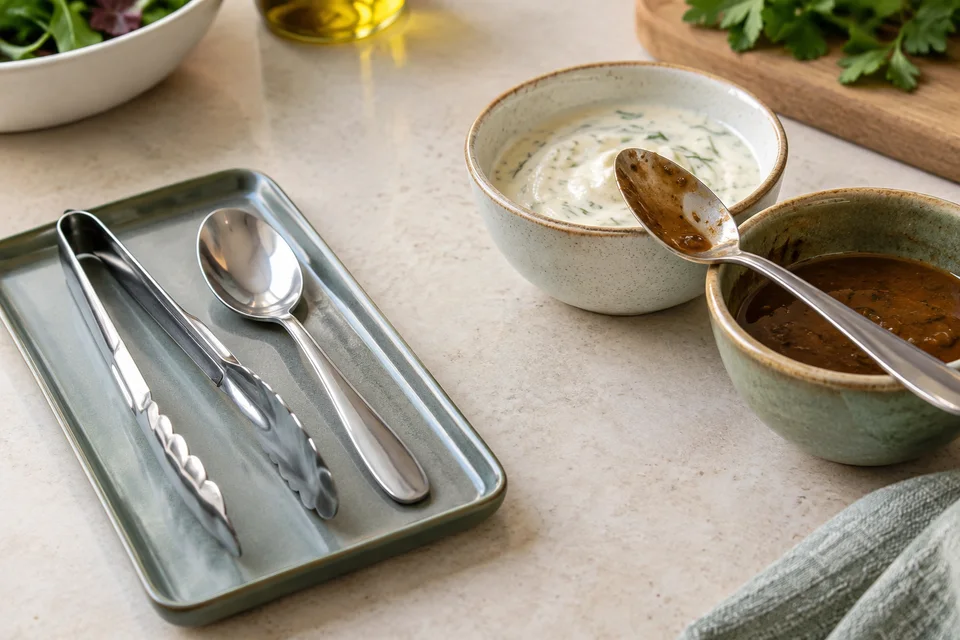
Ask how sesame-containing bread or ingredients are sliced, toasted, plated, and stored. Clarify whether boards, knives, tongs, trays, or surfaces are shared during preparation.
No restaurant procedures are recorded. Ask about actual handling, separately from whether sesame is intentionally part of the recipe.
Ask the kitchen How is the bread handled?
Illustrative preparation equipment; practices vary between kitchens.