
DISH RESEARCH · Dessert
Aleppine Baklava
Layered pastry with Aleppian shira. Rachel Sanders reports Richard making this walnut-and-pistachio baklava from a recipe adapted from Poopa Dweck’s Aromas of Aleppo. Buttered phyllo encloses a nut layer and is cut before baking; cold fragrant syrup is poured over the hot pastry. This attributed adaptation is the version described here.
About Aleppine Baklava
Research draft based on the references below. These notes describe particular recipes and presentations; ingredient connections are still being reviewed.
Layered pastry with Aleppian shira. Rachel Sanders reports Richard making this walnut-and-pistachio baklava from a recipe adapted from Poopa Dweck’s Aromas of Aleppo. Buttered phyllo encloses a nut layer and is cut before baking; cold fragrant syrup is poured over the hot pastry. This attributed adaptation is the version described here.
The selected recipe leaves flavour detail open. Sanders calls it delicious but does not explain its finished flavour balance. In a separate firsthand account of Aleppo Sweets, Priya Krishna describes lemon-kissed syrup and a richly buttery impression; those descriptions belong to that maker’s pastries and do not establish the taste of this adaptation.
A puffy, golden pastry with a nut layer. The selected recipe places buttered phyllo below and above the filling, cuts diamonds, squares or rectangles and bakes to that endpoint. It does not describe the finished bite. Aleppo Sweets separately describes crisp layered classics and distinct crunch experiences for its different styles.
Ingredients in Aleppine Baklava
The selected pastry uses 1 pound finely chopped, blanched and peeled walnuts; ½ pound similarly prepared pistachios; 2 tablespoons confectioners’ sugar; 1¼ pounds (5 sticks) melted unsalted butter; 1 pound phyllo; and 1 cup cold shira. The separate 2-cup syrup batch uses 3 cups sugar, 1 cup method-only water, 1 teaspoon fresh lemon juice and ½ teaspoon rose water OR orange blossom water. The method names rose water. Only 1 cup of that batch goes on the pastry; the entire batch is not an extra pastry quantity. Phyllo and commercial ingredient declarations are not provided.
Source limits: Full phyllo and commercial product formulas;butter milk species;alternative floral-water method distinction.
- Walnut[2]Recipe ingredient
- Pistachio[2]Recipe ingredient
- Icing Sugar[2]Recipe ingredientSource-specific formulation remains unresolved.
- Butter[2]Cooking mediumSource-specific formulation remains unresolved.
- Phyllo Dough[2]Recipe ingredientSource-specific formulation remains unresolved.
- Shira[2]Recipe ingredient
These foods describe the cited recipe. Ask the kitchen about its version and any additional ingredients or handling.
Origins & food traditions
Explore the countries and cooking traditions associated with this dish. These connections do not establish a single birthplace or limit where the dish is eaten today.
The home recipe explicitly credits Aromas of Aleppo and calls its syrup fragrant Aleppian dessert syrup. Sanders also states that she does not know where this preparation falls among Greek, Syrian and Turkish traditions. Krishna’s separately reported Aleppo-born baker began training in his home city as a teenager, and an Aleppo-born customer calls his product Aleppo baklava. These support a bounded cookbook-adaptation and maker association, not a universal formula or exclusive invention. Viviane Bowell’s JFS recipe follows an Aleppo-to-Cairo family journey but is expressly presented through her Egyptian upbringing and cookbook.
Source limits: Exclusive origin and equivalence of all national/regional baklava versions not established.
Countries
Cuisines & regions
Associations in the cited sources
These describe source-specific cultural or geographic connections. Catalogue links may still need review.
- Countries & places
- Syria
- Cooking traditions
- Aleppine Cuisine
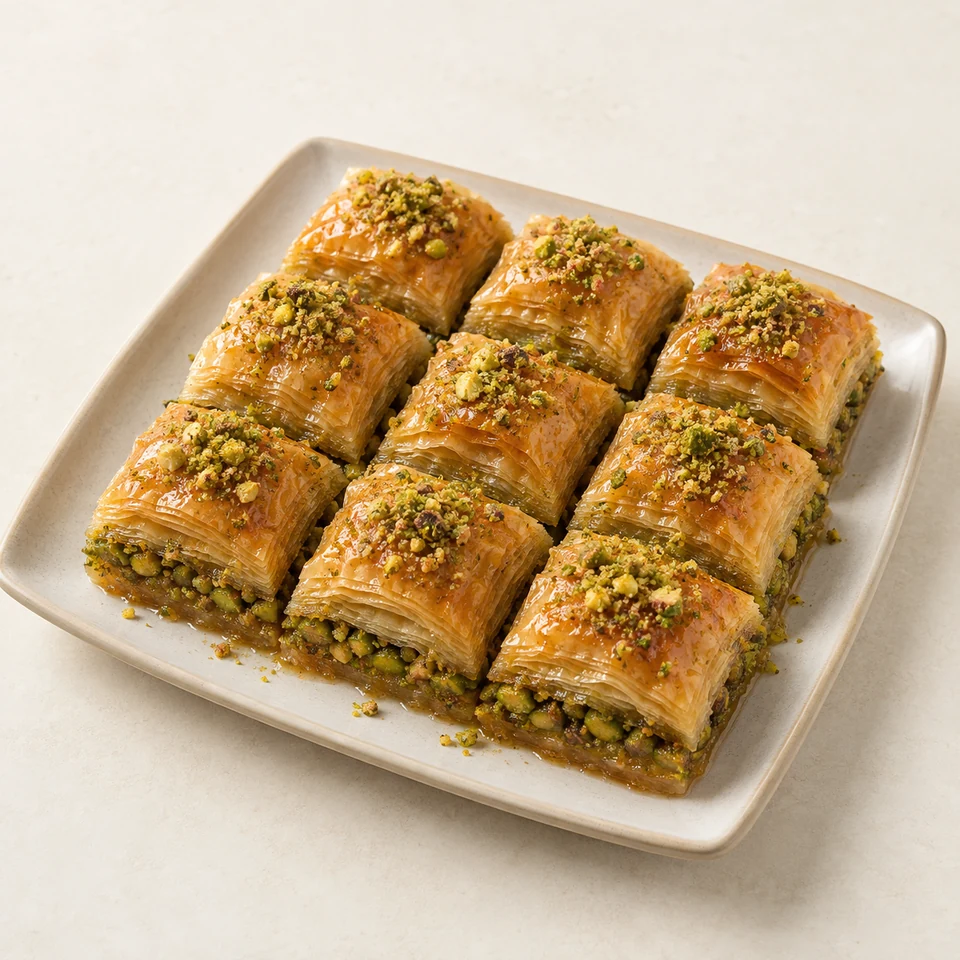
AI-generated illustration of one possible presentation. Recipes and ingredients vary; the image does not establish allergen content.
Sources & references
Selected: Rachel Sanders, Field & Forest, “baklava in rose water syrup”, 5 October 2015, reporting Richard’s bake and an adaptation of Poopa Dweck’s Aromas of Aleppo; the cookbook itself was not acquired. Separate maker context: Aleppo Sweets FAQ/café menu and Priya Krishna’s Bon Appétit field account. Separate family formula: Viviane Bowell, Jewish Food Society, “Baklava”, 5 January 2023, updated 7 August 2025.
Source limits: No claim of reading the credited cookbook itself.
- “This is Aleppo baklava,” says Nora Barre, a customer who moved to the U.S. from Aleppo when she was a child. “I used to think, You can’t get this outside of Aleppo.”
- adapted from Aromas of Aleppo, by Poopa Dweck - makes 30 baklava
- This walnut baklava recipe comes from Viviane Bowell and her cookbook “A Culinary legacy: Recipes from a Sephardi Egyptian kitchen.” Growing up in Cairo, Viviane remembers baklava being served at special occasions like a bris or a bar mitzvah. Her mother would also set it out as part of a spread for guests along with Turkish coffee, menenas, candied orange segments, and quince jam.
- We carry a nice selection of Vegan and Vegetarian options — both savory AND we also serve VEGAN BAKLAVA. Vegan Baklava is made with vegetable ghee and does not use honey, though honey is rarely used in Syrian Baklava (traditionally sugar is used). We make VEGAN BAKLAVA on Wednesdays and Fridays so you can always find some on those days. It is also possible to order 2 or 5 pound boxes of VEGAN BAKLAVA online for pick-up or shipment.
- Traditionally Syrian Baklava is made with sugar (not honey). Nuts are tossed with orange blossom water. In general, the ingredients are the same, the variation is in the quantity of each and THE CRUNCH experience. The different treatments of the phyllo dough and the nuts, creates different crunching experiences. Each style is also it’s own artistic expression, similar to sushi, and like Sushi Masters in Japan; being a creator of baklava carries with it a certain level of prestige, and secrecy.