
DISH RESEARCH · Dish
Fataya
Iba’s Fatayas with a tuna filling. Les Ateliers de Iba publishes dough and tuna-filling ingredient lists under Fataya, Pastel ou Empanada. This account preserves that named list; the article does not provide a cooking method, and its separate minced-meat filling remains a different branch.
About Fataya
Research draft based on the references below. These notes describe particular recipes and presentations; ingredient connections are still being reviewed.
Iba’s Fatayas with a tuna filling. Les Ateliers de Iba publishes dough and tuna-filling ingredient lists under Fataya, Pastel ou Empanada. This account preserves that named list; the article does not provide a cooking method, and its separate minced-meat filling remains a different branch.
A Senegalese childhood memory of tomato-onion sauce. The writer recalls hot Fatayas with fish filling and sauce after school. That memory supplies flavour context, while the listed tuna recipe’s finished flavour is not independently described.
Crisp edges belong to the remembered food. Iba recalls enjoying the crisp dough edges, but gives no shaping or frying instructions for the listed formula. The finished shape, texture and serving temperature of that exact recipe remain unknown.
Ingredients in Fataya
For dough, Iba lists 500 g flour, 200 ml water, 1 sachet levure, 2 eggs, 3 teaspoons milk powder, optional 20 g butter and unmeasured salt. The flour grain and whether levure means yeast or another raising agent are unresolved. The tuna filling lists one 425 ml can (250 g drained tuna), 1 onion, a drizzle olive oil, 3 tablespoons concentrated tomato, 2 tablespoons Nokoss, 1 glass water and a grouped “1 teaspoon paprika, thyme, salt” line. Nokoss is described with 3 garlic cloves, 1 tablespoon unspecified pepper, half a bell pepper, 2 green-onion branches and a quarter bouillon; these are mixture components, not additional duplicate quantities added to the filling. The mixture yield, glass size and grouped seasoning allocation are unknown.
Source limits: This source lists dough and filling ingredients but supplies no preparation method, shaping, sealing, rising, frying quantities, cooking times, temperatures or equipment.
Source limits: Generic flour grain and levure identity are unknown. Nokoss components are listed, but its yield, quarter-bouillon unit and allocation to the filling are unresolved.
Source limits: The listed can is 425 ml with 250 g drained tuna; the author’s remembered sardinelle filling is separate. The one-teaspoon paprika/thyme/salt wording is ambiguous.
Source limits: The separate minced-meat filling and Chouquette’s fish Pastels recipe are not combined with this tuna list. Gambia and Mali associations and universal naming equivalence are not established.
- 500 g flour[2]Recipe ingredientSource-specific formulation remains unresolved.
- 200 ml water[2]Recipe ingredient
- 1 sachet unspecified leavening[2]Identity unresolved
- 2 eggs[2]Recipe ingredient
- 3 teaspoons milk powder[2]Recipe ingredientSource-specific formulation remains unresolved.
- 20 g butter optional[2]OptionalSource-specific formulation remains unresolved.
- Unmeasured dough salt[2]Recipe ingredient
- 1 can tuna 425 ml, 250 g drained[2]Recipe ingredientSource-specific formulation remains unresolved.
- 1 onion[2]Recipe ingredient
- A drizzle olive oil[2]Recipe ingredientSource-specific formulation remains unresolved.
- 3 tablespoons concentrated tomato[2]Recipe ingredientSource-specific formulation remains unresolved.
- 2 tablespoons Nokoss spice mixture[2]Identity unresolved
- 3 garlic cloves within Nokoss[2]Recipe ingredient
- 1 tablespoon pepper within Nokoss[2]Identity unresolved
- Half bell pepper within Nokoss[2]Recipe ingredient
- 2 green-onion branches within Nokoss[2]Recipe ingredient
- Quarter bouillon within Nokoss[2]Recipe ingredientSource-specific formulation remains unresolved.
- 1 glass water for tuna filling[2]Recipe ingredient
- Paprika in grouped 1 teaspoon wording[2]Recipe ingredient
- Thyme in grouped paprika/thyme/salt wording[2]Recipe ingredient
- Salt in grouped paprika/thyme/salt wording[2]Recipe ingredient
These foods describe the cited recipe. Ask the kitchen about its version and any additional ingredients or handling.
Origins & food traditions
Explore the countries and cooking traditions associated with this dish. These connections do not establish a single birthplace or limit where the dish is eaten today.
The March 2017 article recalls childhood in Senegal and neighbourhood sellers of hot Fatayas, often with sardinelles and tomato-onion sauce. Its selected list instead names canned tuna. Iba compares Empanadas with Fatayas, while Chouquette separately reserves Fataya for meat and calls the fish preparation Pastels. Those writers’ naming differs; it does not prove every name denotes one formula or establish a Gambia or Mali version.
Source limits: This source lists dough and filling ingredients but supplies no preparation method, shaping, sealing, rising, frying quantities, cooking times, temperatures or equipment.
Source limits: Generic flour grain and levure identity are unknown. Nokoss components are listed, but its yield, quarter-bouillon unit and allocation to the filling are unresolved.
Source limits: The listed can is 425 ml with 250 g drained tuna; the author’s remembered sardinelle filling is separate. The one-teaspoon paprika/thyme/salt wording is ambiguous.
Source limits: The separate minced-meat filling and Chouquette’s fish Pastels recipe are not combined with this tuna list. Gambia and Mali associations and universal naming equivalence are not established.
Cuisines & regions
Associations in the cited sources
These describe source-specific cultural or geographic connections. Catalogue links may still need review.
- Countries & places
- Senegal
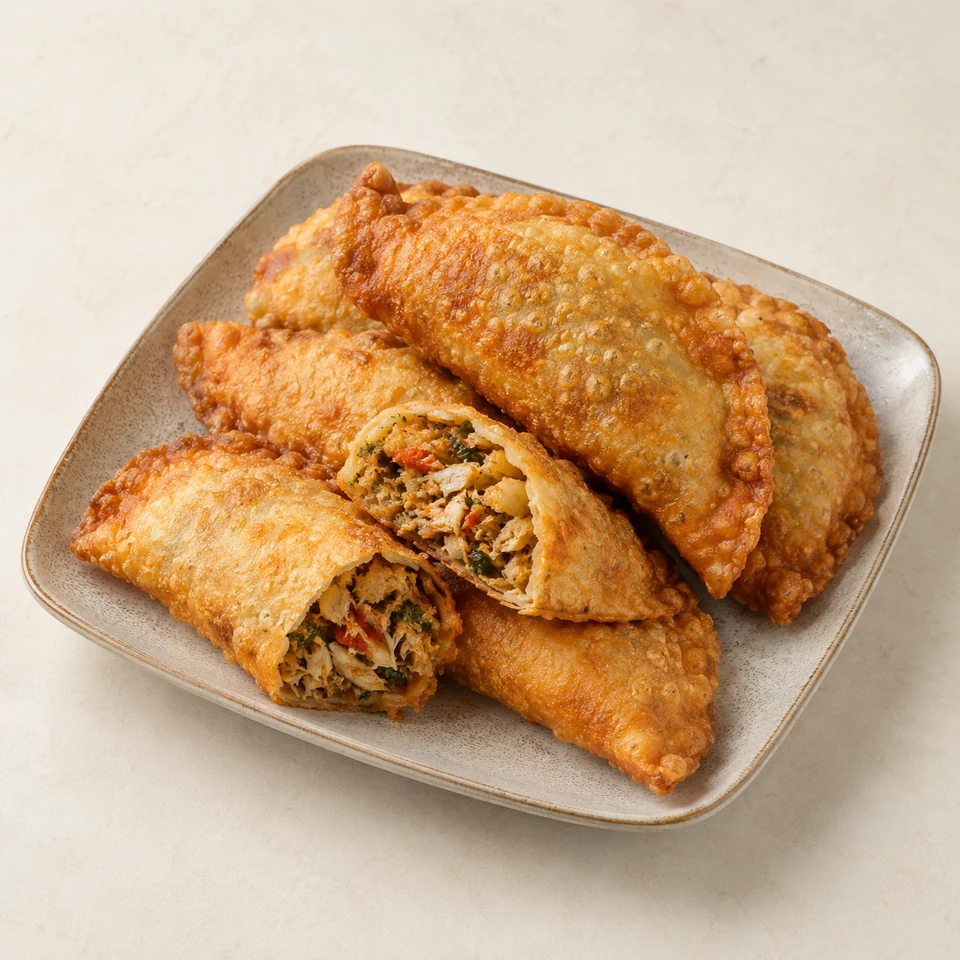
AI-generated illustration of one possible presentation. Recipes and ingredients vary; the image does not establish allergen content.
Sources & references
Les Ateliers de Iba, “Fataya, pastel ou empanada,” 3 March 2017, https://lesateliersdeiba.wordpress.com/2017/03/03/fataya-pastel-ou-empanada/. Separate naming comparison: En cuisine avec Chouquette, “Pastels express au thon,” 3 January 2021, https://encuisineavecchouquette.wordpress.com/2021/01/03/pastels-express-au-thon/. Their recipes and terminology remain distinct. Food Standards Agency guidance supplies narrow category context without completing the recipe or resolving supplier products.
Source limits: This source lists dough and filling ingredients but supplies no preparation method, shaping, sealing, rising, frying quantities, cooking times, temperatures or equipment.
Source limits: Generic flour grain and levure identity are unknown. Nokoss components are listed, but its yield, quarter-bouillon unit and allocation to the filling are unresolved.
Source limits: The listed can is 425 ml with 250 g drained tuna; the author’s remembered sardinelle filling is separate. The one-teaspoon paprika/thyme/salt wording is ambiguous.
Source limits: The separate minced-meat filling and Chouquette’s fish Pastels recipe are not combined with this tuna list. Gambia and Mali associations and universal naming equivalence are not established.