
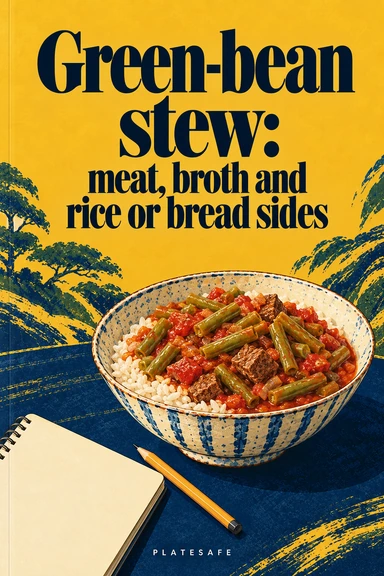
Read fasolia khadra as a recipe question
Fasolia khadra gives you a green-bean starting point, but a menu name does not settle the meat, spices or accompaniment. The Batata & Bundora sisters describe their blog as a place to document Palestinian recipes made by family and friends. Their green-bean post is particularly useful because it gives a meat recipe and then a separate meatless variation. Following those two branches carefully is more informative than combining their ingredients into a single supposedly definitive stew. [1]
This guide uses that published family preparation. Open the Platesafe fasolia khadra guide to compare it with a restaurant’s description. If you are choosing between several stews, start by identifying the vegetable and cooking liquid, then ask about meat and sides. The same menu translation can conceal a different household formula. The purpose of the source is to show concrete possibilities and useful distinctions, rather than to predict every bowl served under the name.
The meat version has a separate broth phase
The sisters’ main version starts with green beans and either beef or lamb, along with onion, tomatoes, vegetable oil, water, salt, pepper and small amounts of cinnamon, cardamom and nutmeg. They specify trimming and cutting the green beans into short pieces. The meat is seared first and simmered until tender, producing a liquid that is later used in the bean pot. This makes the broth part of the selected meat preparation; it should not disappear from an ingredient summary merely because the list begins with water. [1]
The beans do not simply cook alongside the meat for the entire time. The source browns onion in another pan, adds the beans and then combines them with tomatoes, cooked meat and enough of the meat liquid to barely cover them. This phased method helps explain what to ask about another version: “Are the beans cooked in meat broth?” is more precise than asking only whether visible meat pieces are present. A restaurant could strain a broth or use a prepared stock, and you would need its own answer to understand that preparation. [1]
Keep the meatless branch separate
The post’s meatless variation changes more than the visible protein. The sisters use olive oil, suggest fresh tomatoes or canned tomatoes, omit the meat steps and give a different finishing sequence. They also say they prefer eating that variation with pita rather than rice. Those details belong together as the authors’ stated alternative. It would be misleading to retain the meat broth while describing the dish as their meatless version, or to suggest that their olive-oil choice automatically applies to the main meat recipe. [1]
At a restaurant, ask what “vegetarian” or “vegan” means in the kitchen’s current version. Does it use water, a vegetable stock or a broth made with meat? Is a prepared sauce or seasoning added? Is the side the same as for the meat dish? The Food Standards Agency explains that a vegan label is not an assurance that an allergen is absent, including where handling can introduce cross-contact. That distinction remains useful even when your first enquiry is about whether a stew contains meat. The agency’s statutory discussion is specific to the UK. [2]
What the source says about texture
The recipe explicitly cooks the meat until tender and browns onion until golden. Those are actual instructions. They do not provide a full finished texture account of the green beans, such as whether the beans have a firm bite or become very soft. A specified simmering period is a method detail, not permission to invent a tasting note. Similarly, the presence of cinnamon, cardamom and nutmeg documents seasoning but does not prove that a served portion tastes strongly of any one of them. [1]
If texture determines whether you will enjoy the dish, ask a simple question that gives the kitchen room to describe its version: “Are the green beans still firm or cooked until soft?” You can also ask whether the sauce is plentiful or reduced, and whether the meat is served in large pieces or small pieces mixed through the beans. These answers are more useful than relying on a generic claim that every green-bean stew is silky, hearty or spicy. A photograph may show arrangement and portion size, but it cannot replace a description of the finished food.
The rice or bread changes the order
The source serves the meat version with steamed rice and describes a preference for pita with the meatless branch. That is a meaningful serving distinction, not a garnish to ignore. The rice and the bread are separate foods that may have their own preparation and ingredients. The post does not provide a complete recipe for either accompaniment. If you need to understand the whole plate, ask what is included and how that side is made, rather than treating the stew’s ingredient list as a complete meal declaration. [1]
For a practical comparison, you could ask whether rice comes alongside the stew or whether the order is intended to be eaten with bread. Neither choice needs to be called more authentic on the evidence here: the authors themselves document two preferences within one family post. If you are also looking at white-bean fasolia bayda, compare the actual published versions. Different beans, meat choices and cooking phases deserve their own descriptions rather than a single regional template.
Make your enquiry about the actual plate
A compact ordering enquiry might cover four points: the current meat or meatless branch, the liquid used for cooking, the seasoning or prepared sauces, and the side included. For an allergy requirement, explain the specific ingredient you need to discuss and speak to someone who knows the preparation. The Food Standards Agency’s consumer advice also recommends asking about equipment, handling and substitutions. An apparently suitable ingredient list does not answer those process questions. [2]
Keep the response tied to this restaurant and this order. If the staff offer to remove visible meat or omit bread, ask whether the change also addresses the cooking liquid and preparation you discussed. If they cannot describe a stock or sauce, record that uncertainty rather than filling it with a family recipe found online. A source-backed guide helps you ask better questions; the kitchen’s current information is what describes the dish it is actually serving. That approach preserves the useful differences between the sisters’ two versions without promising an outcome the guide cannot establish. [2]
Sources & references
Source pages checked 10 October 2026. Confirm the exact current recipe and preparation with the venue.