
Begin with the consistency the source actually describes
Rendang and kalio are useful names to investigate when you want to understand how a coconut-and-spice preparation changes as it cooks. The clearest comparison begins with the source’s description of the sauce and the selected recipe’s endpoint. It does not begin by assuming that every use of either name gives the same formula.
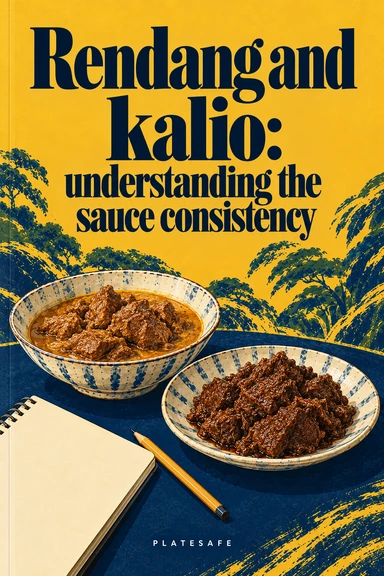
Indonesia’s official tourism article places Rendang Padang in Minangkabau culinary culture and describes stages with different sauce consistencies. In its account, gulai has plentiful, thinner sauce; kalio has thickened gravy; and the final rendang is reduced nearly dry.[1] This is the article’s cultural and culinary explanation, not a complete recipe card.
For an actual cooking example, this guide also uses Nagi Maehashi’s published beef rendang. She traces that recipe to a former colleague’s Malaysian mother.[2] Keep that attribution visible. The official Minangkabau context and this Malaysian-family recipe supply different kinds of evidence and should not be fused into a new “authentic” formula.
“Dry curry” describes the sauce arrangement
Nagi describes her finished rendang as tender beef coated in thick sauce, rather than beef sitting in a large quantity of sauce. Her notes call the reduced coating a sticky paste.[2] That is a useful explanation of the word dry in this specific preparation: it concerns the arrangement of the sauce, not a claim that the meat has a dry mouthfeel.
Keep the two observations separate in a recipe note. One field can describe how much free sauce remains; another can describe the source’s finished meat texture. This avoids turning a consistency term into an imagined tasting note.
For a restaurant item, ask how that kitchen describes the finished version. A photograph may suggest that sauce is pooled or coating the meat, but it cannot identify the ingredients or supply a complete texture description. Use the current recipe or the business’s explanation for those details.
Keep flavour and texture descriptions with their author
Nagi characterises this recipe’s flavour as deep and complex, and the finished beef as very tender. The official tourism account describes rich flavour in its discussion of the wetter kalio stage.[1][2] These are attributed descriptions at different scopes; one does not establish the taste of the other source’s exact batch.
If you are comparing recipes, save each description with its source and version. Record whether it describes a general food tradition, a particular cooked dish or a raw ingredient. An ingredient list by itself cannot support a detailed account of how the finished curry tastes.
You can also leave a sensory field open. A source that establishes coconut milk, spices and beef may still omit a meaningful description of the finished dish. Keeping that gap visible is more useful than writing a confident tasting paragraph from those ingredients alone.
Read the paste and the curry as separate phases
Nagi’s card separates a blended spice paste from the remaining curry ingredients. The paste includes aromatics such as garlic, lemongrass, galangal and ginger; coconut milk and other ingredients enter the later curry phase.[2] Preserve that structure when you save the recipe.
An ingredient can appear twice for different purposes. In this example, lemongrass is included in the paste and separately added to the curry. A summary that collapses the phases into a single word list loses that useful distinction.
For a purchased curry paste or a restaurant preparation, the actual formula may differ. Ask whether the paste is made in the kitchen or supplied as a product, then identify the relevant ingredients or label. A named homemade paste elsewhere online cannot resolve the formula of an unrelated mixture.
The cooking endpoint matters more than a borrowed timetable
The selected Nagi method simmers the beef before a separate uncovered reduction stage. Her instructions describe the sauce reducing to a coating and check that the beef reaches the stated tenderness.[2] Follow the full recipe if cooking that version; a shortened summary is not a substitute for its method and notes.
The official tourism account explains a broader sequence of consistency changes.[1] It does not make a different recipe’s minutes transferable to every pot. Batch size, the selected ingredients and the actual method belong with the recipe being followed.
When comparing two sources, record the stated endpoint and cooking method for each. A wetter preparation may be a deliberate finished version in its own context. Do not call it a failed dry preparation merely because another source ends with less free sauce.
Substitutions create a selected version
The Nagi recipe includes choices and substitutions in its notes, including alternatives for some aromatics, sour ingredients and cooking equipment.[2] Choose the branch you actually use and record it. Listing every alternative as though all were present creates a formula the author did not write.
Keep a substitute’s description separate from the original ingredient’s description. If you use a souring alternative, write its name rather than continuing to label the recipe as though the original were used. The same applies to a different spice form or a purchased paste.
For a meal outside your kitchen, ask which branch or product the business uses today. A recipe’s permitted option tells you what is possible in that source; it does not identify the choice made by another cook.
Keep rice and sides outside the curry formula
Nagi suggests plain rice or her separate coconut-rice recipe and also provides a pickled-cucumber side idea.[2] These are serving possibilities and component recipes, not reasons to add every accompaniment’s ingredients to the curry itself.
If you select a side, keep its formula with that meal. If you do not select it, leave it outside the inventory of what you prepared. A photograph of a complete plate can help describe presentation, but it does not establish the formula or product used in every component.
This distinction is useful when asking about a food requirement. The curry, rice, side, garnish and preparation need their own current answers. A confirmed ingredient in a published recipe is evidence about that recipe, not a guarantee about every meal served under the same name.
Make a comparison that stays useful
Use Platesafe’s rendang record as a sourced dish reference, and read its attribution and research status. Keep any current restaurant or product information in a separate dated note so a general dish record does not stand in for the exact version you order.
A helpful comparison table has room for source, regional context, selected formula, sauce consistency, stated texture and serving components. Fill the fields the source supports and preserve the rest as unknown. This lets you compare named versions without forcing them into one complete recipe.
For a trip, add the current place and menu item to your food-focused planning worksheet. For home cooking, save the author’s full method alongside your selected branch. In both cases, the exact version is what makes the comparison meaningful.
Sources & references
Source pages checked 9 October 2026. Confirm the exact current recipe and preparation with the venue.