
Candied orange peel
Candied orange peel is orange rind preserved in sugar syrup and used in cakes, pastries, desserts, and confectionery.
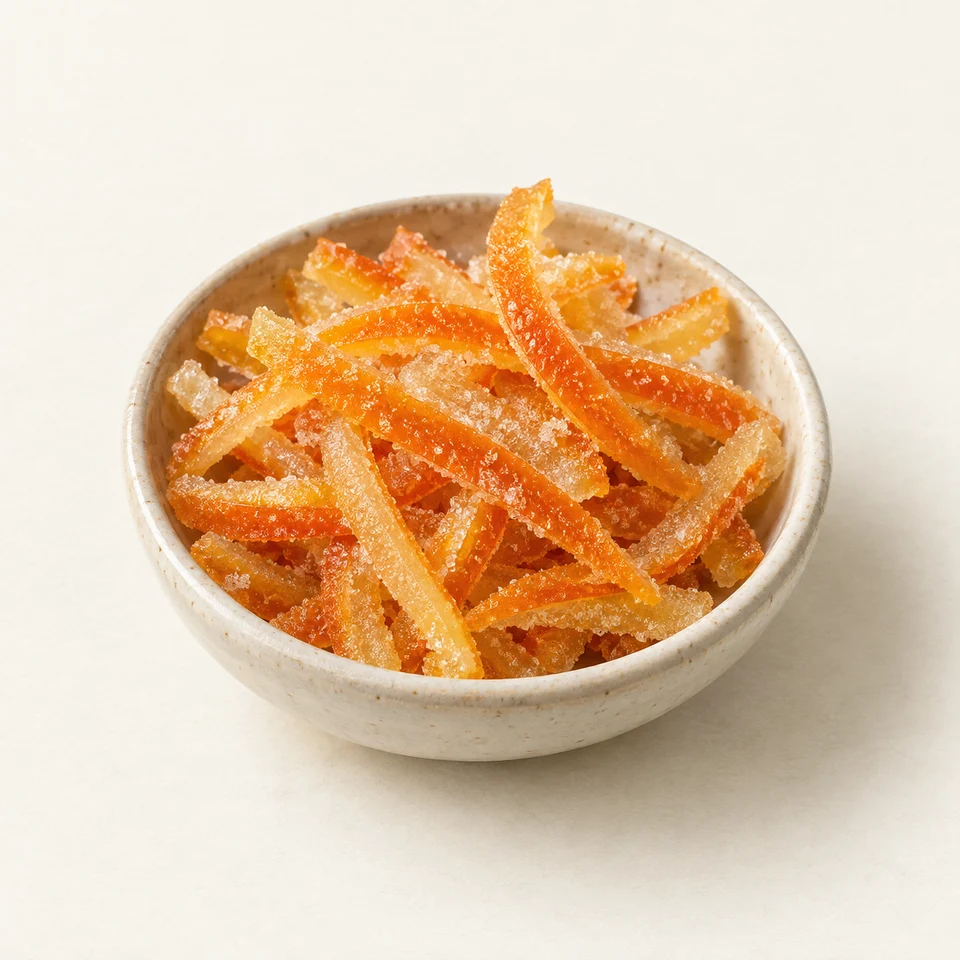
About Candied orange peel
Candied orange peel is orange rind, including the coloured zest and usually the white pith, simmered or soaked in sugar syrup until softened and sweetened. It is used in fruitcakes, panettone-style breads, pastries, cookies, desserts, chocolate confectionery, and decorative garnishes.
Its flavour combines pronounced orange aroma with sweetness and mild bitterness. The peel has a chewy texture, while pith thickness, blanching, and drying influence firmness, translucency, and bitterness; products therefore need not have identical sensory qualities.
It is commonly sold as strips, small dice, or larger pieces, with a glossy or crystallized surface. The finished peel may be stored moist in syrup or drained and dried, and surface sugar changes its appearance and handling.
- Ingredient type
- whole food
FOLLOW IT TO THE PLATE
Where will you meet it?
Explore the dishes that use this ingredient and their country and cuisine connections.
Explore linked dishesON A MENU OR LABEL
Find local names and written forms to help recognise this ingredient.
See local namesWhere candied orange peel appears
14 linked foodsFind foods to recognise by country and type. Recipes and products vary; these are recorded ingredient connections.
Showing 13–14 of 14
Desserts
Rice dishes
Ingredient connections awaiting review · Coverage is still growing, including packaged snacks.
Name examples awaiting language review. Confirm the specific food or product.
Local names for candied orange peel
Names and romanised forms to recognise on menus and labels.
candied orange peel
écorce d’orange confite
scorza d’arancia candita
cáscara de naranja confitada
kandierte Orangenschale
gekonfijte sinaasappelschil
casca de laranja cristalizada
pell de taronja confitada
kandyzowana skórka pomarańczowa
цукаты из апельсиновой корки
tsukaty iz apel'sinovoy kórki
цукати з апельсинової шкірки
tsukaty z apel'synovoi shkirky
ζαχαρωμένη φλούδα πορτοκαλιού
zacharoméni flóuda portokaliú
şekerlenmiş portakal kabuğu
オレンジピールの砂糖漬け
orenji pīru no satōzuke
오렌지 껍질 당절임
orenji kkeopjil dangjeorim
糖渍橙皮
tángzì chéngpí
قشر البرتقال المُسَكَّر
qishr al-burtuqāl al-musakkar
پوست پرتقال قندی
pust-e porteqāl-e qandi
कैंडीड संतरे का छिलका
kaiṇḍīḍ santare kā chhilkā
zacharoméni flóuda portokaliú
Romanised form
orenji pīru no satōzuke
Romanised form
qishr al-burtuqāl al-musakkar
Romanised form
tsukaty z apel'synovoi shkirky
Romanised form
orenji kkeopjil dangjeorim
Romanised form
tángzì chéngpí
Romanised form
kaiṇḍīḍ santare kā chhilkā
Romanised form
tsukaty iz apel'sinovoy kórki
Romanised form
pust-e porteqāl-e qandi
Romanised form
Available names only. Languages may be spoken in other countries; a name alone does not identify every ingredient in a dish.
Name not available yet.
A name in English has not been added for candied orange peel. Choose another language to see its available names.
Candied orange peel nutrition & diet
Candied orange peel nutritional value
Reference: Candied orange peel
Per 100 g of the edible portion in the named reference form.
- Calories
- 306kcal
- Protein
- 0.4g
- Carbs
- 74.3g
- Fat
- 0.3g
Per 100 g edible portion. Swiss Federal Food Safety and Veterinary Office, Food Composition Database version 7.1 (2026). Reused with source acknowledgment as required by the published reuse terms. Energy is the source-calculated energy; carbohydrate is available carbohydrate. Original reference values, not a current product label or a universal recipe.
Portions & preparation
Use the peel portion as sold, including any retained syrup or crystallized coating. Chopping, rinsing, draining, or cooking changes the amount of syrup accompanying each serving, so preparation and whether the peel is heavily coated should be recorded when comparing entries.
Compare the right form: Match to candied orange rind or peel, specifying drained, syrup-packed, crystallized, chopped, or whole form and edible portion.
Diet considerations
Orange peel is plant-derived, but candied preparation adds cane or other sugars and may include glucose syrup or coatings. Compatibility changes with recipe ingredients, coloring, glazing agents, and the portion used in cereal-based cakes, pastries, or confectionery.
AI-authored reading notes · Awaiting editorial review. Measured values, where available, have a separate source above.
Dietary compatibility
- VeganNot established
- VegetarianNot established
- PescatarianNot established
- KetoNot established
- PaleoNot established
- Low-carbNot established
- HalalNot established
- KosherNot established
What these diet assessments mean
- Vegan · Not established
- The available profile does not establish the full composition or processing for this dietary pattern.
- Vegetarian · Not established
- The available profile does not establish the full composition or processing for this dietary pattern.
- Pescatarian · Not established
- The available profile does not establish the full composition or processing for this dietary pattern.
- Keto · Not established
- A defined serving and sourced carbohydrate data are needed before assessing this dietary pattern.
- Paleo · Not established
- The ingredient form and processing have not been assessed against this dietary pattern.
- Low-carb · Not established
- A defined serving and sourced carbohydrate data are needed before assessing this dietary pattern.
- Halal · Not established
- Sourcing, processing and any applicable certification have not been verified. A food name alone does not establish halal status.
- Kosher · Not established
- Sourcing, processing and any applicable certification have not been verified. A food name alone does not establish kosher status.
For the plain ingredient · Awaiting review. Diet compatibility is not allergy suitability or halal/kosher certification. Keto and low-carb depend on the portion.
AI-generated illustration for visual context. It does not identify a particular product or establish allergen content.
Sources & review
Nutrition reference: Swiss Food Composition Database 7.1 — 855 ↗. Values are scaled from 100 g of the recorded edible form. Individual portions have no assumed fixed weight.
Expanded overview, name examples and nutrition notes are database drafts awaiting editorial review. Numeric nutrition values, where shown, have their own source and food-form reference.
The ingredient description and dish connections come from the draft catalogue and may change after review.
Last recorded verification: .