
Confectionery lollies
Confectionery lollies are sweet molded or chewy candies commonly made with sugar and, in some varieties, setting agents.
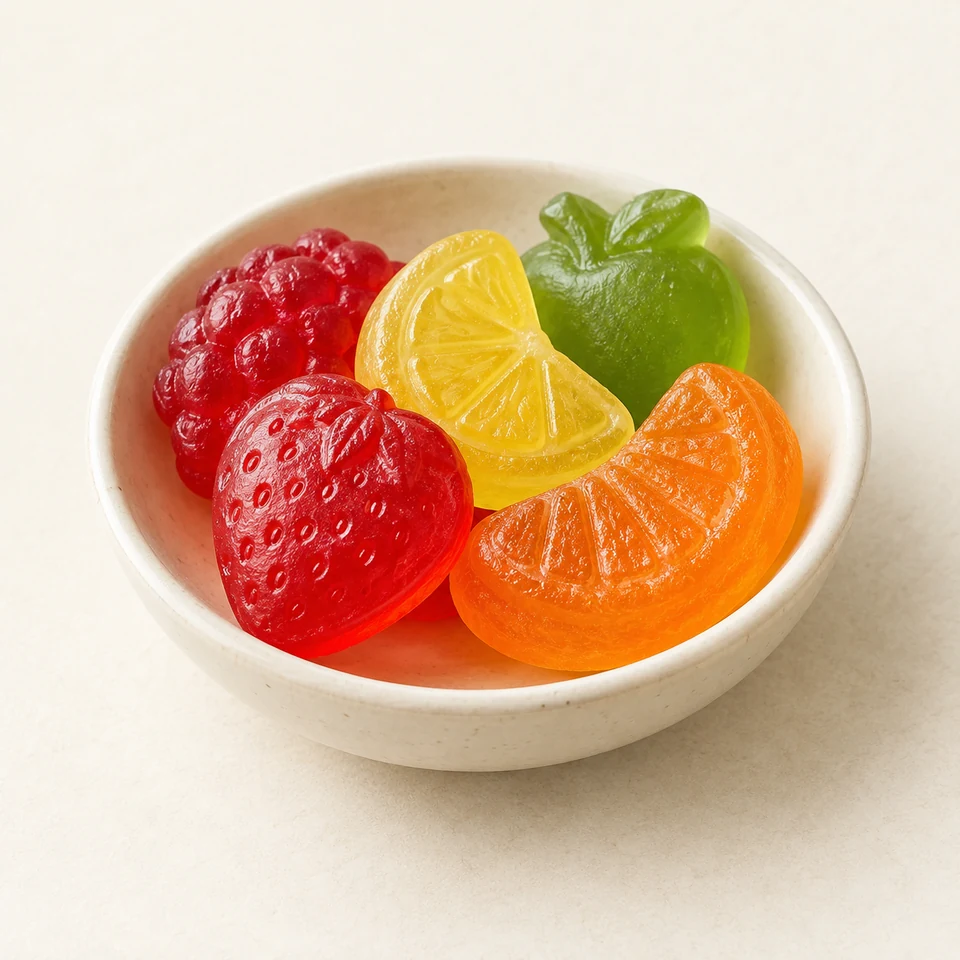
About Confectionery lollies
Confectionery lollies are individual sweet candies, often sold as molded, boiled, gelatinous, gummy, or chewy pieces. They are eaten as ready-to-consume sweets and may be shaped into fruits, animals, letters, rings, or other forms.
They may have smooth, elastic, soft, or hard textures, depending on their formulation and processing. Common ingredients include sweeteners, flavourings, colourings, and, in some varieties, gelling or setting agents, acids, or coatings; the category therefore covers varied sensory results.
Some lollies are mounted on sticks, while others are loose pieces or mixed assortments. They may be clear or opaque, with different surface finishes, fillings, and coatings; shape, firmness, and chew change with the product type and processing.
- Ingredient type
- compound ingredient
Forms & related ingredients
FOLLOW IT TO THE PLATE
Where will you meet it?
Explore the dishes that use this ingredient and their country and cuisine connections.
Explore linked dishesON A MENU OR LABEL
Find local names and written forms to help recognise this ingredient.
See local namesWhere confectionery lollies appears
1 linked foodsFind foods to recognise by country and type. Recipes and products vary; these are recorded ingredient connections.
Showing 1–1 of 1
Desserts
Ingredient connections awaiting review · Coverage is still growing, including packaged snacks.
Name examples awaiting language review. Confirm the specific food or product.
Local names for confectionery lollies
Names and romanised forms to recognise on menus and labels.
confectionery lollies
lollies
bonbons
caramelos
guloseimas
Süßigkeiten
snoepjes
caramelle
llaminadures
bomboane
cukierki
bonbony
cukríky
cukorkák
bomboni
бомбоне
bombone
бонбони
bonboni
конфеты
konfety
цукерки
tsukerky
καραμέλες
karaméles
şekerlemeler
حلويات
ḥalawiyyāt
آبنباتها
ābnabāt-hā
टॉफियाँ
ṭոֆiyā̃
ক্যান্ডি
kyānḍi
糖果
tángguǒ
キャンディー
kyandī
사탕
satang
kẹo
permen
gula-gula
pipi
karaméles
Romanised form
kyandī
Romanised form
ḥalawiyyāt
Romanised form
tsukerky
Romanised form
satang
Romanised form
kyānḍi
Romanised form
tángguǒ
Romanised form
ṭոֆiyā̃
Romanised form
konfety
Romanised form
bonboni
Romanised form
ābnabāt-hā
Romanised form
bombone
Romanised form
Available names only. Languages may be spoken in other countries; a name alone does not identify every ingredient in a dish.
Name not available yet.
A name in English has not been added for confectionery lollies. Choose another language to see its available names.
Confectionery lollies nutrition & diet
Confectionery lollies nutritional value
Product example: RAYGE CANDY & NUTS LOLLIES, 5 OZ (Rayge Candy Co. Inc.)
Per 100 g of this specific product as recorded by USDA, per 100 g.
- Calories
- 375kcal
- Protein
- 0.0g
- Carbs
- 87.5g
- Fat
- 0.0g
A product-specific label example, not a generic average. Formulations can change; use the nutrition label on the product being eaten.
Portions & preparation
Identify the exact lolly type, including hard candy, gummy, jelly, foam, liquorice-style, or filled confection, and match the edible piece or serving. Gelatin, starch, pectin, waxes, fats, colorants, coatings, acids, and fillings can vary by product and brand.
Compare the right form: Match the specific lolly style, brand or recipe, piece or serving form, setting agent, coating, filling, and edible portion.
Diet considerations
Lollies are processed confectionery, not one uniform ingredient. Some contain gelatin or other animal-derived additions, while others use plant or synthetic setting agents; cereal ingredients, dairy, coatings, and fillings may also occur. Brand and recipe determine compatibility, and portion size drives carbohydrate patterns.
AI-authored reading notes · Awaiting editorial review. Measured values, where available, have a separate source above.
Dietary compatibility
- VeganDepends on the version
- VegetarianDepends on the version
- PescatarianDepends on the version
- KetoNot established
- PaleoTypically incompatible
- Low-carbNot established
- HalalNot established
- KosherNot established
What these diet assessments mean
- Vegan · Depends on the version
- Optional or variable recorded ingredients: Gelatin. The ingredient profile identifies an animal-derived food or derivative. Recipes and products can differ.
- Vegetarian · Depends on the version
- Optional or variable recorded ingredients: Gelatin. The profile identifies animal flesh, seafood or a derivative excluded by a vegetarian diet. Recipes and products can differ.
- Pescatarian · Depends on the version
- Check the version or source of: Sugar. Check the refining process and processing aids for the particular producer.
- Keto · Not established
- A defined serving and sourced carbohydrate data are needed before assessing this dietary pattern.
- Paleo · Typically incompatible
- Recorded common ingredients: Sugar. This profile falls outside the conventional paleo pattern used here (grains and pseudograins, legumes, dairy or refined sugar). Recipes and products can differ.
- Low-carb · Not established
- A defined serving and sourced carbohydrate data are needed before assessing this dietary pattern.
- Halal · Not established
- Sourcing, processing and any applicable certification have not been verified. A food name alone does not establish halal status.
- Kosher · Not established
- Sourcing, processing and any applicable certification have not been verified. A food name alone does not establish kosher status.
For the plain ingredient · Awaiting review. Diet compatibility is not allergy suitability or halal/kosher certification. Keto and low-carb depend on the portion.
AI-generated illustration for visual context. It does not identify a particular product or establish allergen content.
Sources & review
Nutrition reference: USDA FoodData Central branded product — RAYGE CANDY & NUTS LOLLIES, 5 OZ ↗. Values are scaled from 100 g of the recorded edible form. Individual portions have no assumed fixed weight.
Expanded overview, name examples and nutrition notes are database drafts awaiting editorial review. Numeric nutrition values, where shown, have their own source and food-form reference.
The ingredient description and dish connections come from the draft catalogue and may change after review.
Last recorded verification: .