
Curing Spices
Curing spices are aromatic seasonings used to flavor meat, fish, and preserved foods during curing.
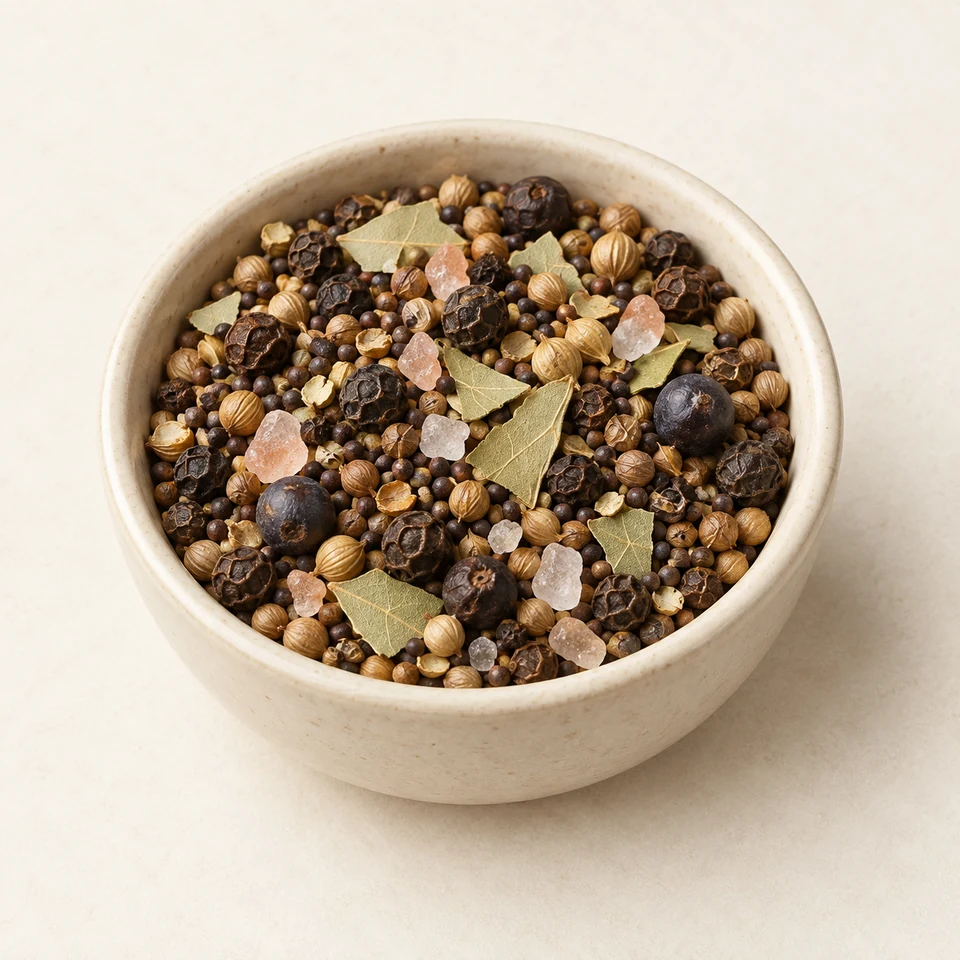
About Curing Spices
Curing spices are aromatic spices or spice mixtures used alongside curing ingredients to season meat, fish, or other foods during preservation. The term describes a culinary function rather than a fixed blend, so its composition can range from one spice to a mixture selected for a particular product.
Flavour is not uniform: it may be warm and peppery, herbal, sweet, smoky, or pungent according to the spices included. Texture similarly depends on the blend, ranging from intact seeds and crushed pieces to flakes or powder.
They are used in cured meats, fish, pickled foods, and preserved preparations, either mixed into a cure or applied to the surface. Sold forms may be whole, crushed, flaked, or powdered; retaining or removing the spices changes the finished appearance and texture.
- Ingredient type
- seasoning
Forms & related ingredients
FOLLOW IT TO THE PLATE
Where will you meet it?
Explore the dishes that use this ingredient and their country and cuisine connections.
Explore linked dishesON A MENU OR LABEL
Find local names and written forms to help recognise this ingredient.
See local namesWhere curing spices appears
1 linked foodsFind foods to recognise by country and type. Recipes and products vary; these are recorded ingredient connections.
Showing 1–1 of 1
Snacks

Ingredient connections awaiting review · Coverage is still growing, including packaged snacks.
Name examples awaiting language review. Confirm the specific food or product.
Local names for curing spices
Names and romanised forms to recognise on menus and labels.
Curing Spices
curing spices
épices de salaison
Pökelgewürze
especias para curado
spezie per la salagione
especiarias para cura
espècies per a la salaó
kruiden voor het pekelen
przyprawy do peklowania
začini za salamurenje
začini za salamurenje
зачини за саламурење
začini za salamurenje
začimbe za razsoljevanje
condimente pentru sărare
pácolófűszerek
μπαχαρικά για πάστωμα
b||||acharika gia pástoma
специи для засолки
spetsii dlya zasolki
спеції для засолювання
spetsii dlia zasoliuvannia
подправки за осоляване
podpravki za osoliavane
kürleme baharatları
腌制香料
yānzhì xiāngliào
漬け込み用スパイス
tsukekomi-yō supaisu
염지용 향신료
yeomji-yong hyangsinnyo
b||||acharika gia pástoma
Romanised form
tsukekomi-yō supaisu
Romanised form
spetsii dlia zasoliuvannia
Romanised form
yeomji-yong hyangsinnyo
Romanised form
yānzhì xiāngliào
Romanised form
spetsii dlya zasolki
Romanised form
podpravki za osoliavane
Romanised form
začini za salamurenje
Romanised form
Available names only. Languages may be spoken in other countries; a name alone does not identify every ingredient in a dish.
Name not available yet.
A name in English has not been added for curing spices. Choose another language to see its available names.
Curing Spices nutrition & diet
Curing Spices nutritional value
Representative benchmark: Spices, not further specified
Per 100 g of 100 g edible portion in the named official reference form.
- Calories
- 349kcal
- Protein
- 12.1g
- Carbs
- 30.5g
- Fat
- 14.5g
Representative benchmark from a comparable official food-composition category; it is not a laboratory measurement of this exact ingredient. The displayed reference form must be considered, and species, cultivar, recipe, brand, processing and preparation can change values.
Portions & preparation
Establish the exact curing-spice blend and the amount applied before selecting a reference, because recipes range from single spices to packaged mixtures. Record whether the blend includes salt, sugar, curing agents, herbs, smoke flavor, or carrier ingredients, and separate the spice from the cured food.
Compare the right form: Identify the brand or recipe and match the dry blend, paste, or liquid preparation, including salt, sugar, curing agents, and carriers.
Diet considerations
Curing spices are plant-derived only when the named ingredients are solely spices, but commercial blends and pastes require label or recipe review. They may contain sugar, cereal ingredients, dairy, animal-derived flavorings, or curing agents. Compatibility and carbohydrate patterns depend on the formula, applied portion, and cured food.
AI-authored reading notes · Awaiting editorial review. Measured values, where available, have a separate source above.
Dietary compatibility
- VeganNot established
- VegetarianNot established
- PescatarianNot established
- KetoNot established
- PaleoNot established
- Low-carbNot established
- HalalNot established
- KosherNot established
What these diet assessments mean
- Vegan · Not established
- The available profile does not establish the full composition or processing for this dietary pattern.
- Vegetarian · Not established
- The available profile does not establish the full composition or processing for this dietary pattern.
- Pescatarian · Not established
- The available profile does not establish the full composition or processing for this dietary pattern.
- Keto · Not established
- A defined serving and sourced carbohydrate data are needed before assessing this dietary pattern.
- Paleo · Not established
- The ingredient form and processing have not been assessed against this dietary pattern.
- Low-carb · Not established
- A defined serving and sourced carbohydrate data are needed before assessing this dietary pattern.
- Halal · Not established
- Sourcing, processing and any applicable certification have not been verified. A food name alone does not establish halal status.
- Kosher · Not established
- Sourcing, processing and any applicable certification have not been verified. A food name alone does not establish kosher status.
For the plain ingredient · Awaiting review. Diet compatibility is not allergy suitability or halal/kosher certification. Keto and low-carb depend on the portion.
AI-generated illustration for visual context. It does not identify a particular product or establish allergen content.
Sources & review
Nutrition reference: Pacific Nutrient Database 2020 — 01.1.9.4.0_99 ↗. Values are scaled from 100 g of the recorded edible form. Individual portions have no assumed fixed weight.
Expanded overview, name examples and nutrition notes are database drafts awaiting editorial review. Numeric nutrition values, where shown, have their own source and food-form reference.
The ingredient description and dish connections come from the draft catalogue and may change after review.
Last recorded verification: .