
Demi-glace sauce
Demi-glace sauce is a concentrated brown sauce traditionally made by reducing stock and used with meats and other savory dishes.
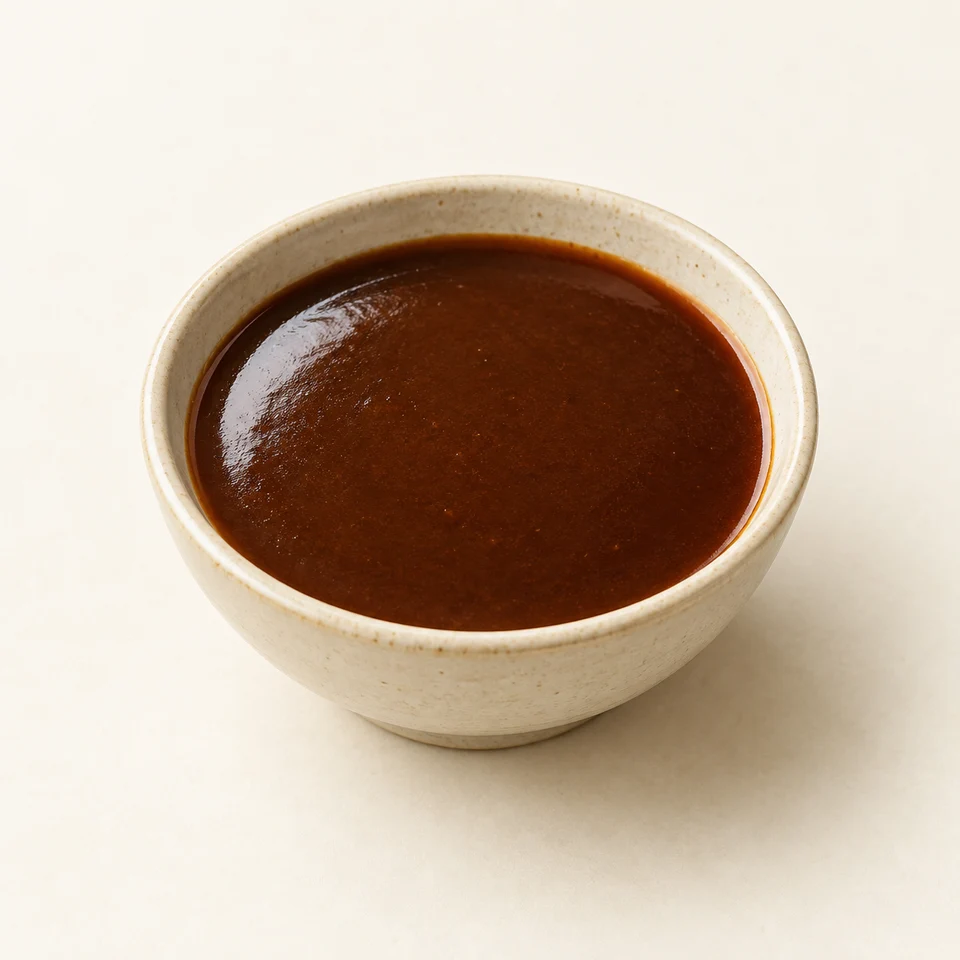
About Demi-glace sauce
Demi-glace is a concentrated brown sauce traditionally made by combining brown stock with espagnole sauce and reducing the mixture. Contemporary products and kitchen methods may instead reduce brown stock or use a prepared base, so the name covers related but nonidentical formulations. It is served with meat, poultry, and other savory dishes.
It is glossy and dark brown, with a concentrated roasted, meaty, and savory flavour. Its consistency is pourable to spoon-coating, becoming thicker as it is reduced and looser when incorporated into a thinner sauce or preparation.
Demi-glace is sold as a prepared sauce, concentrate, powder, or stock-based substitute, although formats vary by product. It is used with meat and poultry, or in pan sauces, gravies, and cooked dishes. Reduction intensifies its flavour and thickens it; dilution or blending changes its body.
- Ingredient type
- sauce
Forms & related ingredients
FOLLOW IT TO THE PLATE
Where will you meet it?
Explore the dishes that use this ingredient and their country and cuisine connections.
Explore linked dishesON A MENU OR LABEL
Find local names and written forms to help recognise this ingredient.
See local namesWhere demi-glace sauce appears
3 linked foodsFind foods to recognise by country and type. Recipes and products vary; these are recorded ingredient connections.
Showing 1–3 of 3
Main dishes

Rice dishes

Hayashi Rice
Optional additionIngredient connections awaiting review · Coverage is still growing, including packaged snacks.
Name examples awaiting language review. Confirm the specific food or product.
Local names for demi-glace sauce
Names and romanised forms to recognise on menus and labels.
demi-glace
Demi-glace sauce
demi-glace sauce
Demi-glace
salsa demi-glace
salsa demi-glace
molho demi-glace
demi-glacesaus
sos demi-glace
demi-glace sos
デミグラスソース
demigurasu sōsu
데미글라스 소스
demigeullaseu soseu
demi-glace酱
demi-glace jiàng
соус демиглас
sous demiglas
demigurasu sōsu
Romanised form
demigeullaseu soseu
Romanised form
demi-glace jiàng
Romanised form
demi-glace酱
sous demiglas
Romanised form
Available names only. Languages may be spoken in other countries; a name alone does not identify every ingredient in a dish.
Name not available yet.
A name in English has not been added for demi-glace sauce. Choose another language to see its available names.
Demi-glace sauce nutrition & diet
Demi-glace sauce nutritional value
Seasoning sauce, demi-glace sauce — MEXT 17105
Per 100 g of the edible portion in the explicitly named reference form.
- Calories
- 82kcal
- Protein
- 2.9g
- Carbs
- 11.0g
- Fat
- 3.0g
Per 100 g edible portion. Values use MEXT 2023 with March 2026 corrections; the English food name is matched by food code from the official English edition. Carbohydrate is total carbohydrate by difference. Values in parentheses in the source are estimates reported by MEXT. This reference does not cover other preparations or brands.
Portions & preparation
Match the reference to the actual demi-glace style and serving form: traditional reduced stock sauce, prepared concentrate, powder, or modern shortcut. Identify whether it contains meat stock, bones, wine, butter, flour, or added seasonings. Record the sauce portion separately from the meat, vegetables, starch, or garnish it accompanies.
Compare the right form: Use a reference matching traditional or commercial demi-glace, including stock base, concentration, thickeners, and whether it is ready-to-serve or reconstituted.
Diet considerations
Traditional demi-glace is animal-derived through meat stock and often includes gelatinous stock components, while commercial versions vary and may use other bases. Recipes can add butter, cream, wine, flour, or cereal thickeners. Compatibility depends on the full ingredient list and the accompanying meat, vegetable, or starch dish.
AI-authored reading notes · Awaiting editorial review. Measured values, where available, have a separate source above.
Dietary compatibility
- VeganDepends on the version
- VegetarianDepends on the version
- PescatarianDepends on the version
- KetoNot established
- PaleoDepends on the version
- Low-carbNot established
- HalalNot established
- KosherNot established
What these diet assessments mean
- Vegan · Depends on the version
- Optional or variable recorded ingredients: Beef stock. The ingredient profile identifies an animal-derived food or derivative. Recipes and products can differ.
- Vegetarian · Depends on the version
- Optional or variable recorded ingredients: Beef stock. The profile identifies animal flesh, seafood or a derivative excluded by a vegetarian diet. Recipes and products can differ.
- Pescatarian · Depends on the version
- Optional or variable recorded ingredients: Beef stock. The profile identifies land-animal meat or a derivative, which is excluded by this pescatarian definition. Recipes and products can differ.
- Keto · Not established
- A defined serving and sourced carbohydrate data are needed before assessing this dietary pattern.
- Paleo · Depends on the version
- Check the version or source of: Brown sauce. Optional or variable recorded ingredients: Sugar. This profile falls outside the conventional paleo pattern used here (grains and pseudograins, legumes, dairy or refined sugar). Recipes and products can differ.
- Low-carb · Not established
- A defined serving and sourced carbohydrate data are needed before assessing this dietary pattern.
- Halal · Not established
- Sourcing, processing and any applicable certification have not been verified. A food name alone does not establish halal status.
- Kosher · Not established
- Sourcing, processing and any applicable certification have not been verified. A food name alone does not establish kosher status.
For the plain ingredient · Awaiting review. Diet compatibility is not allergy suitability or halal/kosher certification. Keto and low-carb depend on the portion.
AI-generated illustration for visual context. It does not identify a particular product or establish allergen content.
Sources & review
Nutrition reference: MEXT Standard Tables of Food Composition in Japan, 2023 supplement, corrected March 2026 ↗. Values are scaled from 100 g of the recorded edible form. Individual portions have no assumed fixed weight.
Expanded overview, name examples and nutrition notes are database drafts awaiting editorial review. Numeric nutrition values, where shown, have their own source and food-form reference.
The ingredient description and dish connections come from the draft catalogue and may change after review.
Last recorded verification: .