
Edible Termites
Edible termites are harvested insects eaten roasted, fried, or incorporated into traditional dishes.
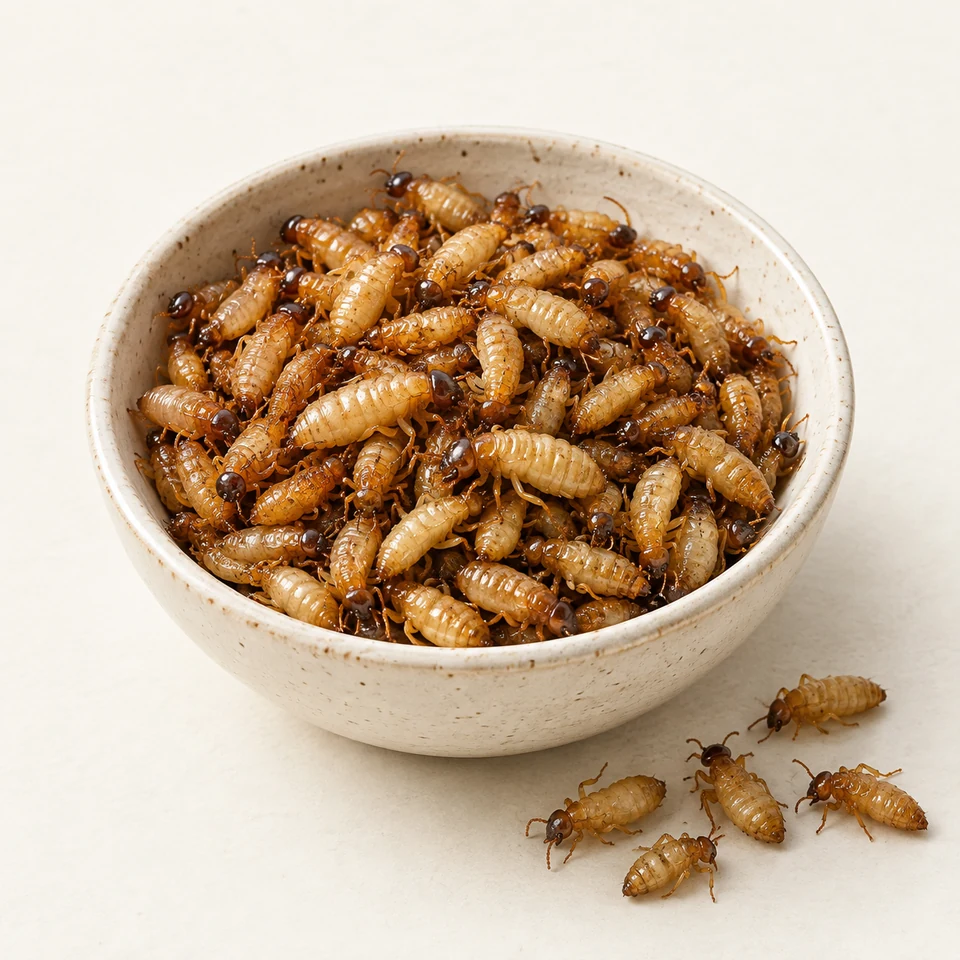
About Edible Termites
Edible termites are termites harvested for human consumption, often winged adults or other collectable castes chosen according to local practice. Different species and castes produce products that vary in size, colour, fatness, and texture. They may be eaten whole, seasoned as snacks, or added to savoury dishes.
Roasting and frying make the insects crisp, while drying produces a firmer, lighter food suited to storage. Fresh termites can be softer and more delicate. Flavour may be nutty, toasted, earthy, or savoury, with the result shaped by species, caste, maturity, harvest condition, cooking, and seasoning.
They may be sold fresh, roasted, fried, or dried. Wings and other unwanted parts can be removed before or after cooking, while some preparations retain the complete insect. Whole bodies are the usual form, although termites may also be crushed or incorporated into prepared dishes.
- Ingredient type
- whole food
FOLLOW IT TO THE PLATE
Where will you meet it?
Explore the dishes that use this ingredient and their country and cuisine connections.
Explore linked dishesON A MENU OR LABEL
Find local names and written forms to help recognise this ingredient.
See local namesWhere edible termites appears
1 linked foodsFind foods to recognise by country and type. Recipes and products vary; these are recorded ingredient connections.
Showing 1–1 of 1
Snacks

Ingredient connections awaiting review · Coverage is still growing, including packaged snacks.
Name examples awaiting language review. Confirm the specific food or product.
Local names for edible termites
Names and romanised forms to recognise on menus and labels.
Edible Termites
edible termites
termites
termitas
cupins
mchwa
Termiten
Available names only. Languages may be spoken in other countries; a name alone does not identify every ingredient in a dish.
Name not available yet.
A name in English has not been added for edible termites. Choose another language to see its available names.
Edible Termites nutrition & diet
Edible Termites nutritional value
Termite, dried, raw — WAFCT 07_082
Per 100 g of the edible portion in the named food form.
- Calories
- 518kcal
- Protein
- 34.1g
- Carbs
- 8.7g
- Fat
- 37.7g
Per 100 g edible portion. Source: Vincent et al., FAO/INFOODS Food Composition Table for Western Africa (2019). Carbohydrate is available carbohydrate calculated by difference; square-bracketed fat in the source uses continuous-extraction analysis. Values describe this reference form, not every recipe, cultivar or preparation.
Portions & preparation
Establish the termite species, harvested stage, and preparation before selecting a reference. Roasted, fried, dried, boiled, and incorporated forms can differ substantially because processing may remove moisture or add oil. Use the edible insect portion only, excluding discarded wings, debris, or cooking ingredients unless the catalogue item includes them.
Compare the right form: Match the reference to the identified termite species, edible body portion, and exact roasted, fried, dried, boiled, or recipe form.
Diet considerations
Termites are animals, so a plain edible-insect preparation is not plant-based. Compatibility changes with frying oils, animal fats, seasoning mixes, cereal coatings, sauces, or incorporation into a mixed dish. Species, harvesting practice, and recipe should be established before drawing dietary conclusions about the catalogue entry.
AI-authored reading notes · Awaiting editorial review. Measured values, where available, have a separate source above.
Dietary compatibility
- VeganTypically incompatible
- VegetarianTypically incompatible
- PescatarianNot established
- KetoNot established
- PaleoNot established
- Low-carbNot established
- HalalNot established
- KosherNot established
What these diet assessments mean
- Vegan · Typically incompatible
- The ingredient profile identifies an animal-derived food or derivative.
- Vegetarian · Typically incompatible
- The profile identifies animal flesh, seafood or a derivative excluded by a vegetarian diet.
- Pescatarian · Not established
- The animal source or category needs checking against the pescatarian definition.
- Keto · Not established
- A defined serving and sourced carbohydrate data are needed before assessing this dietary pattern.
- Paleo · Not established
- The ingredient form and processing have not been assessed against this dietary pattern.
- Low-carb · Not established
- A defined serving and sourced carbohydrate data are needed before assessing this dietary pattern.
- Halal · Not established
- Sourcing, processing and any applicable certification have not been verified. A food name alone does not establish halal status.
- Kosher · Not established
- Sourcing, processing and any applicable certification have not been verified. A food name alone does not establish kosher status.
For the plain ingredient · Awaiting review. Diet compatibility is not allergy suitability or halal/kosher certification. Keto and low-carb depend on the portion.
AI-generated illustration for visual context. It does not identify a particular product or establish allergen content.
Sources & review
Nutrition reference: FAO/INFOODS Food Composition Table for Western Africa (2019) — 07_082 ↗. Values are scaled from 100 g of the recorded edible form. Individual portions have no assumed fixed weight.
Expanded overview, name examples and nutrition notes are database drafts awaiting editorial review. Numeric nutrition values, where shown, have their own source and food-form reference.
The ingredient description and dish connections come from the draft catalogue and may change after review.
Last recorded verification: .