
Hare
Hare is a lean game meat commonly braised, roasted, or used in rich stews and pies.
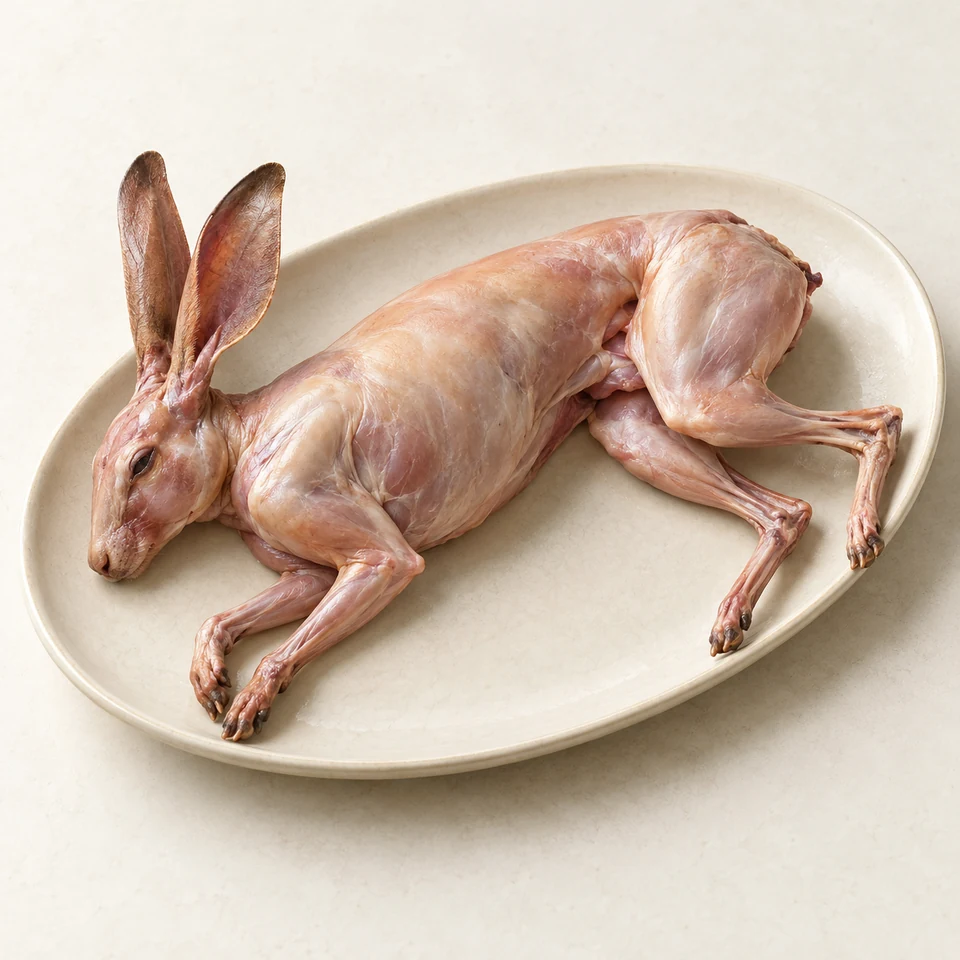
About Hare
Hare is the meat of a hare, a lean game animal with relatively dark, fine-grained flesh. It is commonly braised or stewed, and it is also roasted, baked in pies, or prepared in other long-cooked game dishes. Cuts may include whole dressed animals, portions, legs, saddle, or boned meat.
The meat is commonly described as strongly flavoured and can become dry or firm if cooked without sufficient moisture. Its texture and eating qualities vary with the animal’s age, diet, cut, hanging or ageing, and whether the meat is fresh or frozen. Rich sauces, stock, and moist cooking methods complement its pronounced flavour.
Hare may be sold as a whole dressed animal, a bone-in portion, a leg, saddle, or boned meat, in fresh or frozen form. Bones and connective tissue affect preparation and serving texture. Braising, stewing, roasting, or baking changes firmness and moisture, while sauces and stock alter the finished dish.
- Ingredient type
- whole food
FOLLOW IT TO THE PLATE
Where will you meet it?
Explore the dishes that use this ingredient and their country and cuisine connections.
Explore linked dishesON A MENU OR LABEL
Find local names and written forms to help recognise this ingredient.
See local namesWhere hare appears
3 linked foodsFind foods to recognise by country and type. Recipes and products vary; these are recorded ingredient connections.
Showing 1–3 of 3
Main dishes

Noodle dishes
Ingredient connections awaiting review · Coverage is still growing, including packaged snacks.
Name examples awaiting language review. Confirm the specific food or product.
Local names for hare
Names and romanised forms to recognise on menus and labels.
hare
lièvre
liebre
Hase
lepre
lebre
llebre
haas
haas
hare
hare
hare
héri
jänis
jänes
zaķis
kiškis
zając
zajíc
zajac
zec
зец
zec
заяц
zayats
заєць
zaiets
заек
zaek
iepure de câmp
mezei nyúl
λαγός
lagós
yabani tavşan
أرنب بري
arnab barrī
ארנבת
arnevet
野ウサギ
no-usagi
산토끼
santokki
野兔
yětù
خرگوش صحرایی
khargush-e ṣaḥrā'ī
lagós
Romanised form
no-usagi
Romanised form
hare (jugged, in wine sauce)
Search alias · Not a confirmed translation
hare (jugged, with vegetables and wine sauce)
Search alias · Not a confirmed translation
hare fresh fat tissue
Search alias · Not a confirmed translation
Hare fresh meat
Search alias · Not a confirmed translation
arnab barrī
Romanised form
zaiets
Romanised form
santokki
Romanised form
yětù
Romanised form
zayats
Romanised form
zaek
Romanised form
arnevet
Romanised form
khargush-e ṣaḥrā'ī
Romanised form
zec
Romanised form
Available names only. Languages may be spoken in other countries; a name alone does not identify every ingredient in a dish.
Name not available yet.
A name in English has not been added for hare. Choose another language to see its available names.
Hare nutrition & diet
Hare nutritional value
Reference: Hare, meat only, stewed
Per 100 g of the edible portion of the stated reference food.
- Calories
- 192kcal
- Protein
- 29.9g
- Carbs
- 0.0g
- Fat
- 8.0g
Reference example for the named food and preparation, per 100 g edible portion. This is not a universal value for every recipe or brand; packaged products should be compared with their own label. CoFID 2021 food code 18-379. Carbohydrate follows the dataset’s available-carbohydrate convention. Contains public sector information licensed under the Open Government Licence v3.0: https://www.nationalarchives.gov.uk/doc/open-government-licence/version/3/.
Portions & preparation
Reference the edible cooked hare meat separately from bones, skin, drippings, and sauce. Preparation matters: braising, roasting, stewing, and pie fillings can introduce different fats, liquids, coatings, or pastry, so the cut, cooking method, and finished dish should be recorded.
Compare the right form: Reference should match the identified hare species, edible meat cut, raw or cooked state, and whether skin, bones, sauce, or pastry remain.
Diet considerations
Animal-derived game meat. Compatibility changes when hare is combined with dairy, meat stock, bacon, flour-thickened sauce, pastry, or other animal additions. Plain cooked meat has a different carbohydrate pattern from pies and stews, so the finished preparation and portion should be distinguished from the uncombined meat.
AI-authored reading notes · Awaiting editorial review. Measured values, where available, have a separate source above.
Dietary compatibility
- VeganTypically incompatible
- VegetarianTypically incompatible
- PescatarianTypically incompatible
- KetoMay be compatible
- PaleoMay be compatible
- Low-carbMay be compatible
- HalalNot established
- KosherNot established
What these diet assessments mean
- Vegan · Typically incompatible
- The ingredient profile identifies an animal-derived food or derivative.
- Vegetarian · Typically incompatible
- The profile identifies animal flesh, seafood or a derivative excluded by a vegetarian diet.
- Pescatarian · Typically incompatible
- The profile identifies land-animal meat or a derivative, which is excluded by this pescatarian definition.
- Keto · May be compatible
- The plain form may fit a carbohydrate-restricted diet. Check the portion, added sugar, coatings and sauces against the nutrition values above.
- Paleo · May be compatible
- May fit a paleo pattern, depending on the cut or form, processing and added ingredients.
- Low-carb · May be compatible
- The plain form may fit a carbohydrate-restricted diet. Check the portion, added sugar, coatings and sauces against the nutrition values above.
- Halal · Not established
- Sourcing, processing and any applicable certification have not been verified. A food name alone does not establish halal status.
- Kosher · Not established
- Sourcing, processing and any applicable certification have not been verified. A food name alone does not establish kosher status.
For the plain ingredient · Awaiting review. Diet compatibility is not allergy suitability or halal/kosher certification. Keto and low-carb depend on the portion.
AI-generated illustration for visual context. It does not identify a particular product or establish allergen content.
Sources & review
Nutrition reference: UK Composition of Foods Integrated Dataset (CoFID), 2021 — Hare, meat only, stewed ↗. Values are scaled from 100 g of the recorded edible form. Individual portions have no assumed fixed weight.
Expanded overview, name examples and nutrition notes are database drafts awaiting editorial review. Numeric nutrition values, where shown, have their own source and food-form reference.
The ingredient description and dish connections come from the draft catalogue and may change after review.
Last recorded verification: .