
Langoustine
Langoustine is a small lobster-like crustacean with delicate, mildly sweet flesh, commonly boiled, grilled, or added to seafood dishes.
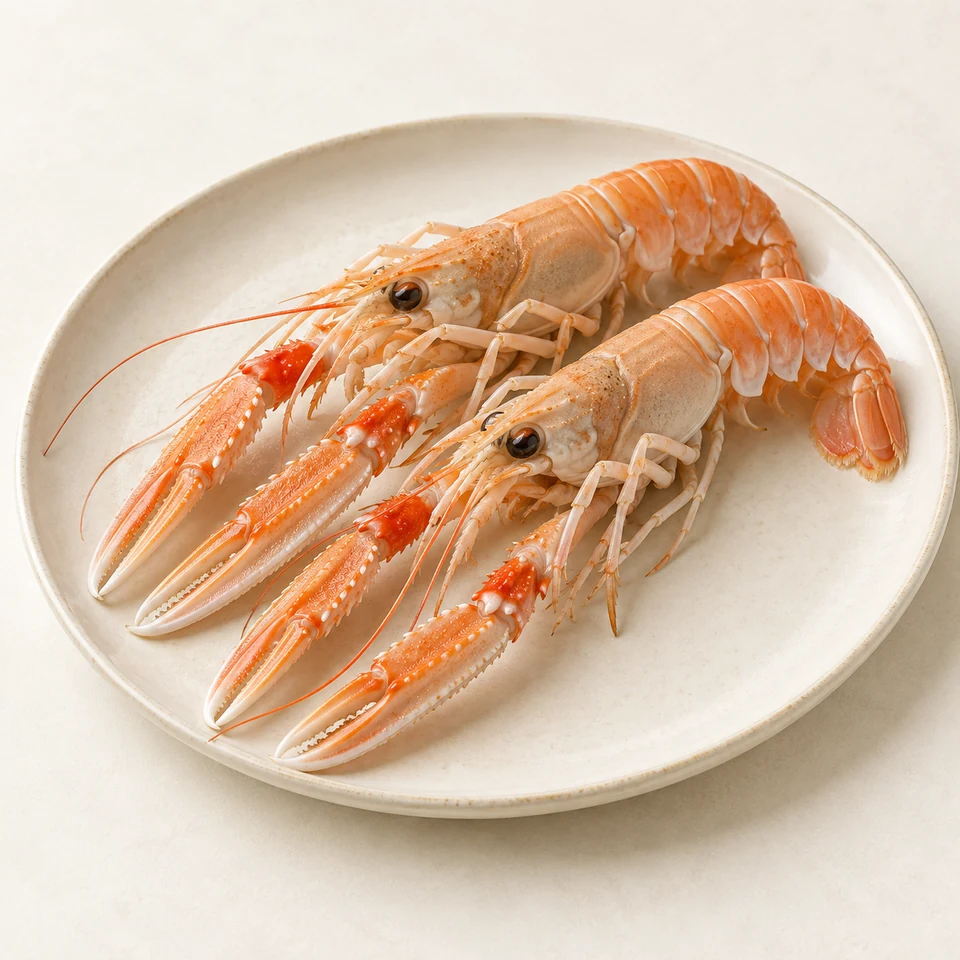
About Langoustine
Langoustine is a small lobster-like marine crustacean with slender claws, a segmented shell, and delicate flesh. It is commonly boiled, grilled, baked, or pan-cooked, and is also added to seafood dishes.
Its flesh is mildly sweet, tender, and less dense than many larger lobsters. Whole specimens provide shell and head components that can contribute flavor to stocks or sauces, while tail-only products present less shell and head material.
In culinary trade, langoustine may refer to the whole animal or its tail. It may be sold fresh, chilled, frozen, cooked, or peeled; cooking changes the flesh to a firmer, opaque form, while peeling removes the shell and head components.
- Ingredient type
- whole food
FOLLOW IT TO THE PLATE
Where will you meet it?
Explore the dishes that use this ingredient and their country and cuisine connections.
Explore linked dishesON A MENU OR LABEL
Find local names and written forms to help recognise this ingredient.
See local namesWhere langoustine appears
2 linked foodsFind foods to recognise by country and type. Recipes and products vary; these are recorded ingredient connections.
Showing 1–2 of 2
Main dishes
Soups
Ingredient connections awaiting review · Coverage is still growing, including packaged snacks.
Name examples awaiting language review. Confirm the specific food or product.
Local names for langoustine
Names and romanised forms to recognise on menus and labels.
langoustine
cigala
scampo
Langoustine
langoustine
lagostim
Kaisergranat
langoustine
escamarlà
cigala
cigala
καραβίδα Νορβηγίας
karavíða Norvigías
jomfruhummer
havskräfta
sjøkreps
humar
keisarihummeri
homarzec
норвежский омар
norvezhskiy omar
アカザエビ
akazaebi
挪威海螯虾
Nuówēi hǎi áo xiā
닭새우
daksaeu
karavíða Norvigías
Romanised form
akazaebi
Romanised form
Langoustine, boiled
Search alias · Not a confirmed translation
Langoustine, bouillie/cuite à l'eau
Search alias · Not a confirmed translation
Langoustine, panée, frite
Search alias · Not a confirmed translation
daksaeu
Romanised form
Nuówēi hǎi áo xiā
Romanised form
norvezhskiy omar
Romanised form
Available names only. Languages may be spoken in other countries; a name alone does not identify every ingredient in a dish.
Name not available yet.
A name in English has not been added for langoustine. Choose another language to see its available names.
Langoustine nutrition & diet
Langoustine nutritional value
Reference: Langoustine, boiled
Per 100 g of the edible portion of the stated reference food.
- Calories
- 86kcal
- Protein
- 19.7g
- Carbs
- 0.0g
- Fat
- 0.8g
Reference example for the named food and preparation, per 100 g edible portion. This is not a universal value for every recipe or brand; packaged products should be compared with their own label. CoFID 2021 food code 16-425. Carbohydrate follows the dataset’s available-carbohydrate convention. Contains public sector information licensed under the Open Government Licence v3.0: https://www.nationalarchives.gov.uk/doc/open-government-licence/version/3/.
Portions & preparation
Use the edible tail and claw meat after thorough cooking, removing shell and digestive tract as appropriate. Preparation changes the accompanying ingredients and added fat, while sauces, breading, or serving liquid can materially alter the composition of a recorded portion.
Compare the right form: Match references to cooked langoustine flesh, or specify raw whole langoustine, including whether shell, head, and claws are included.
Diet considerations
Langoustine is an animal-derived crustacean. Compatibility changes with butter, cream, stock, sauces, batter, or other seafood additions. Plain cooked flesh differs from breaded, fried, marinated, or prepared dishes; portion context also affects carbohydrate patterns when served with grains, potatoes, or sweet sauces.
AI-authored reading notes · Awaiting editorial review. Measured values, where available, have a separate source above.
Dietary compatibility
- VeganTypically incompatible
- VegetarianTypically incompatible
- PescatarianTypically compatible
- KetoMay be compatible
- PaleoMay be compatible
- Low-carbMay be compatible
- HalalNot established
- KosherTypically incompatible
What these diet assessments mean
- Vegan · Typically incompatible
- The ingredient profile identifies an animal-derived food or derivative.
- Vegetarian · Typically incompatible
- The profile identifies animal flesh, seafood or a derivative excluded by a vegetarian diet.
- Pescatarian · Typically compatible
- Seafood fits this pescatarian definition. Added meat-based stock or other ingredients would need checking separately.
- Keto · May be compatible
- The plain form may fit a carbohydrate-restricted diet. Check the portion, added sugar, coatings and sauces against the nutrition values above.
- Paleo · May be compatible
- May fit a paleo pattern, depending on the cut or form, processing and added ingredients.
- Low-carb · May be compatible
- The plain form may fit a carbohydrate-restricted diet. Check the portion, added sugar, coatings and sauces against the nutrition values above.
- Halal · Not established
- Sourcing, processing and any applicable certification have not been verified. A food name alone does not establish halal status.
- Kosher · Typically incompatible
- This profile identifies shellfish, which does not meet the kosher fish criteria.
For the plain ingredient · Awaiting review. Diet compatibility is not allergy suitability or halal/kosher certification. Keto and low-carb depend on the portion.
AI-generated illustration for visual context. It does not identify a particular product or establish allergen content.
Sources & review
Nutrition reference: UK Composition of Foods Integrated Dataset (CoFID), 2021 — Langoustine, boiled ↗. Values are scaled from 100 g of the recorded edible form. Individual portions have no assumed fixed weight.
Expanded overview, name examples and nutrition notes are database drafts awaiting editorial review. Numeric nutrition values, where shown, have their own source and food-form reference.
The ingredient description and dish connections come from the draft catalogue and may change after review.
Last recorded verification: .