
Maize grain
Maize grain is the dried whole seed of maize, commonly boiled, ground, or used in porridges and other dishes.
About Maize grain
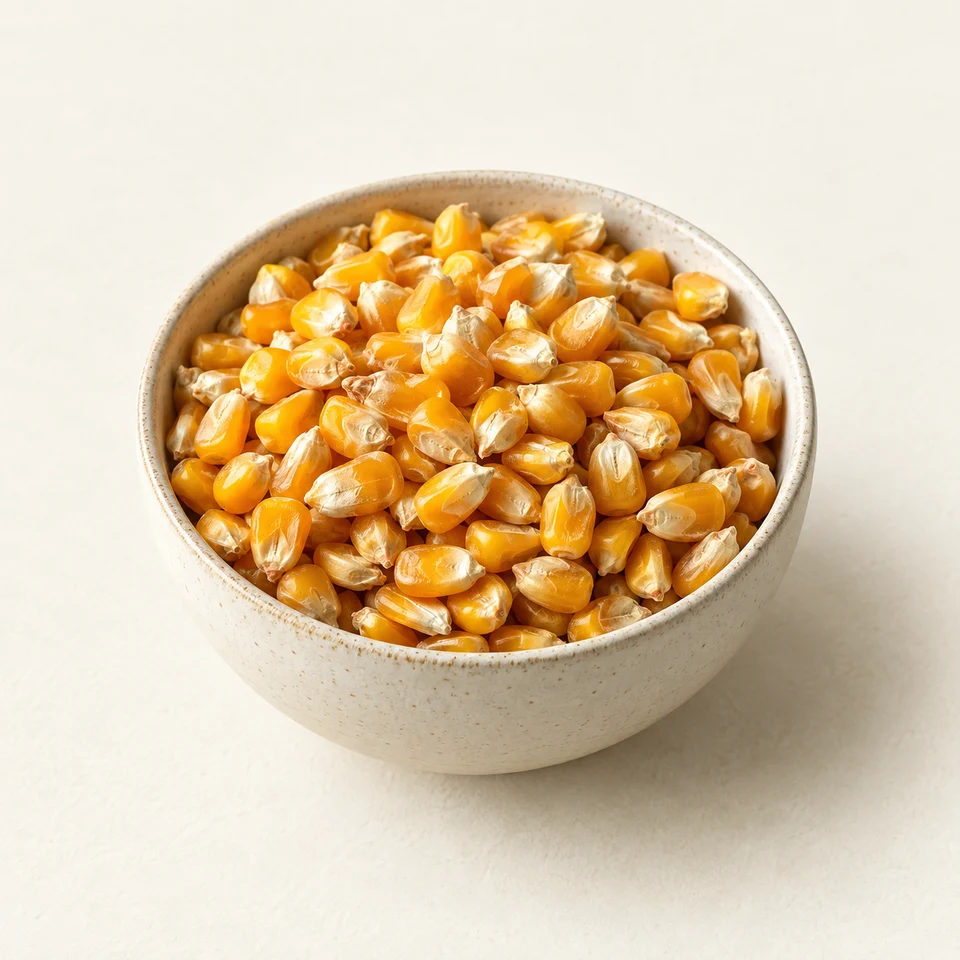
Maize grain is the dried, whole seed of maize, with each kernel remaining intact rather than being milled into flour or meal. It is used in porridges, stews, soups, and other cooked dishes, and it can be ground or cracked when a finer product is wanted. The kernels are firm and hard before cooking.
Dry maize has a mild, starchy flavour with a gentle sweetness that becomes more noticeable in some varieties. Kernel colour may be yellow, white, red, blue, or another cultivar-specific shade. Soaking and boiling make the kernels softer and more yielding, while prolonged cooking can produce a tender, chewy texture.
The grain consists of separate, solid kernels and is commonly washed before preparation. Soaking shortens the time needed for cooking and helps the kernels hydrate; cracking reduces their size and changes the final texture. Whole kernels may be boiled or simmered until tender, while ground or cracked grain is cooked as meal or porridge.
- Ingredient type
- whole food
FOLLOW IT TO THE PLATE
Where will you meet it?
Explore the dishes that use this ingredient and their country and cuisine connections.
Explore linked dishesON A MENU OR LABEL
Find local names and written forms to help recognise this ingredient.
See local namesWhere maize grain appears
3 linked foodsFind foods to recognise by country and type. Recipes and products vary; these are recorded ingredient connections.
Showing 1–3 of 3
Main dishes


Soups

Ingredient connections awaiting review · Coverage is still growing, including packaged snacks.
Name examples awaiting language review. Confirm the specific food or product.
Local names for maize grain
Names and romanised forms to recognise on menus and labels.
maize grain
dried maize
grano de maíz
grain de maïs
Maiskorn
grão de milho
chicco di mais
maïskorrel
mieliegraan
punje ya mahindi
मक्के का दाना
makke kā dānā
ভুট্টার দানা
bhuṭṭār dānā
ਮੱਕੀ ਦਾ ਦਾਣਾ
makkī dā dāṇā
मकैको दाना
makaiko dānā
மக்காச்சோளத் தானியம்
makkāccōḷat tāṉiyam
మొక్కజొన్న గింజ
mokkajonna ginja
ಮೆಕ್ಕೆಜೋಳದ ಕಾಳು
mekkejōḷada kāḷu
เมล็ดข้าวโพด
malet khao phot
hạt ngô
biji jagung
biji jagung
玉米粒
yùmǐ lì
トウモロコシの粒
tōmorokoshi no tsubu
옥수수 알
oksusu al
حبوب الذرة
ḥubūb adh-dhurra
دانه ذرت
dāne-ye zorrat
mısır tanesi
зерно кукурузы
zerno kukuruzy
зерно кукурудзи
zerno kukurudzy
ziarno kukurydzy
zrno kukuřice
zrno kukurice
kukoricaszem
boabă de porumb
царевично зърно
tsarevichno zărno
σπόρος καλαμποκιού
spóros kalampokioú
makaiko dānā
Romanised form
spóros kalampokioú
Romanised form
mekkejōḷada kāḷu
Romanised form
tōmorokoshi no tsubu
Romanised form
makkāccōḷat tāṉiyam
Romanised form
ḥubūb adh-dhurra
Romanised form
zerno kukurudzy
Romanised form
oksusu al
Romanised form
bhuṭṭār dānā
Romanised form
yùmǐ lì
Romanised form
makke kā dānā
Romanised form
zerno kukuruzy
Romanised form
tsarevichno zărno
Romanised form
dāne-ye zorrat
Romanised form
malet khao phot
Romanised form
makkī dā dāṇā
Romanised form
mokkajonna ginja
Romanised form
Available names only. Languages may be spoken in other countries; a name alone does not identify every ingredient in a dish.
Name not available yet.
A name in English has not been added for maize grain. Choose another language to see its available names.
Maize grain nutrition & diet
Maize grain nutritional value
Reference: Yellow maize, dried seeds, raw
Per 100 g of the edible portion in the named reference form.
- Calories
- 354.3kcal
- Protein
- 8.6g
- Carbs
- 69.4g
- Fat
- 4.7g
Per 100 g edible portion. SMILING Vietnam Food Composition Table (2013), hosted by FAO. Energy is the source-calculated energy; carbohydrate is total carbohydrate. Original 2013 reference values, not a current product label or a universal recipe.
Portions & preparation
Use dried whole maize grain as the reference identity, distinguishing it from fresh kernels, meal, flour, hominy, or popped products. Record soaking, boiling, nixtamalization, fermentation, grinding, and discarded parts, because processing and the final preparation determine the comparable edible portion.
Compare the right form: Match the reference to dried whole maize seed, specifying variety, treatment such as nixtamalization, cooked state, and edible portion.
Diet considerations
Maize grain is plant-derived cereal. Compatibility changes when it is nixtamalized, fermented, ground, popped, or combined with dairy, meat, sauces, or cereal ingredients. Whole cooked kernels differ from porridges and ground preparations, and portion size influences the resulting carbohydrate pattern in a meal.
AI-authored reading notes · Awaiting editorial review. Measured values, where available, have a separate source above.
Dietary compatibility
- VeganTypically compatible
- VegetarianTypically compatible
- PescatarianTypically compatible
- KetoDepends on the version
- PaleoTypically incompatible
- Low-carbDepends on the version
- HalalNot established
- KosherNot established
What these diet assessments mean
- Vegan · Typically compatible
- The plain ingredient profile is plant, fungal or mineral based. Added ingredients in a prepared product need a separate check.
- Vegetarian · Typically compatible
- The plain ingredient profile is plant, fungal or mineral based. Added ingredients in a prepared product need a separate check.
- Pescatarian · Typically compatible
- The plain ingredient profile is plant, fungal or mineral based. Added ingredients in a prepared product need a separate check.
- Keto · Depends on the version
- Compatibility depends on the portion and preparation. A sourced carbohydrate amount for a defined serving is not available.
- Paleo · Typically incompatible
- This profile falls outside the conventional paleo pattern used here (grains and pseudograins, legumes, dairy or refined sugar).
- Low-carb · Depends on the version
- Compatibility depends on the portion and preparation. A sourced carbohydrate amount for a defined serving is not available.
- Halal · Not established
- Sourcing, processing and any applicable certification have not been verified. A food name alone does not establish halal status.
- Kosher · Not established
- Sourcing, processing and any applicable certification have not been verified. A food name alone does not establish kosher status.
For the plain ingredient · Awaiting review. Diet compatibility is not allergy suitability or halal/kosher certification. Keto and low-carb depend on the portion.
AI-generated illustration for visual context. It does not identify a particular product or establish allergen content.
Sources & review
Nutrition reference: Vietnam Food Composition Table, SMILING 2013 — 1008 ↗. Values are scaled from 100 g of the recorded edible form. Individual portions have no assumed fixed weight.
Expanded overview, name examples and nutrition notes are database drafts awaiting editorial review. Numeric nutrition values, where shown, have their own source and food-form reference.
The ingredient description and dish connections come from the draft catalogue and may change after review.
Last recorded verification: .