
Mung bean noodles
Mung bean noodles are translucent noodles commonly made from mung bean starch and used in soups, stir-fries, and salads.
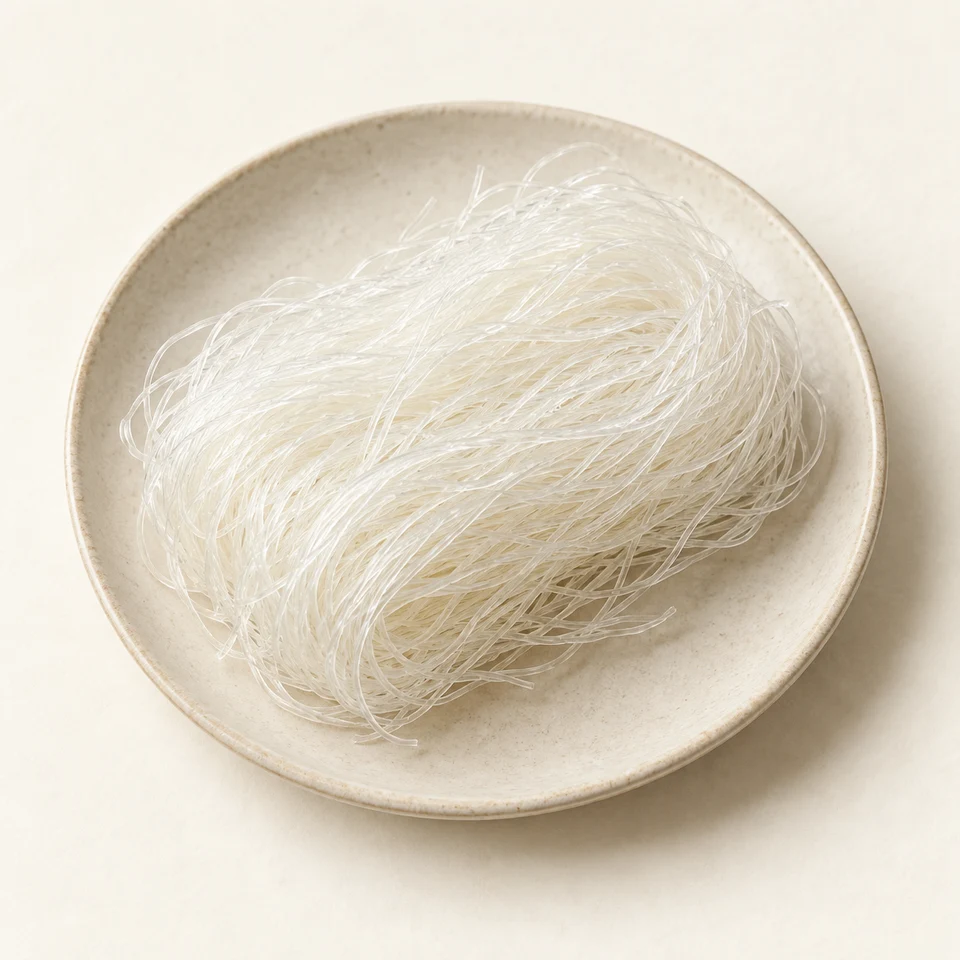
About Mung bean noodles
Mung bean noodles are noodles made wholly or partly from mung bean starch, usually sold dried and rehydrated before use. They are used in soups, stir-fries, salads, and filled or wrapped dishes, where they provide a neutral starch component.
When cooked, they are generally translucent, smooth, and slippery, with a springy or tender bite depending on thickness and cooking time. Their flavour is neutral enough to take on accompanying sauces, fillings, and broths.
Products differ in strand width, starch blend, and degree of transparency and are commonly sold dried. Rehydrating or cooking changes the strands from their dry form to a translucent, smooth, slippery noodle. In English, this name often overlaps with “mung bean glass noodles.”
- Ingredient type
- derived ingredient
Forms & related ingredients
FOLLOW IT TO THE PLATE
Where will you meet it?
Explore the dishes that use this ingredient and their country and cuisine connections.
Explore linked dishesON A MENU OR LABEL
Find local names and written forms to help recognise this ingredient.
See local namesWhere mung bean noodles appears
1 linked foodsFind foods to recognise by country and type. Recipes and products vary; these are recorded ingredient connections.
Showing 1–1 of 1
Main dishes
Ingredient connections awaiting review · Coverage is still growing, including packaged snacks.
Name examples awaiting language review. Confirm the specific food or product.
Local names for mung bean noodles
Names and romanised forms to recognise on menus and labels.
绿豆粉丝
Lǜdòu fěnsī
Mung bean noodles
mung bean noodles
绿豆粉丝
Lǜdòu fěnsī
วุ้นเส้น
Wún sên
녹두국수
Nokdu guksu
miến đậu xanh
soun kacang hijau
suhun kacang hijau
Nokdu guksu
Romanised form
Lǜdòu fěnsī
Romanised form
Wún sên
Romanised form
Available names only. Languages may be spoken in other countries; a name alone does not identify every ingredient in a dish.
Name not available yet.
A name in English has not been added for mung bean noodles. Choose another language to see its available names.
Mung bean noodles nutrition & diet
Mung bean noodles nutritional value
Noodles, chinese, cellophane or long rice (mung beans), dehydrated
Per 100 g of the edible portion in the recorded food form.
- Calories
- 351kcal
- Protein
- 0.2g
- Carbs
- 86.1g
- Fat
- 0.1g
Reference values for the specific food form shown. Other varieties, brands and preparations can differ.
Portions & preparation
Confirm whether the noodles are made solely from mung-bean starch and record dry, soaked, cooked, or drained form. Preparation in soup, stir-fry, or salad can add oil and sauces. Keep the noodle portion distinct from vegetables, proteins, broths, and garnishes.
Compare the right form: Match references to mung-bean noodles in the same dry, soaked, or cooked state, verifying composition and whether additional starches are present.
Diet considerations
Mung-bean noodles are plant-derived when the formulation is confirmed, but recipes may include other starches or additives. Compatibility changes with meat, seafood, egg, sauces, coatings, and fillings. Plain noodles and complete dishes differ in processing details and portion-dependent carbohydrate patterns.
AI-authored reading notes · Awaiting editorial review. Measured values, where available, have a separate source above.
Dietary compatibility
- VeganMay be compatible
- VegetarianMay be compatible
- PescatarianMay be compatible
- KetoNot established
- PaleoTypically incompatible
- Low-carbNot established
- HalalNot established
- KosherNot established
What these diet assessments mean
- Vegan · May be compatible
- The recorded ingredients may fit this pattern. This is not a complete recipe or manufacturing specification; check additions and preparation.
- Vegetarian · May be compatible
- The recorded ingredients may fit this pattern. This is not a complete recipe or manufacturing specification; check additions and preparation.
- Pescatarian · May be compatible
- The recorded ingredients may fit this pattern. This is not a complete recipe or manufacturing specification; check additions and preparation.
- Keto · Not established
- A defined serving and sourced carbohydrate data are needed before assessing this dietary pattern.
- Paleo · Typically incompatible
- Recorded common ingredients: Mung Bean Starch. Recorded common ingredients: Mung Bean. This profile falls outside the conventional paleo pattern used here (grains and pseudograins, legumes, dairy or refined sugar). Recipes and products can differ. Recipes and products can differ.
- Low-carb · Not established
- A defined serving and sourced carbohydrate data are needed before assessing this dietary pattern.
- Halal · Not established
- Sourcing, processing and any applicable certification have not been verified. A food name alone does not establish halal status.
- Kosher · Not established
- Sourcing, processing and any applicable certification have not been verified. A food name alone does not establish kosher status.
For the plain ingredient · Awaiting review. Diet compatibility is not allergy suitability or halal/kosher certification. Keto and low-carb depend on the portion.
AI-generated illustration for visual context. It does not identify a particular product or establish allergen content.
Sources & review
Nutrition reference: USDA FoodData Central — Noodles, chinese, cellophane or long rice (mung beans), dehydrated ↗. Values are scaled from 100 g of the recorded edible form. Individual portions have no assumed fixed weight.
Expanded overview, name examples and nutrition notes are database drafts awaiting editorial review. Numeric nutrition values, where shown, have their own source and food-form reference.
The ingredient description and dish connections come from the draft catalogue and may change after review.
Last recorded verification: .