
Prawns
Prawns are edible crustaceans commonly boiled, grilled, fried, or added to soups and noodle dishes.
About Prawns
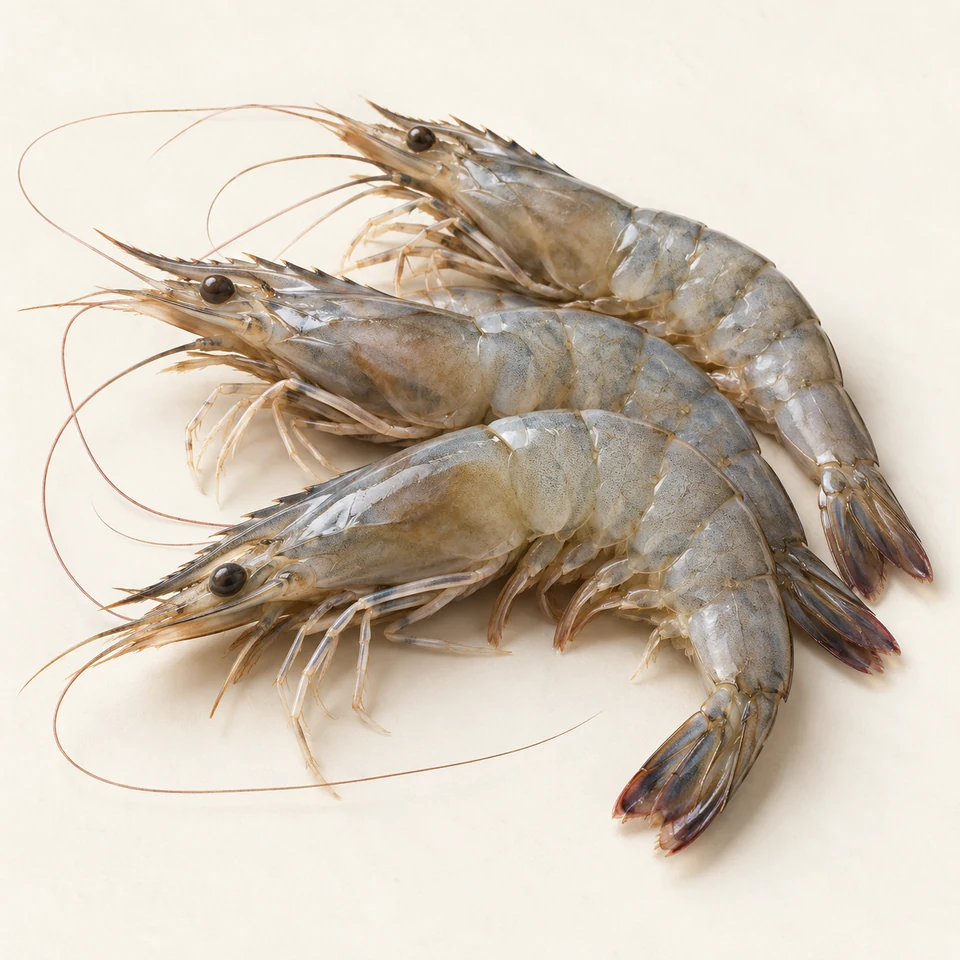
Prawns are edible decapod crustaceans with segmented bodies, shells, legs, and fan-shaped tails. They are used in salads, curries, soups, noodle dishes, rice dishes, and seafood platters, and can be boiled, steamed, grilled, fried, or stir-fried. Regional usage sometimes overlaps with the word shrimp.
Cooked prawn meat is usually mild, slightly sweet, and springy, with a firmer bite in larger specimens. Freshness, species, size, and whether the prawns are raw, frozen, or previously cooked affect flavour and texture. Overcooking makes the flesh firmer and drier.
Prawns may be sold whole, head-on, shell-on, peeled, deveined, raw, or cooked. Raw flesh is translucent and greyish or pale, becoming opaque and pink, orange, or red with heat. Shells and tails can protect the meat during cooking and contribute flavour to stocks and sauces.
- Ingredient type
- whole food
FOLLOW IT TO THE PLATE
Where will you meet it?
Explore the dishes that use this ingredient and their country and cuisine connections.
Explore linked dishesON A MENU OR LABEL
Find local names and written forms to help recognise this ingredient.
See local namesWhere prawns appears
51 linked foodsFind foods to recognise by country and type. Recipes and products vary; these are recorded ingredient connections.
Showing 49–51 of 51
Street food

Ingredient connections awaiting review · Coverage is still growing, including packaged snacks.
Name examples awaiting language review. Confirm the specific food or product.
Local names for prawns
Names and romanised forms to recognise on menus and labels.
prawns
crevettes
gambas
エビ
ebi
camarões
gamberi
Garnelen
garnalen
gambes
γαρίδες
garídes
karidesler
krewetki
krevety
krevety
garnélák
creveți
креветки
krevetki
креветки
krevetky
скариди
skaridi
škampi
шкампи
škampi
روبيان
rubiyān
میگوها
meyguhā
झींगे
jhinge
চিংড়ি
ciṅṛi
இறால்கள்
iṟālkaḷ
虾
xiā
새우
saeu
กุ้ง
kung
tôm
udang
udang
garídes
Romanised form
ebi
Romanised form
iṟālkaḷ
Romanised form
rubiyān
Romanised form
krevetky
Romanised form
saeu
Romanised form
ciṅṛi
Romanised form
xiā
Romanised form
jhinge
Romanised form
krevetki
Romanised form
skaridi
Romanised form
meyguhā
Romanised form
škampi
Romanised form
kung
Romanised form
Available names only. Languages may be spoken in other countries; a name alone does not identify every ingredient in a dish.
Name not available yet.
A name in English has not been added for prawns. Choose another language to see its available names.
Prawns nutrition & diet
Prawns nutritional value
Prawn, flesh, raw (green)
Per 100 g of the edible portion in the stated food form.
- Calories
- 91.1kcal
- Protein
- 20.7g
- Carbs
- 0.0g
- Fat
- 0.8g
Reference values apply to the named food form, not every preparation, variety or brand. © Food Standards Australia New Zealand. AFCD Release 3, food F007433. Available carbohydrate excludes sugar alcohols; energy converted from kJ to kcal (÷4.184). Australian data may not be appropriate for use in other countries. There are limitations associated with food composition databases. Food composition data used in the database or databases may represent an average of the nutrient content of a particular sample of foods and ingredients, determined at a particular time. The nutrient composition of foods and ingredients can vary substantially between batches and brands because of a number of factors, including changes in season, processing practices and ingredient source, and methods of calculation. Data licensed under the FSANZ Data User Licence Agreement, based on CC BY-SA 3.0 AU: https://www.foodstandards.gov.au/science-data/monitoringnutrients/afcd/datauserlicenceagreement.
Portions & preparation
Identify the prawn species or commercial type, shell-on or peeled state, and whether the edible portion is raw or cooked. Boiling, grilling, frying, soups, and noodle dishes introduce different accompanying ingredients. Record discarded shell and head separately, and distinguish plain prawns from breaded or composite preparations.
Compare the right form: Match the reference to the specified prawns, peeled edible portion, cooking state, and any shell, batter, sauce, marinade, noodles, or recipe additions.
Diet considerations
Prawns are animal-derived crustaceans. Plain cooked prawns differ from preparations with dairy, egg, meat stock, batter, breading, noodles, or cereal-based coatings. Soups and noodle dishes can add plant or animal ingredients, sugars, and starches. Compatibility depends on the complete recipe and serving portion, rather than the crustacean alone.
AI-authored reading notes · Awaiting editorial review. Measured values, where available, have a separate source above.
Dietary compatibility
- VeganTypically incompatible
- VegetarianTypically incompatible
- PescatarianTypically compatible
- KetoMay be compatible
- PaleoMay be compatible
- Low-carbMay be compatible
- HalalNot established
- KosherTypically incompatible
What these diet assessments mean
- Vegan · Typically incompatible
- The ingredient profile identifies an animal-derived food or derivative.
- Vegetarian · Typically incompatible
- The profile identifies animal flesh, seafood or a derivative excluded by a vegetarian diet.
- Pescatarian · Typically compatible
- Seafood fits this pescatarian definition. Added meat-based stock or other ingredients would need checking separately.
- Keto · May be compatible
- The plain form may fit a carbohydrate-restricted diet. Check the portion, added sugar, coatings and sauces against the nutrition values above.
- Paleo · May be compatible
- May fit a paleo pattern, depending on the cut or form, processing and added ingredients.
- Low-carb · May be compatible
- The plain form may fit a carbohydrate-restricted diet. Check the portion, added sugar, coatings and sauces against the nutrition values above.
- Halal · Not established
- Sourcing, processing and any applicable certification have not been verified. A food name alone does not establish halal status.
- Kosher · Typically incompatible
- This profile identifies shellfish, which does not meet the kosher fish criteria.
For the plain ingredient · Awaiting review. Diet compatibility is not allergy suitability or halal/kosher certification. Keto and low-carb depend on the portion.
AI-generated illustration for visual context. It does not identify a particular product or establish allergen content.
Sources & review
Nutrition reference: Australian Food Composition Database, Release 3, 2025 — Prawn, flesh, raw (green) ↗. Values are scaled from 100 g of the recorded edible form. Individual portions have no assumed fixed weight.
Expanded overview, name examples and nutrition notes are database drafts awaiting editorial review. Numeric nutrition values, where shown, have their own source and food-form reference.
The ingredient description and dish connections come from the draft catalogue and may change after review.
Last recorded verification: .