
Smoked pork bacon
Smoked pork bacon is cured and smoked pork belly commonly fried or used to flavor savory dishes.
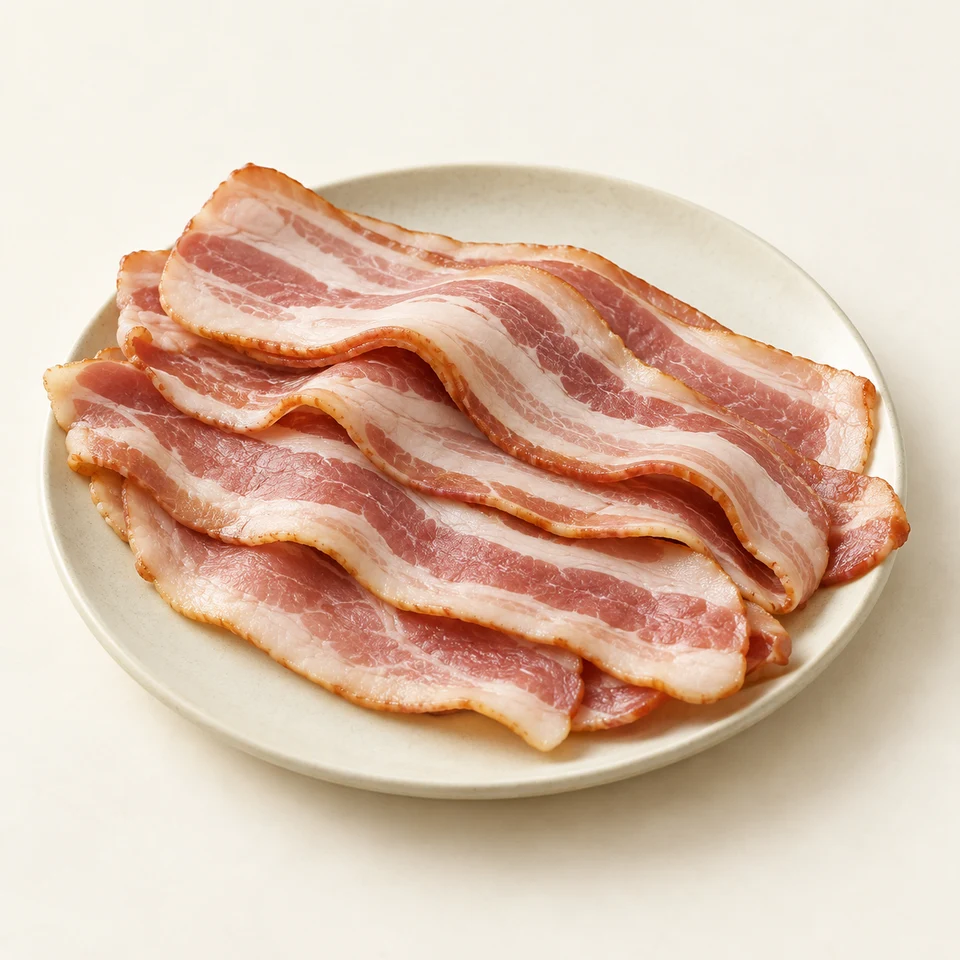
About Smoked pork bacon
Smoked pork bacon is pork belly that has been cured and exposed to smoke, usually sold in strips or slices. It has alternating layers of fat and lean meat, a smoky and savory flavor, and a firm raw texture.
Cooking changes the texture according to the method and slice thickness, producing bacon that may be crisp, chewy, or tender. It is commonly fried and served as a sliced ingredient or used to flavor soups, stews, bean dishes, sandwiches, and other savory foods.
Products may be sold sliced or as a larger piece. Differences in curing, smoking, trimming, and thickness affect their appearance and cooking behavior; the description does not specify the curing formulation, smoking method, rind, or whether a product is raw or cooked.
- Ingredient type
- whole food
FOLLOW IT TO THE PLATE
Where will you meet it?
Explore the dishes that use this ingredient and their country and cuisine connections.
Explore linked dishesON A MENU OR LABEL
Find local names and written forms to help recognise this ingredient.
See local namesWhere smoked pork bacon appears
1 linked foodsFind foods to recognise by country and type. Recipes and products vary; these are recorded ingredient connections.
Showing 1–1 of 1
Main dishes
Ingredient connections awaiting review · Coverage is still growing, including packaged snacks.
Name examples awaiting language review. Confirm the specific food or product.
Local names for smoked pork bacon
Names and romanised forms to recognise on menus and labels.
Smoked bacon
Smoked pork bacon
bacon fumé
tocino ahumado
bacó fumat
bacon fumado
bacon affumicato
Räucherspeck
gerookt spek
καπνιστό μπέικον
kapnistó béikon
füme pastırma
wędzony boczek
копчёный бекон
kopchyónyy bekon
rökt bacon
røget bacon
røkt bacon
savustettu pekoni
燻製ベーコン
kunsei bēkon
훈제 베이컨
hunje beikon
熏培根
xūn péigēn
لحم مقدد مدخن
laḥm muqaddad mudakhkhan
kapnistó béikon
Romanised form
kunsei bēkon
Romanised form
laḥm muqaddad mudakhkhan
Romanised form
hunje beikon
Romanised form
xūn péigēn
Romanised form
kopchyónyy bekon
Romanised form
Available names only. Languages may be spoken in other countries; a name alone does not identify every ingredient in a dish.
Name not available yet.
A name in English has not been added for smoked pork bacon. Choose another language to see its available names.
Smoked pork bacon nutrition & diet
Smoked pork bacon nutritional value
Reference: Pork, bacon
Per 100 g of 100 g edible portion in the named official reference form.
- Calories
- 241kcal
- Protein
- 15.4g
- Carbs
- 3.2g
- Fat
- 19.4g
Official national food-composition reference. The displayed food form is part of the estimate; cultivar, recipe, brand, processing and preparation can change values.
Portions & preparation
Match cured, smoked pork belly by raw or cooked state, slice thickness, rind, and rendered-fat treatment. Fried bacon may be drained or served with its cooking fat, while chopped bacon in dishes can carry sauces, dairy, vegetables, or cereal ingredients. Keep the plain product separate from the completed recipe.
Compare the right form: Match smoked cured pork belly by raw or cooked state, slice or piece form, rind, trimming, drained status, and edible portion.
Diet considerations
Smoked pork bacon is animal-derived and differs from uncured pork or bacon-flavored substitutes. Compatibility changes with curing sugars, coatings, dairy, cereal ingredients, sweet glazes, or recipe additions. Plain cooked slices differ from bacon in sandwiches, soups, and baked dishes; bread, potatoes, grains, and pasta can alter the carbohydrate pattern.
AI-authored reading notes · Awaiting editorial review. Measured values, where available, have a separate source above.
Dietary compatibility
- VeganTypically incompatible
- VegetarianTypically incompatible
- PescatarianTypically incompatible
- KetoMay be compatible
- PaleoMay be compatible
- Low-carbMay be compatible
- HalalTypically incompatible
- KosherTypically incompatible
What these diet assessments mean
- Vegan · Typically incompatible
- The ingredient profile identifies an animal-derived food or derivative.
- Vegetarian · Typically incompatible
- The profile identifies animal flesh, seafood or a derivative excluded by a vegetarian diet.
- Pescatarian · Typically incompatible
- The profile identifies land-animal meat or a derivative, which is excluded by this pescatarian definition.
- Keto · May be compatible
- The plain form may fit a carbohydrate-restricted diet. Check the portion, added sugar, coatings and sauces against the nutrition values above.
- Paleo · May be compatible
- May fit a paleo pattern, depending on the cut or form, processing and added ingredients.
- Low-carb · May be compatible
- The plain form may fit a carbohydrate-restricted diet. Check the portion, added sugar, coatings and sauces against the nutrition values above.
- Halal · Typically incompatible
- This profile identifies pork or a pork-derived ingredient.
- Kosher · Typically incompatible
- This profile identifies pork or a pork-derived ingredient.
For the plain ingredient · Awaiting review. Diet compatibility is not allergy suitability or halal/kosher certification. Keto and low-carb depend on the portion.
AI-generated illustration for visual context. It does not identify a particular product or establish allergen content.
Sources & review
Nutrition reference: Standard Tables of Food Composition in Japan 2023, corrected March 2026 — 11183 ↗. Values are scaled from 100 g of the recorded edible form. Individual portions have no assumed fixed weight.
Expanded overview, name examples and nutrition notes are database drafts awaiting editorial review. Numeric nutrition values, where shown, have their own source and food-form reference.
The ingredient description and dish connections come from the draft catalogue and may change after review.
Last recorded verification: .