
Sugarcane
Sugarcane is a tall grass cultivated for its sweet juice, which is commonly processed into sugar and syrup.
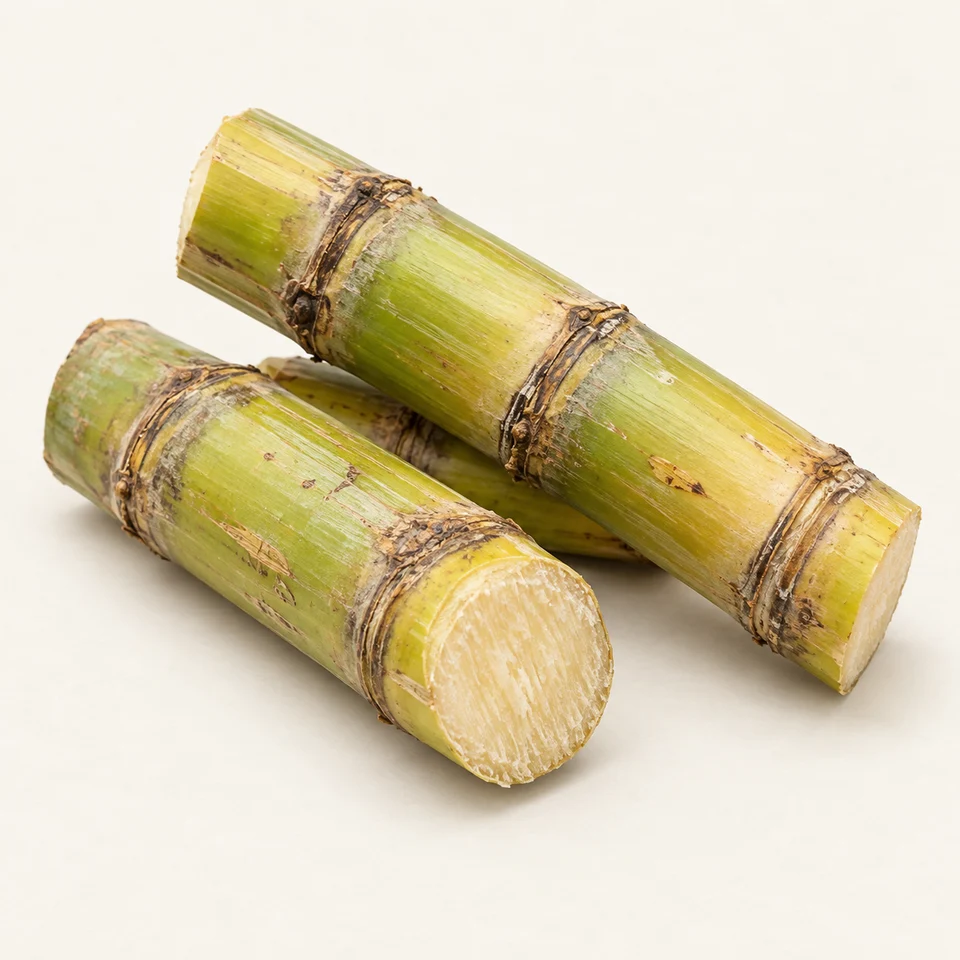
About Sugarcane
Sugarcane is a tall, jointed grass cultivated for the sweet juice in its thick stalks. Fresh stalks have a fibrous outer surface and a juicy, crisp interior that releases a sweet, grassy liquid when chewed or crushed.
Fresh cane is chewed for its juice, while pressed juice is served as a beverage or used in cooking. The stalk itself is fibrous and crisp; extracted juice is liquid, and further processing produces different forms rather than preserving the intact plant.
The whole stalk may be sold fresh. Juice may be filtered, chilled, or concentrated, and sugarcane can be processed into cane syrup, molasses, or crystallized sugar. Stalks, juice, and processed products therefore differ in texture, appearance, and culinary use.
- Ingredient type
- whole food
FOLLOW IT TO THE PLATE
Where will you meet it?
Explore the dishes that use this ingredient and their country and cuisine connections.
Explore linked dishesON A MENU OR LABEL
Find local names and written forms to help recognise this ingredient.
See local namesWhere sugarcane appears
1 linked foodsFind foods to recognise by country and type. Recipes and products vary; these are recorded ingredient connections.
Showing 1–1 of 1
Street food

Ingredient connections awaiting review · Coverage is still growing, including packaged snacks.
Name examples awaiting language review. Confirm the specific food or product.
Local names for sugarcane
Names and romanised forms to recognise on menus and labels.
sugarcane
caña de azúcar
canne à sucre
canna da zucchero
cana-de-açúcar
Zuckerrohr
suikerriet
suikerriet
canya de sucre
trzcina cukrowa
cukrová třtina
cukrová trstina
cukornád
trestie de zahăr
сахарный тростник
sakharnyy trostnik
цукрова тростина
tsukrova trostyna
захарна тръстика
zakhарna trăstika
ζαχαροκάλαμο
zacharokálamo
şeker kamışı
نیشکر
neyshकर
قصب السكر
qaṣab al-sukkar
קנה סוכר
qנה sukar
गन्ना
gannā
আখ
ākh
கரும்பு
karumpu
చెరకు
ceraku
ಕಬ್ಬು
kabbu
കരിമ്പ്
karimb
उखु
ukhu
උක්
uk
サトウキビ
satōkibi
사탕수수
satangssu
甘蔗
gānzhè
cây mía
อ้อย
ɔ̂i
អំពៅ
ʼɑmpɨw
ອ້ອຍ
ɔ̂i
ကြံ
kyan
tebu
tebu
miwa
kākanikura
ʻohe kō
ukhu
Romanised form
zacharokálamo
Romanised form
kabbu
Romanised form
satōkibi
Romanised form
ʼɑmpɨw
Romanised form
karumpu
Romanised form
ɔ̂i
Romanised form
qaṣab al-sukkar
Romanised form
tsukrova trostyna
Romanised form
satangssu
Romanised form
ākh
Romanised form
uk
Romanised form
gānzhè
Romanised form
gannā
Romanised form
karimb
Romanised form
sakharnyy trostnik
Romanised form
kyan
Romanised form
zakhарna trăstika
Romanised form
qנה sukar
Romanised form
neyshकर
Romanised form
ɔ̂i
Romanised form
ceraku
Romanised form
Available names only. Languages may be spoken in other countries; a name alone does not identify every ingredient in a dish.
Name not available yet.
A name in English has not been added for sugarcane. Choose another language to see its available names.
Sugarcane nutrition & diet
Sugarcane nutritional value
Reference: Sugar cane, Raw
Per 100 g of 100 g edible portion in the named official reference form.
- Calories
- 77kcal
- Protein
- 1.1g
- Carbs
- 20.9g
- Fat
- 0.0g
Official national food-composition reference. The displayed food form is part of the estimate; cultivar, recipe, brand, processing and preparation can change values.
Portions & preparation
Clarify whether the edible item is peeled cane stalk, freshly pressed juice, or a processed cane product before using a reference. For stalk pieces, only the chewed juice is typically consumed and fibrous residue is discarded. Preparation, extraction, and serving style materially change the edible portion recorded.
Compare the right form: Match the reference to peeled raw cane stalk, extracted fresh juice, or a named processed cane product; these are not interchangeable forms.
Diet considerations
Sugarcane is a plant grass. Compatibility changes when it is processed into syrup, sugar, juice blends, or confectionery, especially if dairy, gelatin, honey, or cereal ingredients are added. The stalk’s fibrous chewing residue differs from its extracted juice, and carbohydrate patterns depend on the edible form and portion.
AI-authored reading notes · Awaiting editorial review. Measured values, where available, have a separate source above.
Dietary compatibility
- VeganTypically compatible
- VegetarianTypically compatible
- PescatarianTypically compatible
- KetoDepends on the version
- PaleoTypically compatible
- Low-carbDepends on the version
- HalalNot established
- KosherNot established
What these diet assessments mean
- Vegan · Typically compatible
- The plain ingredient profile is plant, fungal or mineral based. Added ingredients in a prepared product need a separate check.
- Vegetarian · Typically compatible
- The plain ingredient profile is plant, fungal or mineral based. Added ingredients in a prepared product need a separate check.
- Pescatarian · Typically compatible
- The plain ingredient profile is plant, fungal or mineral based. Added ingredients in a prepared product need a separate check.
- Keto · Depends on the version
- Compatibility depends on the portion and preparation. A sourced carbohydrate amount for a defined serving is not available.
- Paleo · Typically compatible
- The plain form fits the conventional paleo food groups. Added ingredients and individual interpretations can differ.
- Low-carb · Depends on the version
- Compatibility depends on the portion and preparation. A sourced carbohydrate amount for a defined serving is not available.
- Halal · Not established
- Sourcing, processing and any applicable certification have not been verified. A food name alone does not establish halal status.
- Kosher · Not established
- Sourcing, processing and any applicable certification have not been verified. A food name alone does not establish kosher status.
For the plain ingredient · Awaiting review. Diet compatibility is not allergy suitability or halal/kosher certification. Keto and low-carb depend on the portion.
AI-generated illustration for visual context. It does not identify a particular product or establish allergen content.
Sources & review
Nutrition reference: Korean Standard Food Composition Database 10.4 (2026) — F0970000000a ↗. Values are scaled from 100 g of the recorded edible form. Individual portions have no assumed fixed weight.
Expanded overview, name examples and nutrition notes are database drafts awaiting editorial review. Numeric nutrition values, where shown, have their own source and food-form reference.
The ingredient description and dish connections come from the draft catalogue and may change after review.
Last recorded verification: .