
Wheat berries
Wheat berries are whole wheat kernels used in pilafs, salads, porridges, and other grain dishes.
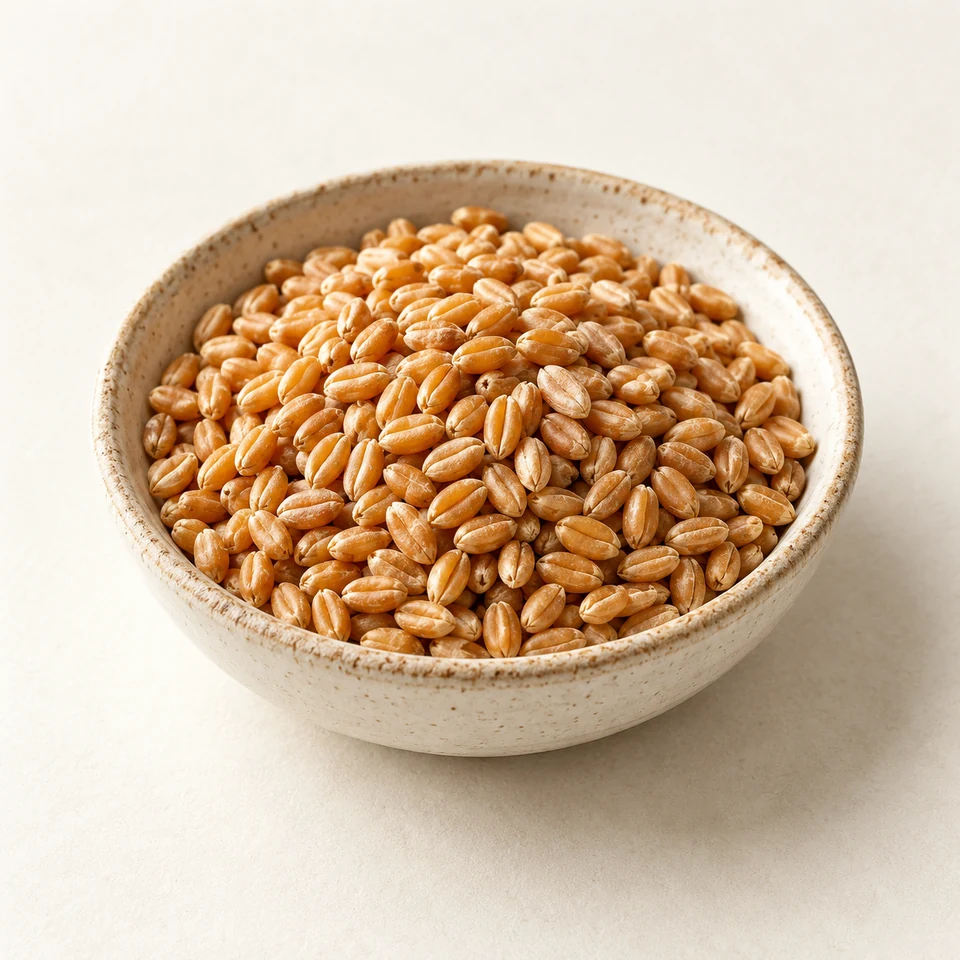
About Wheat berries
Whole-wheat berries are intact wheat kernels containing the bran, germ, and endosperm. They are cooked as a grain in pilafs, salads, soups, stuffings, and side dishes, and they can be milled into whole-wheat flour. Hard and soft wheat types, as well as red and white wheats, give different culinary results.
Dry kernels are firm, oval to elongated, and may be pale tan, reddish brown, or darker. After cooking, they have a pleasantly chewy texture and a nutty, wheaty flavour. Hard varieties generally stay especially firm, while softer varieties cook more tenderly.
They are commonly sold dry, either loose or packaged, and may also appear precooked or ready to eat. Soaking and simmering soften the kernels; draining leaves them suitable for salads or pilafs, while milling turns them into flour. They differ from pearled wheat because the outer layers remain intact.
- Ingredient type
- whole food
FOLLOW IT TO THE PLATE
Where will you meet it?
Explore the dishes that use this ingredient and their country and cuisine connections.
Explore linked dishesON A MENU OR LABEL
Find local names and written forms to help recognise this ingredient.
See local namesWhere wheat berries appears
13 linked foodsFind foods to recognise by country and type. Recipes and products vary; these are recorded ingredient connections.
Showing 13–13 of 13
Soups
Ingredient connections awaiting review · Coverage is still growing, including packaged snacks.
Name examples awaiting language review. Confirm the specific food or product.
Local names for wheat berries
Names and romanised forms to recognise on menus and labels.
Whole-wheat berries
wheat berries
Weizenbeeren
حبوب القمح
ḥubūb al-qamḥ
granos de trigo
grains de blé
grãos de trigo
chicchi di grano
tarwekorrels
vetekärnor
hvedekerner
hvetekjerner
vehnänjyvät
ziarna pszenicy
pšeničná zrna
зерна пшеницы
zerna pshenitsy
зерна пшениці
zerna pshenitsi
गेहूँ के दाने
gehū̃ ke dāne
গমের দানা
gomer dānā
گندم کے دانے
gandum ke dāne
دانهٔ گندم
dāne-ye gandom
buğday tanesi
小麦粒
komugitsubu
小麦粒
xiǎomài lì
밀알
milal
komugitsubu
Romanised form
ḥubūb al-qamḥ
Romanised form
tsili zerna pshen ytsi
Romanised form
zerna pshenitsi
Romanised form
цілі зерна пшениці
milal
Romanised form
tongmiral
Romanised form
통밀알
gomer dānā
Romanised form
całe ziarna pszenicy
xiǎomài lì
Romanised form
zhěnglì xiǎomài
Romanised form
整粒小麦
gehū̃ ke dāne
Romanised form
sābut gehū̃ ke dāne
Romanised form
साबुत गेहूँ के दाने
grains de blé entiers
tam buğday taneleri
ganze Weizenkörner
gandum ke dāne
Romanised form
tsel'nye zyorna pshenitsy
Romanised form
zerna pshenitsy
Romanised form
цельные зёрна пшеницы
hele hvetekorn
hela vetekärnor
hele tarwekorrels
chicchi di grano interi
dāne-ye gandom
Romanised form
celá pšeničná zrna
kokonaiset vehnänjyvät
grãos de trigo inteiros
granos de trigo enteros
egész búzaszemek
hele hvedekerner
Whole Wheat Berries
Search alias · Not a confirmed translation
Whole-wheat berries
Search alias · Not a confirmed translation
Available names only. Languages may be spoken in other countries; a name alone does not identify every ingredient in a dish.
Name not available yet.
A name in English has not been added for wheat berries. Choose another language to see its available names.
Wheat berries nutrition & diet
Wheat berries nutritional value
Wheat, whole, uncooked
Per 100 g of the edible portion in the stated food form.
- Calories
- 325.5kcal
- Protein
- 11.2g
- Carbs
- 58.3g
- Fat
- 2.4g
Reference values apply to the named food form, not every preparation, variety or brand. © Food Standards Australia New Zealand. AFCD Release 3, food F009537. Available carbohydrate excludes sugar alcohols; energy converted from kJ to kcal (÷4.184). Australian data may not be appropriate for use in other countries. There are limitations associated with food composition databases. Food composition data used in the database or databases may represent an average of the nutrient content of a particular sample of foods and ingredients, determined at a particular time. The nutrient composition of foods and ingredients can vary substantially between batches and brands because of a number of factors, including changes in season, processing practices and ingredient source, and methods of calculation. Data licensed under the FSANZ Data User Licence Agreement, based on CC BY-SA 3.0 AU: https://www.foodstandards.gov.au/science-data/monitoringnutrients/afcd/datauserlicenceagreement.
Portions & preparation
Use intact wheat kernels and distinguish dry from cooked berries or flour made from them. Cooking changes water content and serving volume; milling changes the food form and culinary use. Record soaking, sprouting, added oil, sweeteners, vegetables, dairy, or meat in the finished dish separately.
Compare the right form: Match a reference for intact whole-wheat kernels, specifying dry or cooked state, variety when known, and plain edible portion.
Diet considerations
This is a plant-derived cereal containing wheat, but preparation may add dairy, meat, sweeteners, oils, or other ingredients. Wheat-based foods are not suitable for gluten-avoidance patterns unless the exact context establishes otherwise. Cooked berries, milled flour, and mixed grain dishes differ in portion-dependent carbohydrate patterns.
AI-authored reading notes · Awaiting editorial review. Measured values, where available, have a separate source above.
Dietary compatibility
- VeganTypically compatible
- VegetarianTypically compatible
- PescatarianTypically compatible
- KetoDepends on the version
- PaleoTypically incompatible
- Low-carbDepends on the version
- HalalNot established
- KosherNot established
What these diet assessments mean
- Vegan · Typically compatible
- The plain ingredient profile is plant, fungal or mineral based. Added ingredients in a prepared product need a separate check.
- Vegetarian · Typically compatible
- The plain ingredient profile is plant, fungal or mineral based. Added ingredients in a prepared product need a separate check.
- Pescatarian · Typically compatible
- The plain ingredient profile is plant, fungal or mineral based. Added ingredients in a prepared product need a separate check.
- Keto · Depends on the version
- Compatibility depends on the portion and preparation. A sourced carbohydrate amount for a defined serving is not available.
- Paleo · Typically incompatible
- This profile falls outside the conventional paleo pattern used here (grains and pseudograins, legumes, dairy or refined sugar).
- Low-carb · Depends on the version
- Compatibility depends on the portion and preparation. A sourced carbohydrate amount for a defined serving is not available.
- Halal · Not established
- Sourcing, processing and any applicable certification have not been verified. A food name alone does not establish halal status.
- Kosher · Not established
- Sourcing, processing and any applicable certification have not been verified. A food name alone does not establish kosher status.
For the plain ingredient · Awaiting review. Diet compatibility is not allergy suitability or halal/kosher certification. Keto and low-carb depend on the portion.
AI-generated illustration for visual context. It does not identify a particular product or establish allergen content.
Sources & review
Nutrition reference: Australian Food Composition Database, Release 3, 2025 — Wheat, whole, uncooked ↗. Values are scaled from 100 g of the recorded edible form. Individual portions have no assumed fixed weight.
Expanded overview, name examples and nutrition notes are database drafts awaiting editorial review. Numeric nutrition values, where shown, have their own source and food-form reference.
The ingredient description and dish connections come from the draft catalogue and may change after review.
Last recorded verification: .