
DISH RESEARCH · Soup
Belarusian Borscht
A Belarusian family borscht adaptation. A Global Garnish adapts the author’s grandfather Simon’s borscht, using pork-rib stock with diced beets, carrots and cabbage. This selected branch discards bones and onion and follows the author’s preference for leaving the cooked rib meat out of the finished soup; the pork-made broth remains.
About Belarusian Borscht
Research draft based on the references below. These notes describe particular recipes and presentations; ingredient connections are still being reviewed.
A Belarusian family borscht adaptation. A Global Garnish adapts the author’s grandfather Simon’s borscht, using pork-rib stock with diced beets, carrots and cabbage. This selected branch discards bones and onion and follows the author’s preference for leaving the cooked rib meat out of the finished soup; the pork-made broth remains.
A pronounced sweet-and-sour kick. The author explicitly describes this family version as more sweet-and-sour than many borschts. Brown sugar and cider vinegar are adjusted to balance that taste, with dill and ketchup added near the end. The author identifies ketchup as a personal adaptation rather than a traditional universal ingredient.
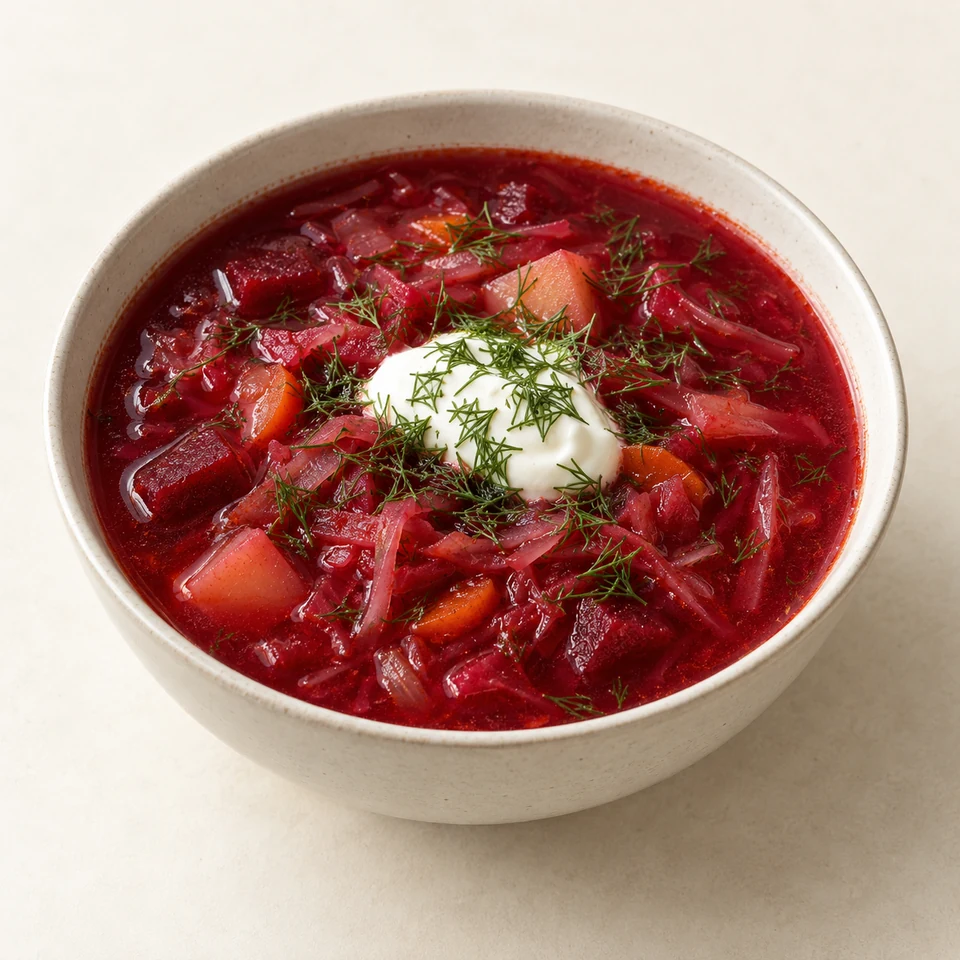
Tender vegetables, without added rib pieces. Large-diced beets and carrots and similarly sized cabbage pieces cook until just tender. The author prefers this soup’s texture without the rib meat returned to it. Sour cream is served with the soup; its inclusion does not supply a stated final temperature.
Ingredients in Belarusian Borscht
Baby-back pork ribs, salt, unspecified pepper, olive oil, onion and water make the stock. The soup adds beets, carrots, selected green cabbage, garlic, brown sugar, salt, unspecified pepper, dill, cider vinegar and ketchup. Sour cream is served with it. The strained pork cooking broth is this recipe’s own preparation, not commercial beef broth.
Source limits: Pepper species, full ketchup/sour-cream declarations and exact initial seasoning amounts unresolved; onion cut differs between card and method.
- Pork ribs[1]Recipe ingredient
- Salt[1]Recipe ingredient
- Unspecified pepper[1]Identity unresolved
- Olive Oil[1]Cooking medium
- Onion[1]Recipe ingredient
- Water[1]Recipe ingredient
- Beetroot[1]Recipe ingredient
- Carrot[1]Recipe ingredient
- Cabbage[1]Recipe ingredient
- Garlic[1]Recipe ingredient
- Brown Sugar[1]Recipe ingredient
- Salt[1]Recipe ingredient
- Unspecified pepper[1]Identity unresolved
- Dill[1]Recipe ingredient
- cider vinegar[1]Recipe ingredient
- Ketchup[1]Identity unresolved
- Sour Cream[1]Recipe ingredientSource-specific formulation remains unresolved.
- Water[1]Recipe ingredient
- Reserved pork cooking broth[1]Identity unresolved
These foods describe the cited recipe. Ask the kitchen about its version and any additional ingredients or handling.
Origins & food traditions
Explore the countries and cooking traditions associated with this dish. These connections do not establish a single birthplace or limit where the dish is eaten today.
The author recounts learning food and heritage from grandfather Simon, who was born and raised in Belarus and later lived in the United States. The published borscht is adapted from his recipe, including a nontraditional ketchup preference. This personal family account does not establish a universal Belarusian recipe or exclusive origin.
Source limits: No national formula, invention date or universal ceremonial serving tradition established.
Countries
Cuisines & regions
Associations in the cited sources
These describe source-specific cultural or geographic connections. Catalogue links may still need review.
- Countries & places
- Belarus
- Cooking traditions
- Belarusian Cuisine
AI-generated illustration of one possible presentation. Recipes and ingredients vary; the image does not establish allergen content.
Sources & references
The Global Garnish Geek / A Global Garnish, “My Grandfather’s Belarusian Borscht” (11 March 2013), adapted from grandfather Simon’s recipe. Selected green-cabbage and no-returned-rib-meat branches; ketchup remains an explicitly personal adaptation.