
Cooked ham
Cooked ham is cured pork that has been cooked and is served sliced or used in sandwiches, salads, and cooked dishes.
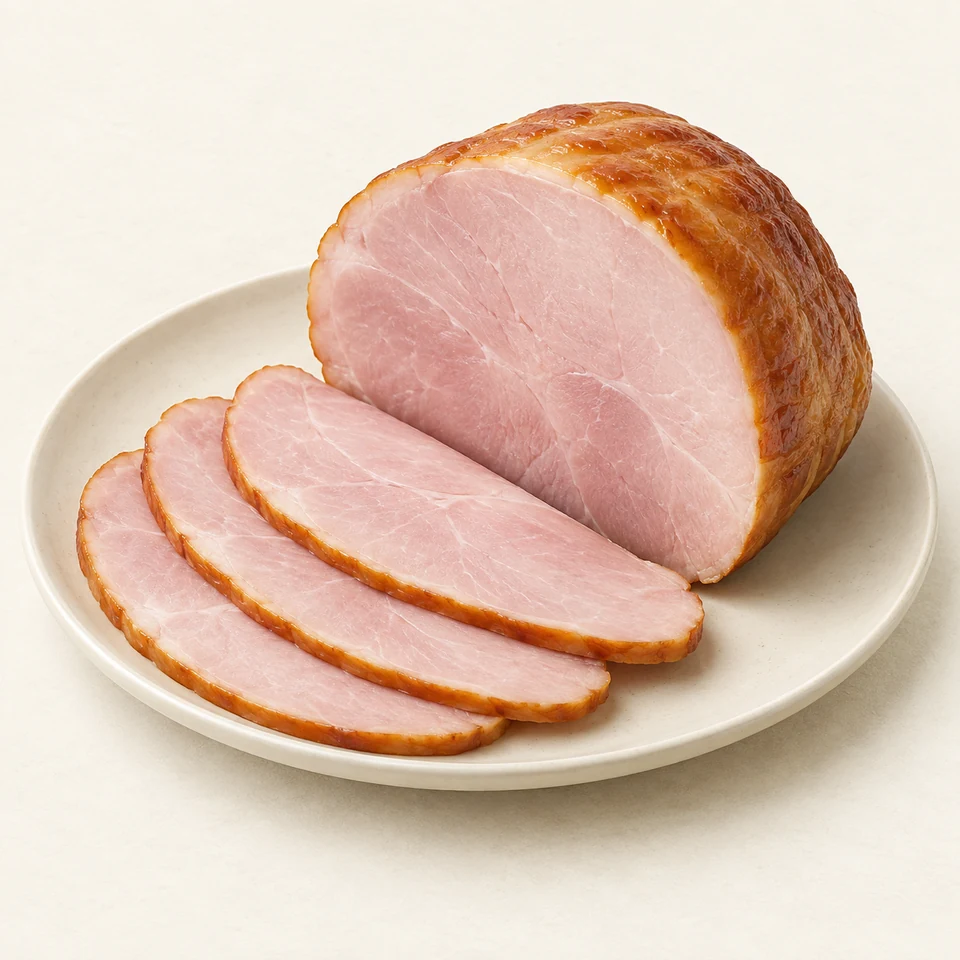
About Cooked ham
Cooked ham is pork from the hind leg that has been cured and then heated until ready to eat. It is served cold or warm in sandwiches, salads, omelettes, soups, pasta, gratins, and other cooked dishes. It is commonly sold as a whole joint, portion, thick slice, thin deli slice, or diced meat.
The interior is usually pink to rosy, with a yielding texture and salty, savoury flavour. Products may be boneless or bone-in and may be whole, pressed, formed, smoked, glazed, or sliced. These differences affect firmness, surface appearance, and flavour, while smoking or glazing adds further sensory variation.
Cooked ham may appear as a joint, portion, slice, or dice, with rind and visible fat present or removed according to the product. It can be eaten directly or reheated and incorporated into another dish. Slicing, pressing, forming, smoking, glazing, and cooking alter its shape, surface, firmness, and flavour.
- Ingredient type
- whole food
FOLLOW IT TO THE PLATE
Where will you meet it?
Explore the dishes that use this ingredient and their country and cuisine connections.
Explore linked dishesON A MENU OR LABEL
Find local names and written forms to help recognise this ingredient.
See local namesWhere cooked ham appears
14 linked foodsFind foods to recognise by country and type. Recipes and products vary; these are recorded ingredient connections.
Showing 13–14 of 14
Salads
Noodle dishes
Ingredient connections awaiting review · Coverage is still growing, including packaged snacks.
Name examples awaiting language review. Confirm the specific food or product.
Local names for cooked ham
Names and romanised forms to recognise on menus and labels.
cooked ham
jambon cuit
jamón cocido
gekochter Schinken
prosciutto cotto
presunto cozido
gekookte ham
szynka gotowana
варёная ветчина
varyonaya vetčina
ボイルドハム
boirudo hamu
익힌 햄
ikhin haem
boirudo hamu
Romanised form
ikhin haem
Romanised form
varyonaya vetčina
Romanised form
Available names only. Languages may be spoken in other countries; a name alone does not identify every ingredient in a dish.
Name not available yet.
A name in English has not been added for cooked ham. Choose another language to see its available names.
Cooked ham nutrition & diet
Cooked ham nutritional value
Reference: Ham
Per 100 g of the edible portion of the stated reference food.
- Calories
- 107kcal
- Protein
- 18.4g
- Carbs
- 1.0g
- Fat
- 3.3g
Reference example for the named food and preparation, per 100 g edible portion. This is not a universal value for every recipe or brand; packaged products should be compared with their own label. CoFID 2021 food code 19-496. Carbohydrate follows the dataset’s available-carbohydrate convention. Contains public sector information licensed under the Open Government Licence v3.0: https://www.nationalarchives.gov.uk/doc/open-government-licence/version/3/.
Portions & preparation
Record whether the ham is sliced, diced, or a larger edible portion, and whether rind or visible fat remains. Curing, cooking, smoking, glazing, and added brine affect the product represented; references should distinguish plain cooked ham from a sweetened or sauce-coated preparation.
Compare the right form: Match references to cured pork ham after cooking, with cut, edible portion, rind or fat retained, smoking, glazing, and draining specified.
Diet considerations
Ham is animal-origin cured pork. Compatibility changes with curing mixtures, smoke flavorings, glazes, dairy or egg additions, and cereal-containing coatings or fillers. Plain sliced ham differs from composite deli products or dishes containing stock, bread, pastry, or sweet sauces; the complete recipe should be considered.
AI-authored reading notes · Awaiting editorial review. Measured values, where available, have a separate source above.
Dietary compatibility
- VeganTypically incompatible
- VegetarianTypically incompatible
- PescatarianTypically incompatible
- KetoMay be compatible
- PaleoMay be compatible
- Low-carbMay be compatible
- HalalTypically incompatible
- KosherTypically incompatible
What these diet assessments mean
- Vegan · Typically incompatible
- The ingredient profile identifies an animal-derived food or derivative.
- Vegetarian · Typically incompatible
- The profile identifies animal flesh, seafood or a derivative excluded by a vegetarian diet.
- Pescatarian · Typically incompatible
- The profile identifies land-animal meat or a derivative, which is excluded by this pescatarian definition.
- Keto · May be compatible
- The plain form may fit a carbohydrate-restricted diet. Check the portion, added sugar, coatings and sauces against the nutrition values above.
- Paleo · May be compatible
- May fit a paleo pattern, depending on the cut or form, processing and added ingredients.
- Low-carb · May be compatible
- The plain form may fit a carbohydrate-restricted diet. Check the portion, added sugar, coatings and sauces against the nutrition values above.
- Halal · Typically incompatible
- This profile identifies pork or a pork-derived ingredient.
- Kosher · Typically incompatible
- This profile identifies pork or a pork-derived ingredient.
For the plain ingredient · Awaiting review. Diet compatibility is not allergy suitability or halal/kosher certification. Keto and low-carb depend on the portion.
AI-generated illustration for visual context. It does not identify a particular product or establish allergen content.
Sources & review
Nutrition reference: UK Composition of Foods Integrated Dataset (CoFID), 2021 — Ham ↗. Values are scaled from 100 g of the recorded edible form. Individual portions have no assumed fixed weight.
Expanded overview, name examples and nutrition notes are database drafts awaiting editorial review. Numeric nutrition values, where shown, have their own source and food-form reference.
The ingredient description and dish connections come from the draft catalogue and may change after review.
Last recorded verification: .