
Tarragon
Tarragon is an aromatic herb used to season sauces, poultry, fish, eggs, and vegetables.
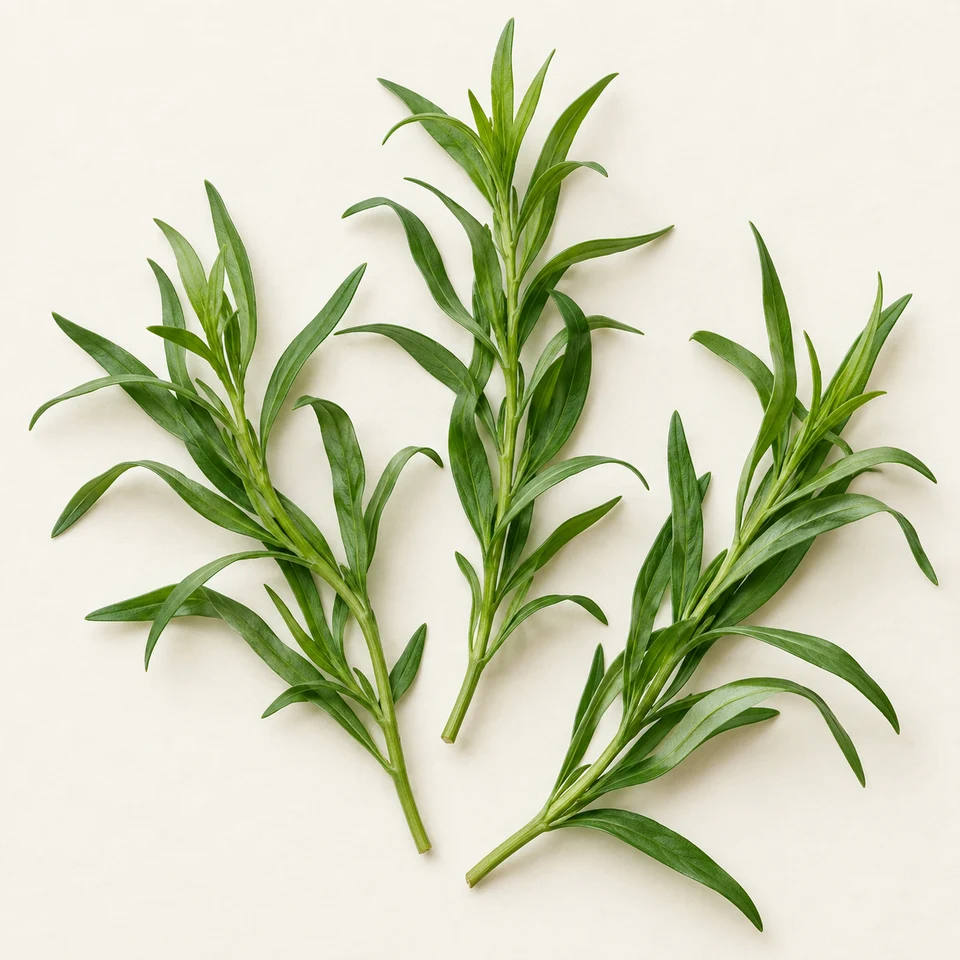
About Tarragon
Tarragon is a leafy aromatic herb used to season sauces, poultry, fish, eggs, vegetables, vinegars, pickles, and compound butters. French tarragon is the usual culinary type, while Russian tarragon and tarragon-like plants have different strengths and flavour profiles. It is used fresh or dried.
Fresh tarragon has a pronounced anise-like, gently peppery flavour with green, slightly bittersweet notes. Its leaves are delicate and tender. Dried tarragon is more concentrated, less leafy, and often somewhat harsher in aroma; prolonged heating can dull its brighter anise character.
Fresh tarragon is sold as sprigs or loose leaves, while dried tarragon is sold as crumbled leaves. Fresh leaves may be chopped into finished dishes or added near the end of cooking. Dried leaves can be added earlier so their flavour infuses sauces, vinegars, stocks, and braises.
- Ingredient type
- whole food
FOLLOW IT TO THE PLATE
Where will you meet it?
Explore the dishes that use this ingredient and their country and cuisine connections.
Explore linked dishesON A MENU OR LABEL
Find local names and written forms to help recognise this ingredient.
See local namesWhere tarragon appears
1 linked foodsFind foods to recognise by country and type. Recipes and products vary; these are recorded ingredient connections.
Showing 1–1 of 1
Main dishes

Ingredient connections awaiting review · Coverage is still growing, including packaged snacks.
Name examples awaiting language review. Confirm the specific food or product.
Local names for tarragon
Names and romanised forms to recognise on menus and labels.
Tarragon
tarragon
Estragon
estragon
Эстрагон
estragon
Tarhun
tarhun
tarragon
estragon
tarhun
Estragon
estragón
dragoncello
estragão
estragó
dragon
estragon
estragon
estragón
tárkony
tarhon
естрагон
estragon
Естрагон
estrahon
эстрагон
estrahon
естрагон
estragon
estragon
estragon
pehtran
dragon
estragon
estragon
rakuuna
estragon
estragons
peletrūnas
εστραγκόν
estragkón
թարխուն
t’arkhun
ტარხუნა
tarkhuna
ترخون
tarkhun
طرخون
ṭarkhūn
טרגון
targon
तारागोन
tārāgon
তারাগন
tarāgan
تارخون
tārkhūn
तारखूण
tārakhūṇ
龙蒿
lónghāo
タラゴン
taragon
타라곤
taragon
ทาร์รากอน
thārākǭn
estragon
tarragon
estragkón
Romanised form
taragon
Romanised form
Dried tarragon
Search alias · Not a confirmed translation
Estragon, frais
Search alias · Not a confirmed translation
Estragon, séché
Search alias · Not a confirmed translation
Fresh tarragon
Search alias · Not a confirmed translation
russian tarragon
Search alias · Not a confirmed translation
Spices, tarragon, dried
Search alias · Not a confirmed translation
tarragon (dried)
Search alias · Not a confirmed translation
tarragon leaf
Search alias · Not a confirmed translation
tarragon leaf (fresh)
Search alias · Not a confirmed translation
TARRAGON LEAVES
Search alias · Not a confirmed translation
Tarragon, dried, ground
Search alias · Not a confirmed translation
Tarragon, fresh
Search alias · Not a confirmed translation
estrahon
Romanised form
ṭarkhūn
Romanised form
estrahon
Romanised form
taragon
Romanised form
tarāgan
Romanised form
lónghāo
Romanised form
tārāgon
Romanised form
tārkhūn
Romanised form
estragon
Romanised form
estragon
Romanised form
t’arkhun
Romanised form
targon
Romanised form
tarkhun
Romanised form
estragon
Romanised form
tārakhūṇ
Romanised form
tarkhuna
Romanised form
thārākǭn
Romanised form
Available names only. Languages may be spoken in other countries; a name alone does not identify every ingredient in a dish.
Name not available yet.
A name in English has not been added for tarragon. Choose another language to see its available names.
Tarragon nutrition & diet
Tarragon nutritional value
Spices, tarragon, dried
Per 100 g of the edible portion in the stated food form.
- Calories
- 295kcal
- Protein
- 22.8g
- Carbs
- 50.2g
- Fat
- 7.2g
Values apply to the food form named above, not every preparation, variety or brand.
Portions & preparation
Use fresh leaves or dried tarragon according to the recipe, because their water content and flavor concentration differ. Culinary quantities are typically seasoning portions, while stems may be removed. Infused vinegar, sauces, compound butter, and packaged blends require separate review for their added oil, dairy, salt, or other ingredients.
Compare the right form: Match references to fresh tarragon leaves or dried tarragon herb, specifying stem inclusion, preservation, and whether it is plain or blended.
Diet considerations
Tarragon is a plant-derived herb. Plain fresh or dried leaves differ from sauces, vinegars, seasoning mixes, and compound butters that may contain dairy, animal ingredients, cereals, sweeteners, or coatings. Compatibility therefore belongs to the exact product or recipe, not automatically to every tarragon-flavored preparation.
AI-authored reading notes · Awaiting editorial review. Measured values, where available, have a separate source above.
Dietary compatibility
- VeganTypically compatible
- VegetarianTypically compatible
- PescatarianTypically compatible
- KetoDepends on the version
- PaleoTypically compatible
- Low-carbDepends on the version
- HalalNot established
- KosherNot established
What these diet assessments mean
- Vegan · Typically compatible
- The plain ingredient profile is plant, fungal or mineral based. Added ingredients in a prepared product need a separate check.
- Vegetarian · Typically compatible
- The plain ingredient profile is plant, fungal or mineral based. Added ingredients in a prepared product need a separate check.
- Pescatarian · Typically compatible
- The plain ingredient profile is plant, fungal or mineral based. Added ingredients in a prepared product need a separate check.
- Keto · Depends on the version
- Compatibility depends on the portion and preparation. A sourced carbohydrate amount for a defined serving is not available.
- Paleo · Typically compatible
- The plain form fits the conventional paleo food groups. Added ingredients and individual interpretations can differ.
- Low-carb · Depends on the version
- Compatibility depends on the portion and preparation. A sourced carbohydrate amount for a defined serving is not available.
- Halal · Not established
- Sourcing, processing and any applicable certification have not been verified. A food name alone does not establish halal status.
- Kosher · Not established
- Sourcing, processing and any applicable certification have not been verified. A food name alone does not establish kosher status.
For the plain ingredient · Awaiting review. Diet compatibility is not allergy suitability or halal/kosher certification. Keto and low-carb depend on the portion.
AI-generated illustration for visual context. It does not identify a particular product or establish allergen content.
Sources & review
Nutrition reference: USDA FoodData Central — Spices, tarragon, dried ↗. Values are scaled from 100 g of the recorded edible form. Individual portions have no assumed fixed weight.
Expanded overview, name examples and nutrition notes are database drafts awaiting editorial review. Numeric nutrition values, where shown, have their own source and food-form reference.
The ingredient description and dish connections come from the draft catalogue and may change after review.
Last recorded verification: .